WH: L13 Ovarian and Adnexal Disorders
 Call Kai
 Learn
Learn Practice Test
 Spaced Repetition
 Match
Match Flashcards
 Knowt Play
1/98

There's no tags or description
Looks like no tags are added yet.
Name | Mastery | Learn | Test | Matching | Spaced | Call with Kai | Chat |
|---|
No analytics yet
Send a link to your students to track their progress
99 Terms
Premenarchal Ovary
non palpable
Reproductive Ovary
palpable about 50% of the time
Perimenopausal Ovary
Residual functional cysts
Postmenopausal Ovary
- majority is non palpable
- palpable enlargement needs evaluation
Which imaging is the primary component of ovarian evaluation
Pelvic US
Helpful ovarian cancer biomarker
Cancer antigen 125 (CA-125)
Hormone studies
- total testosterone
- LH:FSH ratio
- FSH and estradiol
- beta-hCG
Which hormone study is elevated with hyperandrogenism?
Total testosterone
Which hormone study is elevated with PCOS
LH:FSH ratio
What is laparoscopy a definitive dx for?
- salpingitis
- tubo-ovarian abscess
- ovarian torsion
Functional Ovarian Cysts
- not neoplasms
- arise from normal ovarian function
- most resolve spontaneously within 2 menstrual cycles
Functional Ovarian Cysts 3 Types
1. follicular cysts
2. corpus luteum cyst
3. theca lutein cyst
Functional Ovarian Cyst Most common
Follicular Cyst
Follicular Cyst
- occurs when ovarian follicle fails to rupture during follicular maturation
- continues to enlarge and fill with fluid rich in estrogen
How does a Follicular Cyst affect the follicular phase?
Lengthens
When are Follicular Cyst clinically significant?
Only when it causes pain or persists beyond one menstrual interval
Follicular Cyst sx
- transient secondary amenorrhea
- mild/moderate U/L lower abdominal pain
- irregular bleeding
- U/L tenderness
- palpable, mobile and cystic mass
Follicular Cyst dx
- Pelvic US: smooth, thin walled, unilocular
- rule out pregnancy with HCG
Follicular Cyst tx
- most resolve spontaneously within 6 wks
- analgesics if rupture
- OCPs
How do OCPs effect Follicular Cysts?
suppresses development of new cysts
Corpus Luteum Cyst
- fails to degenerate after ovulation
- > 3cm
- luteal phase
- progesterone-dominant
- mc cyst type in perimenopausal women
Corpus Luteum Cyst: 2 variations
- slightly enlarged corpus luteum
- luteal phase cyst ("Corpus hemorrhagicum")
How does a slightly enlarged corpus luteum effect menstruation?
Delays it from days to several weeks
Which Corpus Luteum Cyst is less common?
Luteal phase cyst/Corpus hemorrhagicum
What is a concern with Corpus hemorrhagicum?
Can cause a spontaneous hemorrhage
Typical patient profile with Corpus hemorrhagicum
Not on OCP, has regular cycles, and acute pain late in the luteal phase
Corpus Luteum Cyst sx
- delayed or missed menstrual period
- ipsilateral pelvic pain (dull/LQ)
- anlarged, tender, cystic or solid adnexal mass
- thicker walled
Which finding on US is concerning for hemorrhage with Corpus Luteum Cyst?
- Internal debris
- "ring of fire"
What should always be ordered to rule out with Corpus Luteum Cyst?
Beta-hCG to rule out ectopic pregnancy
slightly enlarged corpus luteum tx
- mild analgesia and reassurance
- recurrent: cyclic contraceptive therapy
- repeat US after 6wks
- if >10cm or in postmenopausal: surgical intervention
Corpus hemorrhagicum tx
- often self limiting
- surgical resection of bleeding cyst
- recurrent hemorrhagic: consider anticoagulant medications
Theca Lutein Cyst
overstimulation from high hCG levels or extreme sensitivity to hCG
What is Theca Lutein Cyst often seen in?
molar pregnancy, multiple gestation, fertility tx
Theca Lutein Cyst sx
- often asymptomatic
- thyroid dysfunction may occur
- preclampsia
Theca Lutein Cyst imaging
B/L, multilocular, large ovarian cysts "soap bubble" appearance
Theca Lutein Cyst tx
- gradually resolves weeks-mo after hCG is eliminated
- surgery if torsion occurs
Benign Ovarian Neoplasma
- 90% of ovarian neoplasms
- 25% or malignant in postmenopausal women
Benign Ovarian Neoplasma sx
- asymptomatic
- blating
- abdominal/pelvic/back pain
- urinary sx
- GI complaints
- palpable ovarian mass (U/L>B/L)
Benign Ovarian Neoplasma tx: if premenopausal, asymptomatic, mobile, or U/L simple cystic mass < 10cm
- observe for 4-6 weeks; most resolve spontaneously
- if longer/unchanged, surgical evaluation needed
How are Benign Ovarian Neoplasma categorized?
By cell type of origin
Benign Ovarian Neoplasma 3 Types
1. benign epithelial cell tumors
2. germ cell tumors
3. sex-cord stromal cell tumors
Which type of Benign Ovarian Neoplasma represents 2/3 of all ovarian tumors?
Benign Epithelial Cell Tumors
Benign Epithelial Cell Tumors
- >30yo (middle aged women)
- typical glandular epithelial cells
4 Types of Benign Epithelial Cell Tumors
- serous cystadenoma
- mucinous cystadenoma
- endometroid tumor
- brenner cell tumor
Which Benign Epithelial Cell Tumor is often B/L, presents at any age, and is most common?
Serous cystadenoma
Which Benign Epithelial Cell Tumors is characterized by a large size filled with mucin and has a median age onset of 50yo?
Mucinous cystadenoma
Which Benign Epithelial Cell Tumors is in reproductive or postmenopausal age, associated with endometriosis, and most often malignant?
Endometroid tumor
Which Benign Epithelial Cell Tumors is more common in older women but uncommon overall?
Brenner Cell tumor
Benign Germ Cell Neoplasms
- arise from primary germ cells
- young females 10-30yrs
- cystic teratoma/dermoid cysts
Benign Germ Cell Neoplasms sx
- abdominal enlargement, pain, and bloating
- often mobile
- non-tender adnexal mass
Benign Germ Cell Neoplasms dx
- can produce tumor markers: CA 19-9, LDH, ESR
- histology at surgical excision
What is the most common ovarian tumor in females 20-30yo
Cystic teratoma/dermoid cysts
Cystic teratoma/dermoid cysts
- multi-cystic mass
- can contain hair, teeth, and/or skin that is mixed into sebaceous, thick, sticky, and foul smelling material
Benign Germ Cell Neoplasms tx depend on
Dermoid size, patient sx, surgical risk, and suspicion for malignancy
Benign Germ Cell Neoplasms tx if expectant management chosen
Close F/U needed with serial USs to monitor for increase in size or characteristics associated with malignancy
Benign Stromal Cell Tumors (SCSTs) 2 types
1. granulose theca cell tumors
2. sertoli-leydig cell tumors
What do granulose theca cell tumors produce and cause?
estrogen; AUB
What do sertoli-leydig cell tumors produce and cuase?
Anrogens; virilization
When should you suspect a SCST?
if adnexal mass + endocrine effects
Benign Stromal Cell Tumors (SCSTs) dx
- labs: testosterone, estradiol, tumor marker
- imaging
- histologic dx
What do you do if your patient presents with an ovarian mass?
- rule out ectopic pregnancy
- perform US to characterize mass
- consider checking CA-125 tumor markers
- surgery if warranted
Ovarian Mass: Surgery for histology/removal ID
- US findings suggest mass could be malignant
- questionable dx
- risks associated with the mass
Ovarian Torsion
- complete or partial rotation of the ovary on its ligamentous support
- often results in partial or complete obstruction of its blood supply
- gynecologic surgical emergency
Adnexal Torsion
if fallopian tube twists along with ovary
Ovarian Torsion primary risk factor
Ovarian mass (especially if >5cm diameter)
Ovarian Torsion sx
- acute onset pelvic pain
- N/V
- hx of recent vigorous activities or a sudden increase in abdominal pressure
Ovarian Torsion dx
- Pelvic US with color flow doppler
- direct visualization of a rotated ovary at the time of surgical evaluation
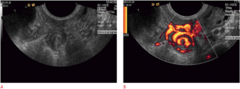
Ovarian Torsion Pelvic US findings
- U/L enlarged ovary (>4-5cm)
- decreased or absent blood flow on doppler
- "whirlpool sign" of twisted vascular pedicle
- pain when scanning over adnexa
Whirlpool Sign
Ovarian Torsion tx: premenarchal + normal ovary
- oophoropexy + detorsion
Ovarian Torsion tx: premenopausal w/ non-malignant ovary
- detorsion and ovarian conservation
Ovarian Torsion tx: unsalvageable ovary, malignancy concern, or postmenopausal
Salpingo-oophorectomy
Salpingitis
- Inflammation of the fallopian tubes secondary to ascending infection
- part of larger PID infection
- major complication of gonorrhea/chlamydia
Salpingitis sx
- pelvic/abdominal pain
- fever
- discharge
- dysuria
- dyspareunia
- tenderness
Salpingitis definitive dx
laparoscopy w/ direct visualization of inflamed tubee
Salpingitis tx
- same as PID
- Ceftriaxone + Doxy + Metronidazole
Tubo-ovarian Abscess (TOA)
- Inflammatory mass involving the fallopian tube, ovary, and occasionally other adjacent pelvic organs
- common complication of PID
- frequently polymicrobial
Tubo-ovarian Abscess (TOA) sx
- acute lower abdominal pain
-fevers/chills
- vaginal discharte
Ruptured TOA
- abscess leaks inflammatory contents into abdominal cavity
- presents with acute abdomen and signs of sepsis
Tubo-ovarian Abscess (TOA) 1st line sx
Pelvic US
Tubo-ovarian Abscess (TOA) clinical dx
Inflammatory adnexal mass + meets dx criteria for PID
Tubo-ovarian Abscess (TOA) definitive dx
Only by direct visualization of the abscess during invasive surgery
Tubo-ovarian Abscess (TOA) tx: concern for ruptures of sx of sepsis
- immediate surgical exploration, laparotomy
- abx as soon as possible
Tubo-ovarian Abscess (TOA) tx: premenopausal, hemodynamically stable, and abscess
- Ceftriaxone 1g IG q24hr + Doxycycline 100mg PO/IV q12hr + Metronidazole 500mg PO/IV q12hr
Tubo-ovarian Abscess (TOA) if no improvement on abx, but not worsening tx
Minimally invasive drainage procedure
Tubo-ovarian Abscess (TOA) if clinically worsening on abx tx
surgical tx
Tubo-ovarian Abscess (TOA) tx: postmenopausal
surgical/laparotomy + abx
Polycystic Ovarian Syndrome (PCOS)
- mc cause of infertility
- mc cause of androgen excess and hirsutism
- ovulatory dysfunction and hyperandrogenism
Polycystic Ovarian Syndrome (PCOS) sx
- menstrual irregularity
- AUB/infertility
- hirsutism
- acne
- alopecia
- insulin resistance/obesity
- B/L enlarged, smooth, mobile ovaries
- acanthosis nigricans
What are women with PCOS at higher risk for?
Metabolic syndrome
Polycystic Ovarian Syndrome (PCOS) dx
- Rotterdam Criteria
- dx of exclusion
- "string of pearl" on TVUS
Rotterdam Criteria (2/3)
- irregular menses
- clinical and/or biochemical signs of hyperandrogenism
- polycystic ovaries on TVUS
Polycystic Ovarian Syndrome (PCOS) labs
- elevated total testosterone
- increase in LH/FSH ratio
- serum anti-mullerian hormone (AMH)
PCOS Hirsutism tx
COCP +/- spironolactone
PCOS acne tx
COCP +/- spironolactone
PCOS scalp hair loss
Minoxidil +/- spironolactone
PCOS DM II/CVD risk
- dietary and lifestyle changes
- weight loss medications
- DM meds as needed
PCOS tx (desire to conceive)
- Letrozole
- weight loss
- IVF
- Clomid, metformin
PCOS tx (no desire to conceive)
- COCP
- metformin
- IUD, intermittent progestin