L4: Early Cognitive Foundations: Sensation, Perception, and Learning
 Call Kai
 Learn
Learn Practice Test
 Spaced Repetition
 Match
Match Flashcards
 Knowt Play
1/35

There's no tags or description
Looks like no tags are added yet.
Name | Mastery | Learn | Test | Matching | Spaced | Call with Kai | Chat |
|---|
No analytics yet
Send a link to your students to track their progress
36 Terms
Sensation versus Perception
Sensation: the detection of physical stimuli (light, sound, touch) by sensory receptors and transmission to the brain (“raw data”)
Perception: the interpretation of sensory input (processing of input to navigate the world - e.g., hot stove → brain perceives it as dangerous to pull hand away)
debate - Are infants born with the ability to perceive the world, or do they need to learn how to interpret sensations?
Empiricists
William James: Described infants' early sensory experiences as a "blooming, buzzing confusion.” → sensory originally disorganized
Perception is Learned: Infants are born without the ability to organize sensory information. They must learn to make sense of it through experience
Example: A newborn initially hears their mother's voice as noise but learns to recognize it as familiar and comforting over time through repeated exposure.
William James did not argue infants have no perception, rather that sensory input is unorganized
learning + experience is source of perceptual organization
Nativists
Basic perceptual abilities are innate.
Supported by René Descartes (innate - understanding + depth babies cannot understand) and Immanuel Kant (structure of experience relies on innate skills) - review
Infants don’t need to learn everything; they are born with basic perceptual skills.
Example: Preference for Faces
Newborns prefer face-like patterns over random ones.
This innate ability helps them bond with caregivers and ensures survival.
Why It Matters?
Some perceptual processes are built-in (innate), supporting the nativist perspective that we are biologically wired to recognize key aspects of our environment.
perception not always shaped by experience
Enrichment theory (Piaget)
Children use mental frameworks (schemas) to categorize and interpret sensory information.
Example: An infant hears the word "milk" and associates it with the actual object (milk).
schemas continue to grow past childhood as we learn more about concepts, etc.
children update schemas upon new experiences
Schemas help children go beyond what is directly sensed by adding meaning based on prior knowledge
Differentiation theory (Gibson)
children don’t require pre-existing mental schemas to interpret sensory world, bur they are naturally born as become better at detecting info
actively engage with surrounding + learn to differentiate important/non-important things (rather than passively) - review this part
Learning occurs as infants become better at detecting information that is already present in the environment.
Example: Detecting differences between soft and rough textures by interacting with their environment.
Infants learn to pick out details from their surroundings through direct sensory interaction.
Difference → Piaget: perception is enriched by knowledge. Gibson: perception improves through detecting information
Preference method (Fantz)
A method used to measure an infant’s visual preference by observing which stimuli they spend more time looking at.
The looking chamber that Fantz used to study infants’ visual preferences.
Example: Infants often prefer complex patterns over simple ones, indicating an early attraction to more detailed stimuli. → challenged idea that newborn perceive the world in an indistinct way, but they are drawn to complexity
Habituation method
Infants are repeatedly exposed to the same stimulus until they lose interest. Introducing a new stimulus helps test their ability to detect differences.
Example: Showing a red square until the infant becomes bored, then switching to a blue square. Renewed interest indicates they can differentiate between the colors.
High-amplitude sucking method
Measures infants' interest by tracking their sucking patterns on a pacifier.
Useful for detecting preferences, like recognizing a mother’s voice. (babies tend to suck more intensely compared to hearing a stranger)
recognition of phonetic sound discrimination (e.g., “ba” vs. “pa”).
Evoked potentials method - neural method
Tracks brainwave changes in response to sensory stimuli using electrodes on the scalp
Shows infants' ability to perceive visual or auditory stimuli.
these research methods are useful for studying pre-mature babies that may have developmental delays
Brain Imaging Techniques - MEG + fMRI
Magnetoencephalography (MEG): (non-invasively) Tracks when and where electrical activity occurs in the brain in response to stimuli.
Example: Measures how an infant’s brain reacts to hearing a parent’s voice or seeing a new object
Functional Magnetic Resonance Imaging (fMRI): Detects changes in blood flow to measure brain activity. - can located areas of brain that are active in response to stimuli
hard to do on children because they cannot stay still, good for olde rchildren though
Example: Can study how infants process language by observing brain areas activated when exposed to speech.
in general, these studies are challenging to use due to it being expensive, requiring technical expertise, cultural context where some parents believe such techniques are harmful
MEG → excellent timing + location
fMRI → excellent location, poor timing
Takeaway
Infants are neither blank slates nor fully formed perceivers
perception develops through a combination of biological preparedness and experience.
Hearing
one of the most developed senses at birth - review
Newborns can discriminate mother’s voice
Early phoneme (smallest sound unit) discrimination
Quickly learn to recognize words and voices
More developed than visual ability at birth
Hearing Development
Hearing develops over the first 4-6 months
Newborns need louder sounds to detect them
By 6-12 months, infants can detect softer sounds (start to recognize words + voices more consistently)
U-shaped curve in sound localization development
Infants orient toward sound at birth, stop around 1 month (suggests temporary reorganization of neural control), and regain this ability by 3-4 months
Can be disrupted by otitis media (a frequently diagnosed disease among children in Canada - middle ear infection; at least 75% of children develop it + recurrence is relatively common) - if persistent, may affect speech + language development
Taste, Smell, Touch, Temperature, Pain
Taste and smell
Newborns have taste preferences, especially for sweet flavors.
React strongly to unpleasant odors.
Can recognize their mother’s scent by 1-2 weeks old
Touch, temperature, pain
Touch, especially therapeutic massage, benefits premature infants - to promote growth + well-being (touch has calming effect + promotes neural development)
Sensitive to changes in temperature (e.g., with milk)
Newborns are sensitive to pain, but skin-to-skin contact and warmth reduce stress (e.g., needles)
Vision
Least mature sense in newborns
Visual acuity of 20/400 (Adult level by ~ 12 months) - considered legally blind by adult standards
Visual Acuity: person’s ability to see small objects and fine detail
Prefer faces, especially mother's face over a stranger
Require sharper visual contrasts to detect patterns
Visual Contrast: amount of light/dark transition in a visual stimulus. (rather than subtle pastel colours)
Color vision improves by 2-3 months (distinguish basic colours) - by 4 months, grouping of colours into broader categories
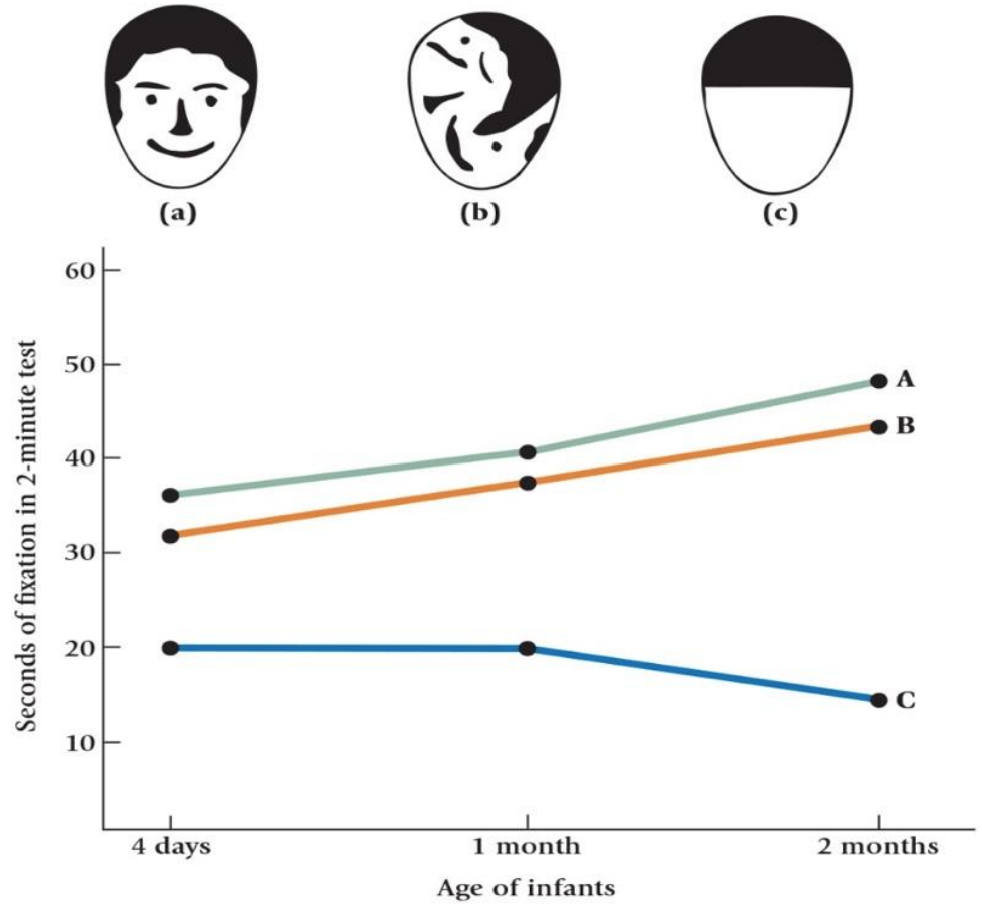
Visual Perception in Infancy - Pattern and form + Fantz’s test
Pattern and form
Early preference for complex patterns
best at seeing High contrast (black/white shapes, distinct lines)
Fantz’s test of young infants’ pattern preferences (right figure)
Infants preferred to look at complex stimuli rather than at a simpler black-and-white oval (c).
However, the infants did not prefer the face-like figure (a) to the scrambled face (b).
not b/c they do not prefer face-like as socially meaningful stimuli… review
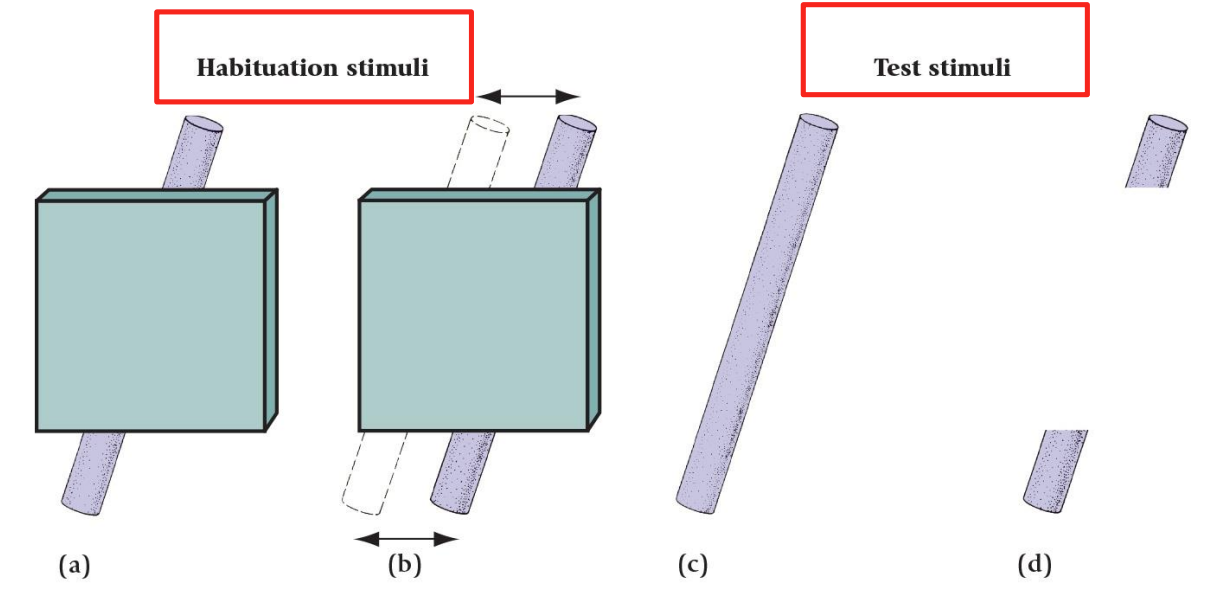
Later form perception: Perception of Object Wholeness
Perceiving objects as wholes. An infant is habituated to a rod partially hidden by the block in front of it. The rod is either stationary (a) or moving (b). When tested afterward, does the infant treat the whole rod (c) as “old hat”? We certainly would, for we could readily interpret cues that tell us that there is one long rod behind the block and would therefore regard the whole rod as familiar. But if the infant shows more interest in the whole rod (c) than in the two rod segments (d), he or she has apparently not been able to use available cues to perceive the whole rod.
may be able to develop parts of an object w/o integrating them as a whole
how long will babies look at this display
if infant perceives rod as one continuous object even if hidden, they show more interest in broken rods
without this perception, more interest in full rod, indicating broken rods are confusing
Visual Perception in Infancy - Depth Perception
Depth perception
Stereopsis by 3 months of age
Pictorial (or perspective) cues to depth by 6 to 7 months of age (depth, 2d, 3d)
Monocular + binocular cues
monocular = relies on 1 eye, includes size differences (car farther away appears smaller even though both cars same size) or overlapping objects (tree in front of house appears closer due to overlap)
binocular = relies on both eyes (stereopsis = 2 eyes work together - brain merges two images seen at diff angles into a 3d picture (to see depth) → to help judge how far away objects are; with 1 eyes, hard to tell depth + distance)
Size constancy present at birth
Visual looming (how an object appears to grow larger as it approaches) - 1 month old reacts by blinking/moving head back
Kinetic cues (object’s movement) - infants tell the size + shape by watching movement of object, even if partially hidden, as visual systems are yet to fully mature
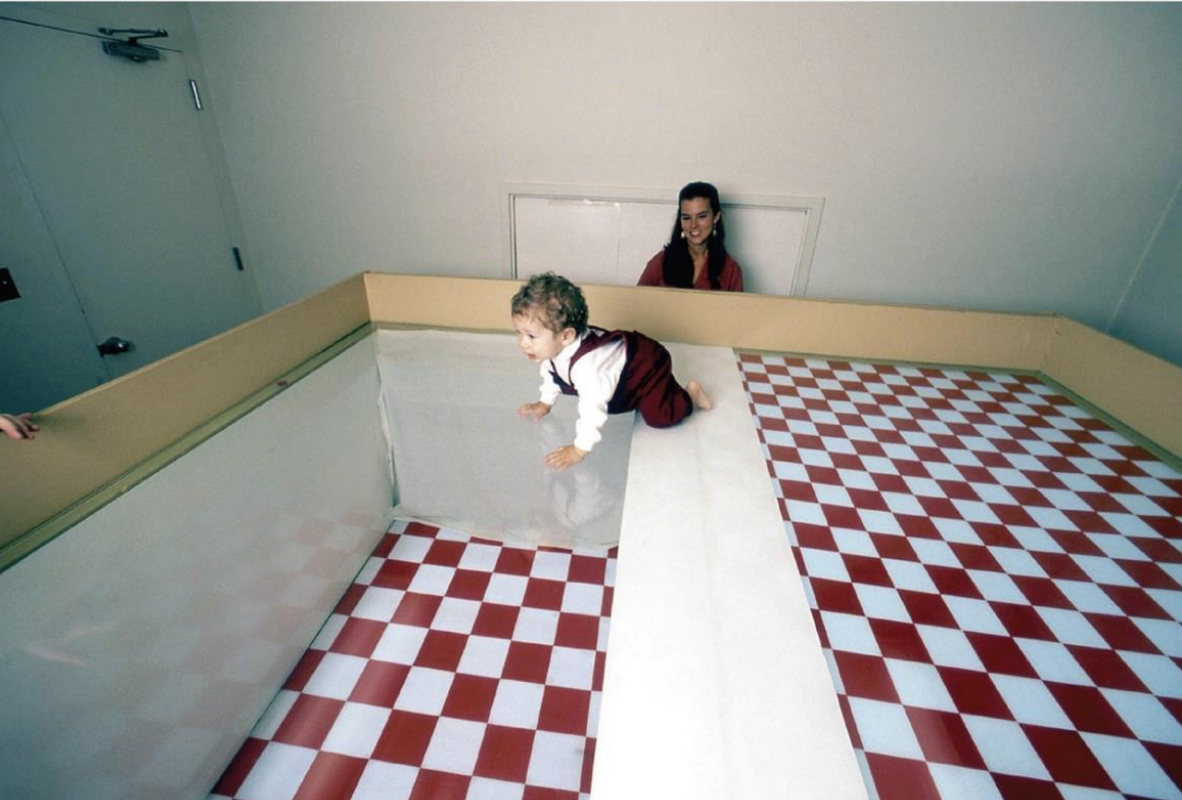
Gibson and Walk’s Visual Cliff
study to analyze visual perception, particularly depth
see if infants can detect shallow vs deep side
6-7 months with the start of crawling, they refuse to crawl to the deep side because it is dangerous
interesting variation of exp - explored role of emotions (mother’s emotional cues) in approaching deep side
if mom is smiling, encouraging, they are more likely to crawl over cliff (glass); with fearful/worried face, they would not take the danger
toddles (18 mths - 2 years) relied less on caregiver cues + sometimes ignore them + would cross the cliff (why? child developing own personality)
Affordances of balance and locomotor experience
Intermodal perception
review
Ability to use one sensory modality to identify something already familiar in another sensory modality
Example: recognizing a golf ball by touch instead of by sight
Intermodal perception is not present at birth, but it begins to emerge very early.
Development of Intermodal Perception
Senses integrated very early in life
Auditory–visual incongruities distress infants (mom’s voice + stranger’s face; or mom’s voice coming from one direction but face somewhere else → they expect sensory info to be well-matched)
Intermodal matching of visual and auditory cues for faces/speech, distance, spatial location (e.g., train sounding quitier → should be that train is going away)
Consistent with Gibson’s differentiation theory: perceptual learning occurs through active exploration (+ gradual perceptual refinement)
culture has huge impact, less sensitivity to other cultural rhymes, music, etc.
3 Features (Requirements) of Learning
Individual thinks, perceives, or reacts to environment in a new way
Change is a result of experience (not just natural maturation/aging)
Change is relatively permanent (temporary change due to illness, medication, etc. not considered learning)
e
Habituation
stop responding to stimulus after repeated exposure, does not require attention anymore due to familiarness
Improves dramatically over first year
Individual differences that predict later competencies
Faster language acquisition
Higher intelligence and language test scores
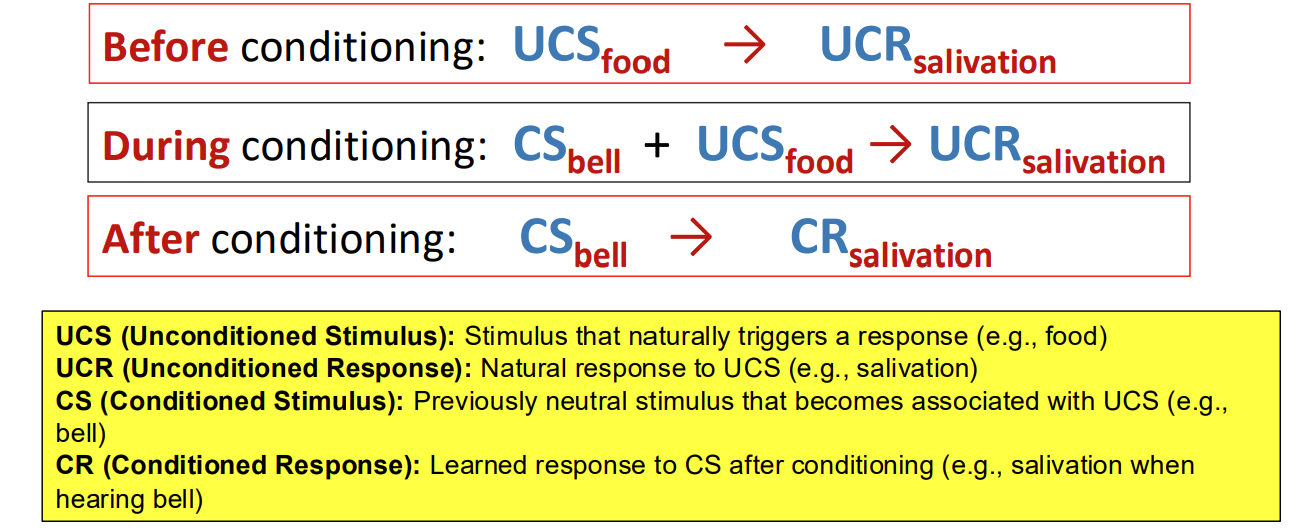
Classical Conditioning
Discovered by Ivan Pavlov with his dog experiments
Involves pairing a neutral stimulus with an unconditioned stimulus
Eventually, the neutral stimulus alone elicits a conditioned response
Before conditioning: UCS (food) → UCR (salivation)
During conditioning: CS (bell) + UCS (food) → UCR (salivation)
CS - bell, which is previously neutral stimulus that becomes associated with UCS
After conditioning: CS (bell) → CR (salivation)
CR - learned response to CS after conditioning
learning occurs through association
Classical Conditioning of Emotions + in Newborns
Classical conditioning of emotions
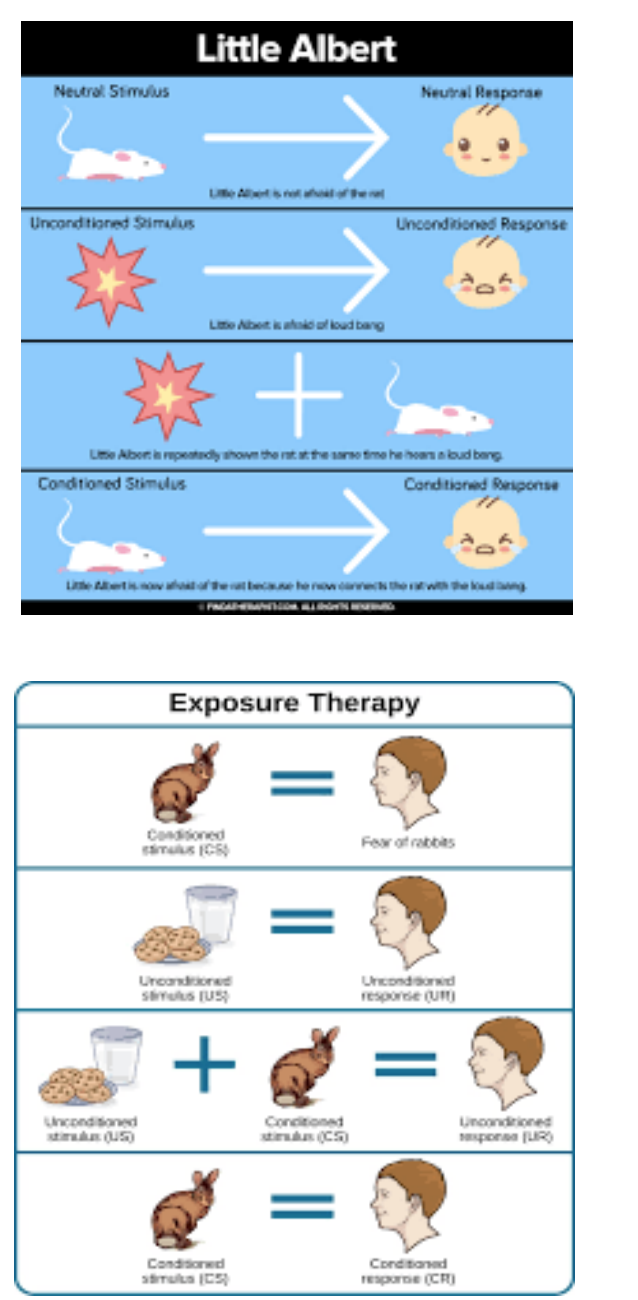
Fears and phobias can develop via classical conditioning (e.g., Little Albert experiment - Watson 1920) → conditioned to be fearful to white rat due to pairing with loud noise
Attitudes and behaviors can also be conditioned (e.g., positive or negative reactions to stimuli based on associations) e.g. Peter experiment-Cover-Jones 1924) - overcame fear of furry objects through counter-conditioning - fear combined w positive experiences?
Classical conditioning in newborns
Possible but challenging
Most effective for biologically programmed reflexes like sucking
Takes more time but helps newborns learn important associations, such as breast/bottle gives milk
Operant conditioning
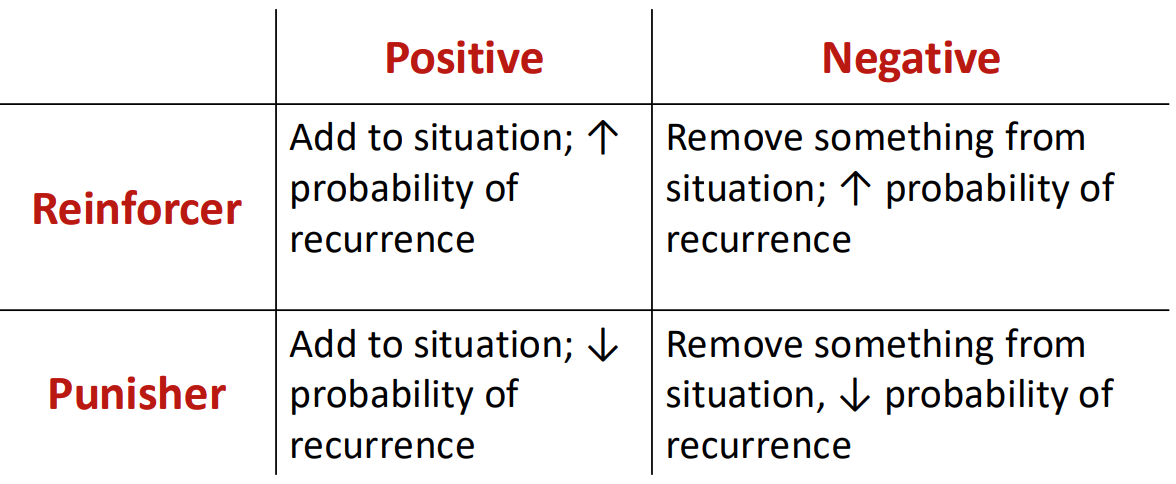
The outcome of a behavior affects the likelihood of it being repeated.
Voluntary behaviors are either strengthened (reinforced) or weakened (punished) depending on the consequence.
learning is powerful in shaping children behaviour
Outcomes of Operant Conditioning
Positive reinforcer: Add to situation; ↑ probability of recurrence → praise for cleaning room
Negative reinforcer: Remove something from situation; ↑ probability of recurrence
Positive punisher: Add to situation; ↓ probability of recurrence
Negative punisher: Remove something from situation, ↓ probability of recurrence
Basic principles of operant conditioning
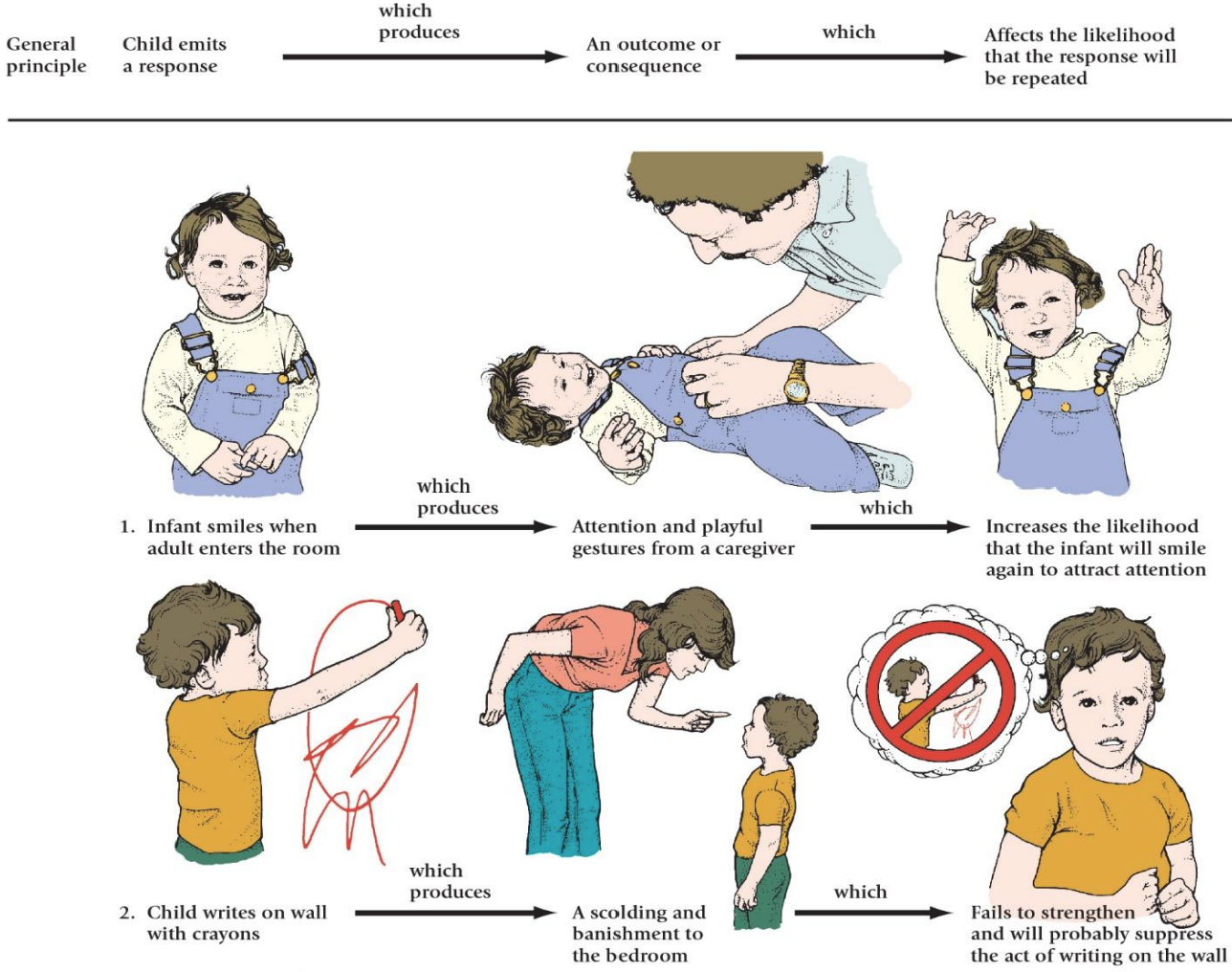
Response → Consequence → Result
smiles + attention → reinforces attention
drawing + punishment
is attention always a reinforcer → may also increase unwanted behaviour
Advanced Points in Operant Conditioning - review
Even premature babies can learn by operant conditioning
Older infants learn faster (fewer trials need for learning to occur)
Infants can remember (retention versus retrieval)
Recognition versus recall (recognizing objects develop prior to recalling)
Is punishment effective?
Infant mobile-kicking study (Carolin Rovee-Collier)
rate of kicking doubles when ribbon attached to blocks compared to attached to stand
with a twin baby boy, he still kicks when not attached to stand, but with the attachment to the blocks, he only kicks with the leg attached to the blocks
Observational Learning
Observational learning: Learning through observing the behavior of others.
Imitation = Learning by watching others’ behavior.
Newborn imitation: Newborns can imitate basic facial expressions, but it is still debated whether these responses are reflexive or voluntary. (imitating mother sticking tongue out)
Deferred imitation: Develops by the second year, allowing the infant to replicate actions they have observed after some delay. (produce action later → central to theory below, emphasizing attention, memory, mental representation for retrieval) - after 2nd year, replication no longer occurs + they selectively produce behaviours
Albert Bandura’s Social Learning Theory: Highlights the importance of cognitive processes in observational learning, where individuals observe, encode, and store models’ behaviors to be reproduced later.
Role of memory: By the second year, infants demonstrate the ability to remember and reproduce actions even after delays, showing cognitive and memory growth.
Gopnik argues that babies learn like scientists: forming hypotheses, testing evidence, and revising beliefs.
Which learning theories from today’s lecture best support this idea, and why?
Bandura’s social learning theory
Differentiation theory
Gopnik describes infants understanding others’ desires (e.g., broccoli vs. crackers).
Does this finding support a nativist or empiricist view of development or both?
interaction perspective
developmentalist - combination of both views
According to Gopnik, play is not “wasted time” but a powerful learning mechanism.
How does play support learning in infancy based on the research methods we discussed (e.g., habituation, operant conditioning, observational learning)?
through operant conditioning, children understand consequences of their actions (light on vs off → try different combos)
Gopnik suggests adults are better at focused problem-solving, while children are better at exploration.
How does this difference relate to recognition vs. recall, or retention vs. retrieval, discussed in operant learning?
children require cues to better retrieve information
If infants are such powerful learners, what does this mean for how adults should teach or parent young children?
prioritize environments w play
explore different routes for learning due to individual differences in learning