WS 1 bones & joints of the shoulder girdle, muscles of the shoulder girdle
 Call Kai
 Learn
Learn Practice Test
 Spaced Repetition
 Match
Match Flashcards
 Knowt Play
1/38

There's no tags or description
Looks like no tags are added yet.
Name | Mastery | Learn | Test | Matching | Spaced | Call with Kai | Chat |
|---|
No analytics yet
Send a link to your students to track their progress
39 Terms
Pectoral/shoulder girdle
Bones = clavicle, scapula, manubrium of sternum, proximal humerus
Joints = Sternoclavicular (SC), acromioclavicular (AC), glenohumeral (GH)

Clavicle
connects upper limb to axial skeleton
long bone
articulates ac and sc joints
Clavicle labelling
Superior surface = smooth
inferior = rough
medial end (sternal) = convex anteriorly
lateral end (acromial end) = concave anteriorly

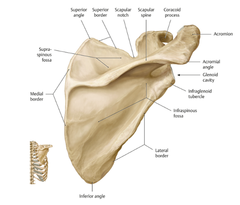
Scapula posterior aspect
spine of scapula
supraspinous fossa
infraspinous fossa
scapula notch
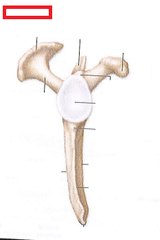
Scapular anterior aspect
subscapular fossa (subscapularis muscle is on this)
three angles - superior, inferior, lateral
three borders - medial, lateral, superior

Scapula - processes, cavity, tubercle
acromial process/acromion - participates in ac joint
coracoid process - lig and muscle attachment
glenoid fossa
supragenoid & infraglenoid tubercle - muscle attachment sites
Humerus
articulates w scapula at gh joint and radius + ulnar at elbow joint
largest bone of upper limb
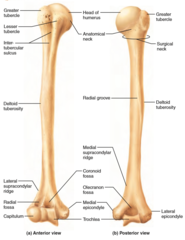
Humerus - proximal aspect
head of humerus
anatomical neck
greater + lesser tubercle
Intertubercular/ bicipital groove
surgical neck
Humerus - distal aspect
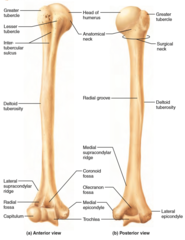
shaft
deltoid tuberosity
radial groove
lateral and medial epicondyles
lateral and medial supracondylar ridges
capitulum and trochlea
fossa - radial, coronoid and olecranon
Scapula movements
protractions, retraction, elevation, depression, rotation of the scapula cannot occur in isolation
Glenohumeral movements
flexion, extension, abduction, adduction, medial and lateral rotation, horizontal flexion and extension, circumduction
Sternoclavicular joint (SC)
articulation between the clavicle and the sternum
saddle synovial joint - functions like ball and socket
articular disc- shock absorber, fibrocartilage
SC joint ligaments
Anterior and posterior Sternoclavicular ligaments
Interclavicular ligament
Costoclavicular ligament
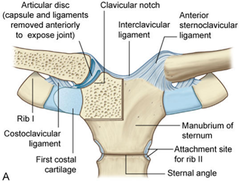
SC joint movements
elevation/depression, protraction/retraction, rotation, circumduction
SC NS
Medial supraclavicular nerve, Nerve to subclavius
Acromioclavicular joint (AC)
articulation between acromion process of scapula and lateral end of clavicle
plane synovial joint
articular disc - fibrocartilage
AC joint ligaments
Acromioclavicular ligament
Coracoclavicular ligament
Coracoacromial ligament

AC joint movements
Acromion of the scapula glides on the acromial end of the clavicle
Axioappendicular muscles move the scapula which in turn moves the acromion on the clavicle
AC NS
lateral supraclavicular nerve, lateral pectoral nerve, axillary nerve
AC joint disclocation
= step defect
Glenohumeral joint (GH)
articulation between the humeral head and the glenoid cavity/fossa of the scapula
ball and socket synovial joint
GH joint ligaments
Glenohumeral ligaments
Transverse humeral ligament
Coracohumeral ligament
Coracoacromial ligament
GH movements
all of them
GH bursa
subacromial bursa, subscapular bursa
bursa - synovial membrane sac which prevents friction
GH NS
axillary nerve, suprascapular nerve, lateral pectoral nerve
Glenoid labrum
fibrocartilaginous, lines glenoid fossa, increases stability
Coracoacromial arch
formed by coracoid process, acromial process (acromion), coracoacromial ligament
Coracoacromial arch function
protection of gh ligament, prevents dislocation
Scapulothoracic joint
not an actual joint
area where scapula moves on the thoracic cage due to contraction of the axioappendicular muscles e.g elevation/depression, protraction/retraction, upward and downward rotation
Muscles of pectoral/shoulder girdle
anterior axioappendicular muscles, posterior axioappendicular muscles, scapulohumeral muscles which cointains the rotator cuff muscles
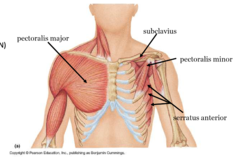
Anterior axioappendicular muscles/pectoral muscles
connect axial skeleton to upper limb
move pectoral girdle
four muscles, pec major, pec minor, subclavius, serratus anterior
Posterior axioappendicular muscles/extrinsic shoulder muscles
5 muscles
superficial muscles = trapezius, latissimus dorsi
deep muscles = levator scapulae, rhomboid major, rhomboid minor

Scapulohumeral muscles/intrinsic shoulder muscles
attach between scapula and humerus
six muscles, deltoid, teres minor, teres major, subscapularis, infraspinatus, supraspinatus
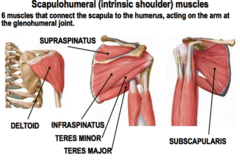
Rotator cuff
SITS
S=supraspinatus
I=infraspinatus
T=teres minor
S=subscapularis
note: all except supraspinatus are rotators of the glenohumeral joint (supraspinatus does not medially or laterally rotate the humerus, it only abducts it)

Fascia of upper limb
Pectoral fascia - chest region
Brachial fascia - arm
Antebrachial fascia - forearm
Palmar aponeurosis - palm of hand
Function of fascia
protect body structures, limits spread of infection, aids the musculovenous pump by limiting outward expansion of muscles, holds tendons in place (retinaculae)
Fascia of upper limb - arm
fascia between muscle compartments, often called intermuscular septa
arm = lateral & medial intermuscular septa form the anterior and posterior compartments of the arm
Fascia of upper limb - forearm
forearm has interosseous membrane which attaches to the bones of the forearm - separates anterior and posterior forearm muscles
Flexor retinaculum (palmar surface of hand/wrist)
Extensor retinaculum (dorsum of hand/wrist)
Fascia of upper limb - hand
Palmar aponeurosis - central, triangular, thickened area of the fascia of the palm