Chapter 5 book
 Call Kai
 Learn
Learn Practice Test
 Spaced Repetition
 Match
Match Flashcards
 Knowt Play
1/127

Earn XP
Description and Tags
you should checkout slide 49
Name | Mastery | Learn | Test | Matching | Spaced | Call with Kai | Chat |
|---|
No analytics yet
Send a link to your students to track their progress
128 Terms
what is a mutation rate
frequency at which new DNA mutations occur
what does a deleterious mutation refer to
mutation that reduces orangism’s ability to survive and reproduce
It is estimated that the limit of essential genes is 30,000 because
more genes provide more chances for harmful mutations
what is an essential gene
gene responsible for survival and reproduction
Germ cells refer to
cells involved in transmission of genetic information from parent to offspring
somatic cells refer to
body cells
What kind of cells mainly affect the individual and not generations
somatic
Local natural selection refers to the
rapid proliferation of a cell causing competition within a tissue for resources
Cancer is a result of
Accumulation of somatic cell mutations giving them a growth advantage.
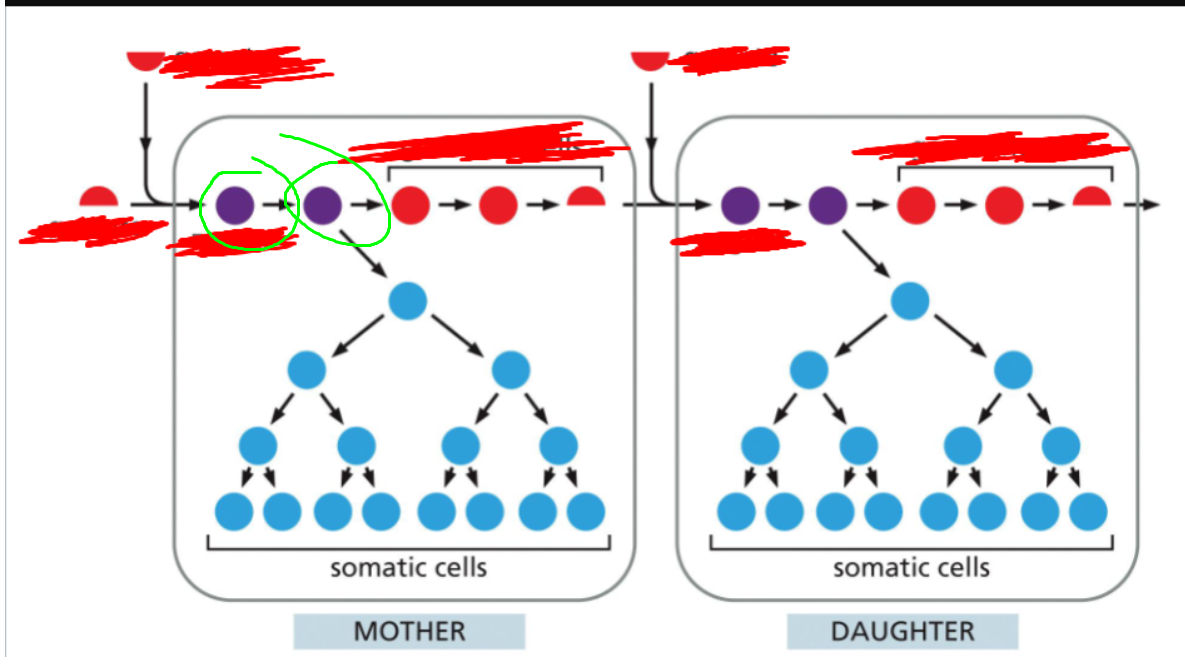
What are the purple circles + what forms them + what do they give rise to
Zygote cell,
formed by fusion of two gametes
germ line and somatic
Why must the DNA helix separate before replication
expose bases to allow pairing

The 3’ OH end on a new strand is important as it
allows next nucleotide to be added
What is a nucleotide triphosphate
nucleotide with a
base
deoxyribose sugar
3 phosphates
why are the 3 phosphates important in a nucleotide triphosphate
provide energy needed to add nucleotide to growing dna strand
What is the fate of the phosphates in a nucleotide triphosphate
1 becomes DNA backbone by forming a phosphodiester bond
2 leave as pyrophosphate (PPi) to drive reaction forward
DNA synthesis proceeds in the ___ direction
5-3
If a complementary strand is made in the 5-3 direction, the template strand is in the __ direction
3-5
DNA Polymerase role
hold template and complementary in correct position
check exposed bases on template
brings correct nucleotide
catalyzes phosphodiester bond
Why is DNA replication considered semiconservative
each dna molecule builds 1 new and keeps old 1

What does this figure reveal
semiconservative replication
each daughter DNA molecule contains one older strand and one newly made strand
Which strand has continuous synthesis
Leading
Which strand has discontinuous synthesis
Lagging

What causes the looping on the lagging strand
Okazaki fragments must be synthesized in 5-3
It is estimated there is 1 mistake per ___ nucleotides copied
10^10
How does polymerase proofread bases
DNA POL changes shape around active site (conformational change)
allows base with correct geometry to pair and catalyze phosphodiester bond
What is the second proofread DNA polymerase is responsible for
Exonucleolytic proofreading
Exonucleolytic proofreading only occurs after
DNA Polymerase added the wrong nucleotide
How does exonucleolytic proofreading work
incorrect nucleotide cut off
Why does RNA polymerase not require such an efficient exonucleolytic proofreading
RNA is temporary
Why is 3-5 synthesis bad for proofreadinbg
Provides no energy to replace bad nucleotide
RNA primer function
Provide free OH group for polymerase
Sequence of nucleic acid building
Primase
rna primer
dna polymerase
ribonucleotide triphosphate is built from
ATP
GTP
CTP
UTP
nucleotide triphosphate is built from
dATP
dGTP
dCTP
dTTP
How is RNA primer started
base pairing of two ribonucleotide triphosphates through a phosphodiester bond
Why is the RNA primer removed from an okazaki fragment
Allows for continuous full DNA
What seals neighboring okazaki fragments together
dna ligase
what bond does dna ligase use
phosphodiester bond
Ligase acts upon a strand ___ an RNA primer has been removed
after
What are the advantages to an erasable RNA primer
errors made during primer synthesis are easily recognized and removable
DNA helicase role
separate two DNA strands ahead of replication fork
Single Strand DNA binding proteins role
bind exposed single strands to hold them open
What sliding clamp do eukaryotes use
PCNA
PCNA role
keep dna pol attached
clamp loader role
attach clamp to dna
Where is a clamp placed on the lagging strand
primer-template junction
Polymerase epsilon is used on a __ to
leading strand
bind sliding clamp
synthesize dna continuously
Polymerase alpha is used on a __ to
lagging strand
start an Okazaki fragment with included primase
Polymerase delta is used on a __ to
lagging strand
bind with sliding clamp and extend fragment
Two wayseukaryotic DNA replication more complex than bacterial replicatoin
SSB uses 3 subunits instead of 1
Eukaryotes divide polymerase into alpha delta epsilon
mutator gene refers to a gene that
when mutated, increases overall mutation rate
3 Consequences of adding RNA instead of DNA to a backbone
break
distort
mutations
__ Nucleotides are more abundant than __ nucleotides in a cell
RNA
DNA
Topoisomerase function
relieve twisting strain
the winding problem refers to
untwisting of DNA causing further DNA ahead of fork to twist tighter
Topoisomerase relieves supercoiling through
temporary cut of phosphodiester bond
Which Topoisomerase method requires ATP
Top 2
Top 2 differs from top 1 as it
cuts both strands
What creates the first opening in a replication fork
initiator protein
Replication origin refers to a location in which
DNA Double helix is first opened
Replication origins usually contain
dna sequence that allow initiator proteins to recognize and bind
regions that are easily separated

what is this
dna replication of ecoli
How does E coli stop an initiator protein
Hydrolysis of ATP to ADP
Why do eukaryotes require many origins and slow forks
DNA is larger + wrapped in chromatin
Unlike bacteria cells, eukaryotic cells can only replicate DNA during
s phase
Two identical sister chromatids only become separated during the
M phase
What increases the chance of ORC in humans
local open chromatin
When are 2 inactive helicases loaded
G1
During 2 phase, what activates incomplete helicases
Kinase
Two roles of kinase during S phase
activate loaded helicase
phsphorylate ORC
Why is important to prevent ORC from loading new helicases
prevent re-replication
Beyond DNA replication, eukaryotic chromosome replication requires large amounts of
histones and nucleosomes
What does it mean when histone synthesis is coupled to s phase
Cell makes the right amount of histones for newly replciated DNA
What makes it hard to access DNA
histones
What helps remove / loose histones
Chromatin remodel proteins
histone chaperones
What signals the termination of DNA replication in a eukaryotic cell
Meeting of two replication forks in which CMG helicases are tagged with ubiquitin
What is the problem with the last RNA primer on the lagging strand
no 3 oh from dna polymerase to extend
Telomere ends are placed on template strands to allow which enzyme to act upon it
Telomerase
How does telomerase help with the end replication issue
Extend 3’ end of parental DNA with telomere repeats
How does Polymerase alpha help with the end replication issue
synthesizes RNA primer + short DNA stretch
How does Polymerase delta help with the end replication issue
synthesizes RNA into DNA strand
Double role of telomeres
Protect degradation
Indicate normal chromosome end rather than DNA Damage
Overhang refers to
the trimming of a 5’ end of a DNA strand leaving an exposed 3’ end
Overhang is achieved by the enzyme
nuclease
3’ Overhang and a telomere repeat sequence attracts
shelterin
shelterin role
cap chromosome end to prevent dna repair system from treating telomere as a break
DNA replication has what effect on telomere length?
Shortens telomeres
Telomerase has what effect on telomere length?
Extends and helps maintain telomeres
How does replicative senescence occur?
Telomeres become critically short, the cell senses the chromosome ends as DNA damage, and permanently exits the cell cycle
Why is too little telomerase a problem?
It causes excessive telomere shortening, which can reduce cell division and contribute to tissue dysfunction and premature-aging effects
What is depurination?
Loss of adenine or guanine when the bond between the purine base and deoxyribose breaks
What is deamination?
Removal of an amino group (nh2)
How does UV light damage DNA?
It causes adjacent pyrimidine bases to form covalent bonds, creating pyrimidine dimers such as thymine dimers
What is the role of DNA glycosylase in base excision repair?
It recognizes a specific damaged base and removes that base from its sugar
How does DNA glycosylase differ from AP endonuclease?
DNA glycosylase removes the damaged base, while AP endonuclease cuts the phosphodiester backbone at the resulting AP site
What DNA repair method does not require excision of the damaged nucleotide?
Direct reversal
What is direct reversal?
A repair process that chemically reverses DNA damage without removing the damaged nucleotide