Blood Banking - Lecture - 1 - History of Immunohematology - Complete
 Call Kai
 Learn
Learn Practice Test
 Spaced Repetition
 Match
Match Flashcards
 Knowt Play
1/113

There's no tags or description
Looks like no tags are added yet.
Name | Mastery | Learn | Test | Matching | Spaced | Call with Kai | Chat |
|---|
No analytics yet
Send a link to your students to track their progress
114 Terms
Immunohematology
Deals with the preparation of blood and blood components for transfusion, which includes the selection of appropriate and compatible components for transfusion. Each of the blood components have different indications depending on the patient's needs
Packed red blood cells, Fresh frozen plasma, Platelet concentrate, Cryoprecipitate
Examples of blood components
Blood banking
Immunohematology is commonly known as?
Transfusion medicine
This term replaced "Blood banking"
Transfusion medicine
Stresses on patient care and the increasing role of the evaluation of clinical results
Transfusion medicine
Concerned with the proper selection and utilization of blood components, as well as the removal of blood and blood components in the treatment or prevention of disease
Transfusion medicine
When indicating for transfusion therapy, the physician has to weigh the expected benefits vs the potential dangers.
To restore or maintain oxygen carrying capacity, blood volume, hemostasis, and leukocyte function
Expected benefits of Transfusion medicine
To restore or maintain oxygen carrying capacity
Expected benefit of Transfusion medicine such as in the case of anemic hypoxia where the oxygen carrying ability of the blood is decreased
To restore or maintain blood volume
Expected benefit of Transfusion medicine such as when the patient underwent major surgery or had a serious injury and lost blood has to be replaced
To restore or maintain hemostasis
Expected benefit of Transfusion medicine such as in the case of dengue hemorrhagic fever where there is thrombocytopenia and so platelet concentrate needs to be transfused to the patient
To restore or maintain leukocyte function
Expected benefit of Transfusion medicine such as in the case of patients with lifethreatening bacterial and fungal infections, and have low WBC counts. (To augment their WBC levels, leukocyte concentrates may be transfused)
Possible development of Transfusion Transmissible Infections, Immunization, Transfusion reactions
Potential dangers of Transfusion medicine
Immunization
What potential danger of Transfusion medicine refers to the recipient may become exposed to certain antigens that can invoke an adaptive response in the immune system?
Transfusion reactions
What potential danger of Transfusion medicine refers to allergic, febrile, and hemolytic reactions?
Acute hemolytic reaction
Among allergic, febrile, and hemolytic reactions, what transfusion reaction is the most severe and most fatal?
Possible development of Transfusion Transmissible Infections
What potential danger of Transfusion medicine refers to hepatitis and HIV?
ABO Blood Group System, Development of the method of anticoagulant and preservation of blood for transfusion
Major factors that greatly influenced the field of transfusion medicine
Karl Landsteiner
Discovered the ABO Blood Group system
ABO Blood Group System
What major factor that greatly influenced the field of transfusion medicine greatly reduced incompatible blood transfusions?
Development of the method of anticoagulant and preservation of blood for transfusion
What major factor that greatly influenced the field of transfusion medicine transformed the transfusion procedure, from one that had to be performed with both donor and recipient in the same place at the same time, to basically the blood banking system in use today?
Pope Innocent VII
The first blood transfusion recorded in history was done on this person who had an apoplectic stroke, became weak, and went into a coma.
Blood was extracted from 3 young boys and was transfused to the pope, hoping that the boys' blood could cure him. Unfortunately, all four of them died
William Harvey
His description of the circulation of blood first kindled the interest in blood transfusion
William Harvey
He showed that the heart was a pump and that the pulse wave was caused by the contraction of the heart which expel blood into the arteries. The same blood return to the heart by travelling through the veins.
William Harvey
He deduced that the function of the valves was to prevent backflow of blood in the veins
Richard Lower
He experimented on animal-to-animal transfusion
Richard Lower
He began his experiments on animal to animal transfusion (Dog to dog blood transfusion). He joined the jugular veins of 2 dogs, but the blood clotted in the tubing since there was no anticoagulant.
It is most likely that the first public demonstration of transfusion was done by him. Although unsuccessful, his efforts provided the stimulus for series of experiments on animals, and eventually lead to animal to man transfusion
Jean-Baptiste Denis
He was the first to perform animal to man transfusion
Jean-Baptiste Denis
He transfused calf blood to a man who manifested insanity. Although the first transfusion had no adverse reactions, a second transfusion on the man resulted in a hemolytic transfusion reaction.
Several months later, the man died. The widow accused Denis and his assistant of causing the death
Hemolytic transfusion reaction
Jean-Baptiste Denis's second transfusion on the man (calf blood to man transfusion) resulted in this condition
Jean-Baptiste Denis
He is the reason why the faculty of medicine in Paris issued a decree which stated that the procedure of transfusion was a criminal act unless given sanction by the faculty of medicine
Cantwell
He was a member of the Faculty of Medicine in Paris who advocated the use of transfusion as a procedure in extreme emergencies.
James Blundell
British obstetrician performed the first successful man to man transfusion to treat a type of hemorrhage
Post-partum hemorrhage
What condition was James Blundell treating in his man-to-man transfusion?
James Blundell
Using the patients' husband as the donor, he extracted a small amount of blood from the husbands' arm, and using a syringe he successfully transfused the wife. Up to the present day, the blood transfusion apparatus he used is still in display in the Science Museum in London
Samuel Armstrong Lane
He did the first successful whole blood transfusion
James Blundell
He assisted Samuel Armstrong Lane in performing the first successful whole blood transfusion to treat a blood condition
Hemophilia
What blood condition were Samuel Armstrong Lane and James Blundell trying to treat with their whole blood transfusion?
Factor VIII
What clotting factor is missing in hemophilia A?
(Genetic disorder where blood does not clot properly due to lacking clotting factors, leading to excessive bleeding and hemorrhages and is fatal in some cases.)
Factor IX
What clotting factor is missing in hemophilia B?
(Genetic disorder where blood does not clot properly due to lacking clotting factors, leading to excessive bleeding and hemorrhages and is fatal in some cases.)
Whole blood
What blood component did Samuel Armstrong Lane and James Blundell use to transfuse to treat hemophilia?
1954
When was the cryoprecipitate or the antihemophilic factor developed specifically for patients with hemophilia?
Joseph Braxton Hicks
He recommended sodium phosphate and this was perhaps the first example of blood preservation research. However, his attempts using sodium phosphate were unsuccessful.
Clotting
This was the principal obstacle for Joseph Braxton Hicks to overcome in blood transfusion
Sodium phosphate
The non-toxic anticoagulant Joseph Braxton Hicks experimented with using chemical methods to prevent the coagulation of blood at St. Mary's Hospital in London.
Transfusion of Milk from Cows/Goats to Man
In 1873-1880, physicians in the United States were documented to have transfused milk from cows/goats to humans.
Saline infusion as a blood substitute
In 1884, this replaced milk as a blood substitute due to increased frequency of adverse reaction to milk
Karl Landsteiner
Austrian physician who discovered the ABO blood group system which explained the reactions of previous transfusions due to incompatibility.
Karl Landsteiner
He has the most important contribution in the field of blood transfusion
Father of Blood Grouping
What is Karl Landsteiner known as?
Alfred von Decastello, Adriano Sturli
They discovered the 4th Main Blood Type AB
Ludvig Hektoen
He proposed that the possible danger of blood transfusions can be avoided by the selection of a donor whose corpuscles (referring to the RBCs) are not agglutinated by the serum of the recipient and whose serum does not agglutinate the corpuscles of the latter
Ludvig Hektoen
He first described the principle of crossmatching
Reuben Ottenberg
He performed the first blood transfusion using blood typing and crossmatching.
Reuben Ottenberg
Based on Landsteiner's findings, this American hematologist performed the first successful ABO matched, human-human transfusion at Mt. Sinai Hospital in New York in 1907
Alexis Carrel
French surgeon that devised a way to prevent blood clotting by joining an artery in the donor directly to a vein in the recipient with surgical sutures.
Mary Lambert
Five-day old baby attached to a forearm of her father, Adrian Lambert, using Alexis Carrel's triangulation anastomotic technique.
Triangulation Anastomotic Technique
This technique is not feasible for blood transfusion, but paved the way for successful organ transplantation for which Alexis Carrel received the Nobel prize
Edward Lindeman
He was the first to succeed in making a device designed for blood transfusions
Edward Lindeman
He carried out vein-to-vein transfusion of blood by using multiple syringes and special cannula for puncturing the vein through the skin. It was a time-consuming complicated procedure that regulated many skilled technicians
Albert Hustin
He reported Sodium citrate as an anticoagulant.
An unprecedented accomplishment in blood transfusion was achieved
Richard Lewinsohn
He used Sodium citrate as an anticoagulant at Mt. Sinai Hospital, New York City
Richard Lewinsohn
He determined the minimum amount of citrate needed for anticoagulation and demonstrated its nontoxicity in small amounts.
Lewinsohn's Method of Transfusion
Transfusion method where blood is collected in a citrated flask and immediately transfused
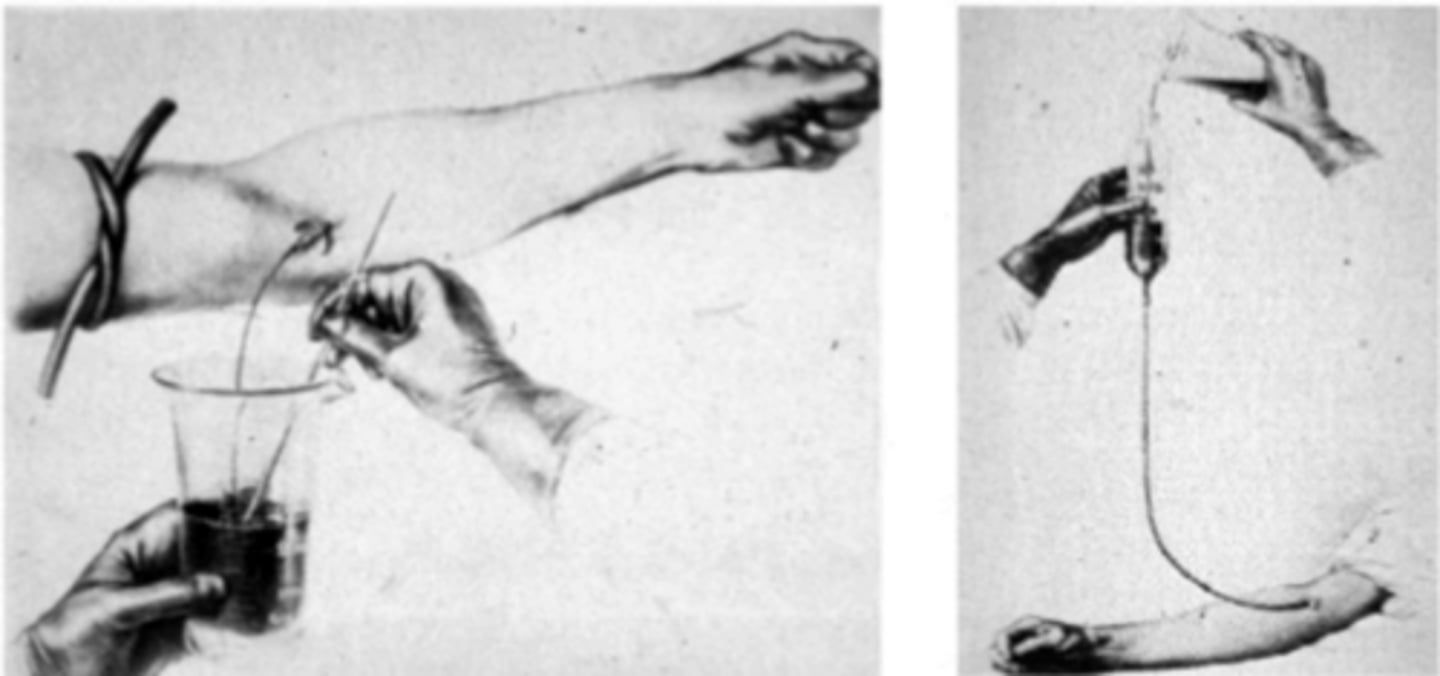
Richard Weil
He demonstrated the Feasibility of Refrigerated Storage of Anticoagulated Blood
Francis Peyton Rous, J.R. Turner
They introduced citrate dextrose solution for the preservation of blood.
Francis Peyton Rous, J.R. Turner
After the development of devices used for transfusion, research on the different anticoagulants, then the development of preservative solutions to enhance the metabolism of RBCs followed. Glucose was tried as early as 1916.
Following World War I, these two men introduced the citrate dextrose solution for the preservation of blood. This aided in the transition from vein to vein method to direct transfusion.
Oswald Robertson
He is credited as the Creator of "Blood Depots"
Blood depots
The medical corps would look for volunteers, these were usually lightly wounded soldiers, with a Type O blood. Each soldier would then donate about 2 cups of blood, which would be put in a bottle and treated with sodium citrate. The bottles would be stockpiled near the fighting in ammunition boxes packed with saw dust and ice, which help them keep for a few weeks. The result is the first ___, the precursor of modern Blood Bank. Transfusion kits were soon taken into the field allowing medics to give blood quickly to soldiers in shock.
Karl Landsteiner, Philip Levine
They discovered 3 more blood groups: M, N, P
British Red Cross
They instituted the first human blood transfusion service in the world
Leningrad Russia Hospital
First facility functioning as a blood bank
Bernard Fantus
He established the first hospital blood bank in the United States
Bernard Fantus
He originated the term "Blood Bank"
M, N, P
3 additional blood groups discovered by Karl Landsteiner and Philip Levine
Karl Landsteiner, Alex Wiener, Philip Levine, R.E. Stetson
They discovered the Rh Blood Group
Rh Blood Group
Second most important blood group next to the ABO
Rhesus macaque
Rh was named after the Rhesus monkeys. Give their scientific name.
Rh Blood Group
Blood group that was soon recognized as the cause of the then majority of transfusion reactions
Edwin Cohn
He developed Cold Ethanol Fractionation
Edwin Cohn
Professor of biological chemistry at Harvard Medical School, developed the process of breaking down plasma into its components and products
Albumin, Gamma globulin, Fibrinogen
During World War II, the demand for blood and plasma increased, which stimulated blood preservation research. ___, a protein with powerful osmotic properties, together with ____ and ___ were isolated and became available for clinical use
Isodor Ravdin
He effectively treated victims of the Pearl Harbor attack with Cohn's albumin for shock.
Cohn's albumin
Developed by Isodor Ravdin, when injected into the bloodstream, the albumin absorbs liquid from the surrounding tissues preventing the blood vessels from collapsing
J.F. Loutit, P.L. Mollison
They introduced the formula for the preservative Acid-Citrate-Dextrose. Advantages:
-Reduced volume of anticoagulant
-Permits transfusion of greater volumes of blood
-Longer term of blood storage
Coombs, Mourant, Race
They described the use of Antihuman Globulin to identify incomplete antibodies
Antiglobulin test
Other name for Coomb's test
Direct Coombs test, Indirect Coombs test
2 types of Coombs tests
Direct Coombs test
Coombs test that detects antibodies on the surface of the RBCs
Indirect Coombs test
Coombs test that detects antibodies found in serum
American Association of Blood Banks
This was formed to promote common goals among Blood Banking facilities and the Blood-donating public.
Carl Walter, W.P. Murphy Jr.
They introduced the use of plastic bags for blood collection.
Plastic bags
Introduced by Carl Walter and W.P. Murphy Jr., this replaced breakable glass bottles with rugged plastic blood bags which is currently used up to now.
Refrigerated centrifuge
The development of this equipment began to further hasten blood component therapy
Refrigerated centrifuge
This was used to separate the whole blood into different blood components.
1
After centrifugation, each blood component is used for a different indication thus the component separation maximized the utility of how many whole blood units?
Refrigerated centrifuge
It is refrigerated since the low temperature storage slows down the glycolytic activity and allows the shelf life of the component to be extended.
Cryoprecipitate
Blood product that was developed for people suffering from Hemophilia
Blood component therapy
Therapy that solved the problems of frequent transfusions such as circulatory overload
Blood component therapy
is the therapeutic use of specific components of blood instead of whole blood so that 1 patient can benefit from 1 donated blood unit at the same time avoiding TACO.