MIC 230 Final
0.0(0)
 Studied by 0 people
 Call Kai
 Learn
Learn Practice Test
 Spaced Repetition
 Match
Match Flashcards
 Knowt Play
Card Sorting
1/218

Earn XP
Description and Tags
Last updated 7:34 PM on 5/7/23
Name | Mastery | Learn | Test | Matching | Spaced | Call with Kai |
|---|
No analytics yet
Send a link to your students to track their progress
219 Terms
1
New cards
What cell structure/layer do all bacteria cells contain?
Cytoplasmic membrane (cell membrane)
2
New cards
What is the cell membrane composed of?
Highly selective permeable barrier
3
New cards
What is the cell envelope? What is always included in it and what is sometimes included?
Refers to all layers of prokaryotic cell. Always includes inner membrane and cell wall, sometimes included outer membrane if present
4
New cards
What are hopanoids?
lipids found in some bacteria, there function is stabilizing the membrane
5
New cards
What does the fluid mosaic model tell us?
Cell membranes are much more fluid than we often picture them
6
New cards
What are prokaryotic cell walls made of and what is their function?
Made out of peptidoglycan and function to protect the cell from osmotic pressure
7
New cards
What is peptidoglycan made of?
Repeating units of NAG and NAM amino acids that are in a cross linking pattern
8
New cards
What types of bonds are between layers of NAG and NAM?
peptide bonds
9
New cards
What type of bonds are in between NAG and NAM within a layer?
glycosidic bonds
10
New cards
What is the s-layer?
A protein layer found in some bateria that is made of proteins sticking out and covering cell
11
New cards
What are characteristics of gram + peptidoglycan layer?
very thick, and contains teichoic and lipteichoic acids
12
New cards
What purpose do teichoic and lipteichoic acids in the peptidoglycan layer of gram + bacteria?
to make the cell more hydrophilic and stabilize the cell wall under changing ionic environments
13
New cards
What is the “most outside” part of the cell envelope for gram + bacteria?
the cell wall
14
New cards
What are characteristics of gram - peptidoglycan
thin layer
15
New cards
Does gram - bacteria have an outer membrane?
Yes
16
New cards
What is the outer membrane of gram - bacteria composed of?
lipopolysaccharide (LPS) and phospholipid layer
17
New cards
What is the periplasm?
Space between the outer membrane and cytoplasmic membrane in gram - bacteria
18
New cards
What are some characteristics of LPS
* has polysaccharide repeats pointing away from the cell surface
* stabilizes outer membrane
* extra permeability layer
* increases hydrophilic nature of the outside of the cell
* stabilizes outer membrane
* extra permeability layer
* increases hydrophilic nature of the outside of the cell
19
New cards
What are the functions of the cell membrane?
* permeability barrier
* protein anchor
* energy conservation
* protein anchor
* energy conservation
20
New cards
What are porins?
channels in the peptidoglycan layer of gram - bacteria that allow the diffusion of hydrophilic small molecular substances through the outer membrane
21
New cards
Why are porins necessary?
Because the outer membrane of gram - bacteria is extremely impermeable
22
New cards
What are some bacterial cell surfaces?
capsule and slime layer
23
New cards
What is a capsule and what purpose does it serve?
a polysaccharide layer that surrounds the cell and prevents water loss
24
New cards
What is a slime layer and what is its purpose?
Thin layer that is loosely attached to the cell wall, is used to prevent water loss and being eaten
25
New cards
What are the extracellular appendages of bacteria cells?
Pili or fimbriae
26
New cards
What is the cytoplasm and what takes place there?
it is the liquid inside the cell and the place where the vast majority of cellular activities take place
27
New cards
What can be found in the cytoplasm of prokaryotes?
DNA, RNA, proteins, DNA poly, RNA poly, ribosome, cytoskeleton structures, and inclusion bodies
28
New cards
What are cytoskeleton structures
cell wall synthesis, cell division, chromosome partitioning
29
New cards
What are inclusion bodies?
crystals (or other chemical form) of energy producing molecules
30
New cards
What are lipid bodies?
found in some cells and made up of triacylglycerol and acts as storage of high energy lipids for long term survival
31
New cards
What are gas vesicles?
protein shells filled with gas and used by microbes to position themselves in a water column
32
New cards
What are magentosomes
A membrane enclosed organelles that allows movment toward a magnetic field
33
New cards
What are endospores?
highly differentiated cells that are resistant to heat, harsh chemicals, and radiation
34
New cards
What are the three main types of motility?
Gliding, pili-dependent, and flagella dependent
35
New cards
How does gliding motility work?
snowmobile-like inner motor
36
New cards
How does pili motility work?
requires repetitive extension and retraction of pili, ATP dependent
37
New cards
How does flagella based motility work>
Uses a biological rotary motor powered by proton motive force, often can only move in one direction and a time so the “tumble and run” model is used
38
New cards
Taxis
the directed movement toward and attractant or away from a repellent
39
New cards
What are the 6 essential macronutrients?
Carbon, Hydrogen, Nitrogen, Oxygen, Phosphorus, and Sulfur
40
New cards
Where do bacteria get carbon?
amino acids, fatty acids, sugars, nucleotides, aromatic compounds, and CO2
41
New cards
Where do bacteria get nitrogen?
proteins, nucleic acids, NH3, NO3, and N2
42
New cards
Where do bacteria get phosphorus?
phospholipids, nucleic acids, and PO4
43
New cards
Where do bacteria get sulfur?
Amino acids, vitomes, and SO4
44
New cards
What are other required elements for growth?
* major ions such as Fe, Mg, Na, Cl, Ca, K
* trace elements (micronutrients) such as copper, zinc, nickle, tungsten, and others
* trace elements (micronutrients) such as copper, zinc, nickle, tungsten, and others
45
New cards
What are growth factors?
Molecules needed for growth that are made by the cell, such as vitamins, amino acids, purines, pyrimidines, etc.
46
New cards
Prototroph
a microbe that can synthesize necessary molecules required for growth
47
New cards
Auxotroph
a microbe that is not able to synthesize a molecule required for growth, instead must acquire that molecule
48
New cards
Is it possible to be both a prototroph and an auxotroph?
Yes, can be one for one nutrient and one for another
49
New cards
True or false: All organisms have the same optimal temperature
False, each organism will have an optimal temperature for growth, although can group these together
50
New cards
What temp do psychophiles perfer?
≤15º C
51
New cards
What temp do mesophiles prefer?
20-45º C
52
New cards
What temp do thermophiles prefer?
>45º C
53
New cards
What temp do hyperthermophiles prefer?
\+80º C
54
New cards
What temp do hyperthermophiles prefer?
106º
55
New cards
Do acidophiles prefer acidic or basic conditions?
acidophiles
56
New cards
Do alkaliphiles prefer acidic or basic conditoins?
basic
57
New cards
What type of environment do halophiles prefer?
high salt
58
New cards
What type of environment do osmophiles prefer?
high sugar
59
New cards
What type of environment do xerophiles prefer?
arid, low water
60
New cards
What is an obligate aerobe?
A microbe that must be in an aerobic envi
61
New cards
What is a tolerant anaerobe?
A microbe that can survive in an anaerobic envi
62
New cards
What is a facultative aerobe?
A microbe that can grow in aerobic or anaerobic envi
63
New cards
What are the phases of microbial growth?
Lag, exponential, stationary, and death
64
New cards
What are the effects of catalysts?
* lowers activation energy of a reaction
* increases reaction rate
* does not affect energetics or eq of a rxn (can’t make something non-spontaneous spontaneous)
* increases reaction rate
* does not affect energetics or eq of a rxn (can’t make something non-spontaneous spontaneous)
65
New cards
Characteristics of enzymes?
* vast majority are proteins
* highly specific
* lowers the activation energy to increase the reaction rate
* are recycled because they are unchanged in the reaction
* often regulated (not always “on”)
* highly specific
* lowers the activation energy to increase the reaction rate
* are recycled because they are unchanged in the reaction
* often regulated (not always “on”)
66
New cards
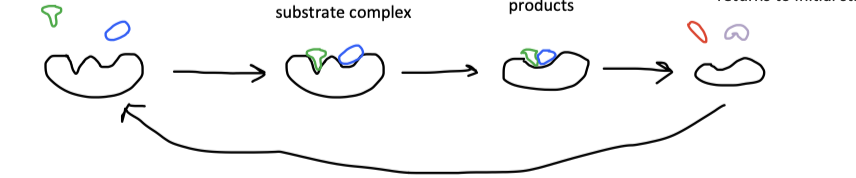
Steps of an enzyme reaction?
1. the enzyme binds the substrates at binding sites within the active site
2. binding brings the substrates into close proximity with one another to form the enzyme substrate complex
3. bond rearrangement forms a transition-state complex
4. the transition-state complex decomposes, releasing final produces and the enzyme returns to initial state
67
New cards
What do some enzymes require to complete their task?
cofactors
68
New cards
What does it mean if a reaction is coupled?
A reaction requiring energy and a reaction producing energy are done at the same time
69
New cards
What are the two categories/ways to obtain energy
Chemicals (chemotrophy)
Light (phototrophy)
Light (phototrophy)
70
New cards
What are the two categories/ways to obtain electrons?
organic molecules (organotrophs)
inorganic molecules (lithotrophs)
inorganic molecules (lithotrophs)
71
New cards
What are the two categories/ways to obtain carbon?
organic molecules (heterotrophs)
CO2 (autotrophs)
CO2 (autotrophs)
72
New cards
What is an organism that is a chemo-organo-heterotroph?
Humans
73
New cards
What is an organism that is a photo-litho-autotroph?
Plants and photosynthetic bacteria
74
New cards
What is an oxidation reaction?
loss of electrons, electron donors get oxidized, after they are oxidized they are more likely to be electron acceptors
75
New cards
What is a reduction reaction?
gain of electrons, electron acceptors get reduced, after they are reduced they are more likely to be electron donors
76
New cards
Where are reduced molecules on the redox tower?
top (-V)
77
New cards
Where are oxidized molecules on the redox tower?
Bottom (+V)
78
New cards
What happens the further the electron “falls” down the tower?
More energy is released
79
New cards
How can energy be preserved in the cell?
* coupling exergonic reactions directly to ATP synthase (substrate level phosphorylation)
* electron transport chain (generates proton motive force)
* electron transport chain (generates proton motive force)
80
New cards
Inputs and outputs of glycolysis
input: glucose, 2 ATP
output: 4 ATP, 2 NADH, and 2 pyruvate
output: 4 ATP, 2 NADH, and 2 pyruvate
81
New cards
How does glucose produce energy?
Via glycolysis and SLP
82
New cards
What are the steps of fermentation?
Starts with glycolysis, then pyruvate is used to make whatever the name of the fermentation is (lactose, ethanol, etc.)
83
New cards
What are the steps of respiration?
1. glycolysis
2. pyruvate dehydrogenase
3. citric acid cycle
4. electron transport chain
84
New cards
Major inputs and outputs of cellular respiration?
Oxygen + glucose → Carbon dioxide + water + ATP
85
New cards
Why can more energy be produced with aerobic respiration?
because O2 has much more positive redox potential than other e- acceptors
86
New cards
What is the cateogory of an organism that uses glucose as the e- donor?
chemoorganotroph
87
New cards
What does a chemolithotorph do?
inorganic molecules are oxidized and their e- are donated to a membrane associated with ETC for the generation of PMF
88
New cards
Phototrophy
use of light as an energy source
89
New cards
Oxygenic phototrophs
* light provides energy to maintain the flow of e- in the chain
* produces ATP
* produces reducing molecules
* PS II is very P so H2O (normally a very poor e- donor) can still be a donor
* produces ATP
* produces reducing molecules
* PS II is very P so H2O (normally a very poor e- donor) can still be a donor
90
New cards
Anoxygenic photorophs
* does not use O2
* not super efficient so a constant flow of e- is required
* not super efficient so a constant flow of e- is required
91
New cards
Autotrophy
carbon fixation = “dark reactions”
CO2 → organic molecules
Calvin cycle
CO2 → organic molecules
Calvin cycle
92
New cards
Inputs and outputs of calvin cycle
CO2 + NADPH + ATP → Glucose + NADP+ + ADP
93
New cards
Metabolism for most eukaryotes
1. glycolysis
2. citric acid cycle
3. ETC
4. very limited fermentation
94
New cards
What are the 4 repair mechanisms
Photoreactivation, excision repair, SOS repair, homologous recombination
95
New cards
What does photoreactivation repair
repairs thymine dimers
96
New cards
What does excision repair?
general response to damage
base or nucleotide excision
base or nucleotide excision
97
New cards
What does SOS repair?
* response to severe DNA damage
* goal is to get genome replicated and repair enough so the cell can divide
* very error prone
* goal is to get genome replicated and repair enough so the cell can divide
* very error prone
98
New cards
What does homologous recombination repair?
* DSBs
* used to repair strands perfectly
* used to repair strands perfectly
99
New cards
Transformation
transfer of free “naked” DNA from environment
100
New cards
What experiment displayed transformation
Griffth’s
 Note
Note  Flashcards (57)