AP environmental science UNIT 1 as of 8/24/26
 Call Kai
 Learn
Learn Practice Test
 Spaced Repetition
 Match
Match Flashcards
 Knowt Play
1/61

There's no tags or description
Looks like no tags are added yet.
Name | Mastery | Learn | Test | Matching | Spaced | Call with Kai | Chat |
|---|
No analytics yet
Send a link to your students to track their progress
62 Terms
Community ecology
he scientific study of how groups of different species living in the same place interact with each other and how these relationships shape the structure, stability, and dynamics of ecosystems.
Symbiosis
a close and long-term biological relationship between two different species
(example Leafcutter Ants and Their Fungus Gardens. The ants need the fungus to turn tough leaves into food they can digest, while the fungus needs the ants to bring it leaves and protect it from pests.
Competitive exclusion principle
two species with identical ecological niches cannot coexist indefinitely if they compete for the same limited resources. (Complete competitors cannot coexist. )
example The introduction of non-native species (like zebra mussels) often crowds out native species by monopolizing the same food and space.
Resource partitioning
an ecological process where similar species divide a shared resource—such as food, space, or time—differently to reduce direct competition and safely coexist within the same habitat
example
Hawks and Owls Red-tailed hawks and great horned owls eat the exact same food, like mice and rats. They share by splitting up the clock
Parasitoid
an organism that lives in or on a host organism and ultimately kills it during its development
Mutualism
a biological interaction where two different species interact and both organisms benefit (Bees and flowers)
Commensalism
a type of biological or ecological relationship where one species benefits while the other species is neither helped nor harmed
(tree and birds laying nest)
Exotic species
plant, animal, or other organism moved by humans to a place outside its natural home (Feral Hogs:)
Biome
a large global community of plants and animals. It is defined by the unique climate, temperature, and amount of rainfall in that region.
Tundra
cold, treeless ecological biome with Permafrost: A permanently frozen layer of soil beneath the surface that prevents tree roots from growing.
Permafrost
A permanently frozen layer of soil beneath the surface that prevents tree roots from growing.
Taiga (Boreal forest)
the largest land biome on Earth. It forms a circumpolar belt across the Northern Hemisphere, covering much of Canada, Alaska, Russia, and Scandinavia. It features long, severe winters, short cool summers, and is dominated by evergreen coniferous trees.
temperate rainforest?
A rare woodland ecosystem found in cooler, coastal, or oceanic regions.
What are the temperature and precipitation characteristics of a temperate rainforest?
Mild temperatures and heavy annual precipitation (at least 55 to 60 inches, often over 100 inches).
What are some major regions where temperate rainforests are found?
Pacific Northwest of North America, parts of Chile, New Zealand, Japan, and small pockets in Western Europe.
Temperate seasonal forest
a mid-latitude biome defined by four distinct seasons, warm and wet summers, cold winters, and broadleaf trees that drop their leaves annually. Found in eastern North America, Europe, and Asia, it receives 30 to 60 inches of annual precipitation. [1, 2, 3]
Shrubland (woodland)
a plant community dominated by woody shrubs and short trees under 10 meters tall, featuring open spaces with grasses and herbs. It typically receives 200 to 1,000 mm of rain annually and frequently occurs in regions with hot, dry summers and cool, moist winters.
Littoral zone
the nearshore area where land meets a body of water, such as an ocean, lake, or river. Because sunlight penetrates all the way to the bottom sediments, this dynamic, transitional zone supports high biological productivity, abundant plant growth, and a diverse range of aquatic and terrestrial life.
Limnetic zone
the open, well-lit surface water area of a freshwater lake or pond. It lies beyond the shallow, near-shore littoral zone and extends to the depth where sunlight can still support photosynthesis. This zone contains no rooted plants, but it is rich in floating plankton and free-swimming fish.
Phytoplankton
microscopic, single-celled, plant-like organisms that drift in the sunlit upper layers of oceans and lakes. Like land plants, they use sunlight, water, and carbon dioxide to make energy through photosynthesis, generating roughly half of the Earth's oxygen and forming the foundation of aquatic food
Benthic zone
is the lowest ecological layer in a body of water. It includes the sediment surface and sub-surface layers of oceans, lakes, and rivers. Organisms living here are called benthos. This zone handles vital nutrient recycling and ranges from shallow sunlit coastal areas to dark, high-pressure deep-sea floors
Oligotrophic
low in nutrients and plant life People usually use it to describe bodies of water like clean, deep lakes that have very clear water and high oxygen levels.
on a graph the dependent variable is the __ axis
Y axis (factor that is measured/observed)
on a graph the independent variable is the __ axis
x axis (the factor that the scientist changes or selects)
soil nutrient availability of tropical rainforest and why
nutrient poor soil (heavy rain makes decomposition to fast for observation) Lots of competition
soil nutrient availability of temperate seasonal/decidous and why
Nutrient poor soil, soil is too cold it stops decomposition, waxy needles resist decomposition.
soil nutrient availability of temperate forest and why
nutrient rich, leaves fall realeasing nutrients, lots of dead organic matter, warm temps.
aquatic biomes are defined by
flow (determines which organizes survive and how much O2 there is), temperature warmer water holds less oxygen
profoundal zone
too deep 4 sunlight, nutrient rich (cus of decomposition)
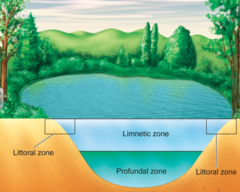
photic
sun
bethnic zone
muddy bottom, nutrient rich.
Chemosynthesis
process in which chemical energy is used to produce carbohydratesIt allows microbes to produce food in dark, extreme environments like deep-sea hydrothermal vents.
Estuary
A habitat in which the fresh water of a river meets the salt water of the ocean. nutrient-rich, High productivity
Intertidal zone
the coastal area between the high tide and low tide lines. It is underwater during high tide and exposed to air during low tide. This harsh, changing zone experiences heavy waves, extreme temperature shifts, and varying salt levels, yet it supports a rich variety of life.
Greenhouse gases
Greenhouse gases are gases in the atmosphere that trap heat and warm Earth, like a greenhouse traps warmth. Examples include carbon dioxide and methane. For apes, greenhouse gases can cause climate change, which may damage their forests, reduce food, and make survival harder.
Limiting nutrients
Limiting nutrients: Nutrients that are in the shortest supply and therefore limit how much an ecosystem can grow.
Easy example: If plants have plenty of sunlight and water but not enough nitrogen, nitrogen is the limiting nutrient because plants can't grow as much without it.
Nitrogen fixation
: The process where certain bacteria convert nitrogen gas from the atmosphere into a form that plants can use to grow.
🌱 Easy example: Bacteria in soil take nitrogen gas (N₂) from the air and turn it into usable nitrogen compounds that plants can absorb.
Nitrification
The process where bacteria in the soil convert ammonia into forms of nitrogen (nitrites and nitrates) that plants can use.
Bacteria change ammonia → nitrites → nitrates, and plants absorb the nitrates.
Nitrification = bacteria turn ammonia into plant-usable nitrates.
Assimilation
: When plants absorb nitrogen from the soil and use it to make things they need to grow, like proteins and DNA.
🌱 Easy example: A plant takes in nitrates (NO₃⁻) through its roots and turns them into nutrients it can use.
APES shortcut: Assimilation = plants take in nitrogen and use it to grow.
★ Mineralization (ammonification)
Mineralization (Ammonification): When decomposers break down dead plants, animals, and waste and turn the nitrogen in them into ammonia/ammonium. Easy example: A dead plant decomposes → bacteria break it down → nitrogen is released as ammonium (NH₄⁺) in the soil.
APES shortcut: Ammonification = dead stuff/waste → ammonium
Denitrification
The process where bacteria convert nitrates in the soil back into nitrogen gas, which is released into the atmosphere.
Easy example: Nitrates in wet soil → bacteria → nitrogen gas (N₂) → atmosphere.
APES shortcut: Denitrification = nitrates → nitrogen gas → atmosphere.
Anaerobic
Anaerobic: Describes a process or organism that does not need oxygen to happen or survive.
🦠 Easy example: Some bacteria can live and work in waterlogged soil where there is little or no oxygen.
APES shortcut: Anaerobic = without oxygen.
Leaching
When water moves through soil and carries nutrients or chemicals deeper into the ground or into groundwater.
APES shortcut: Leaching = water carries nutrients down through soil.
Phosphorus Cycle
he movement of phosphorus through rocks, soil, water, plants, and animals.
🪨 Easy example: Rocks release phosphorus → plants absorb it from soil → animals eat the plants → waste and decomposition return phosphorus to the soil.
APES shortcut: Phosphorus cycle = phosphorus moves through rocks → soil → plants → animals → soil.
⭐ Key fact: Unlike nitrogen, phosphorus has no major atmospheric (gas) phase.
Trophic pyramid
A diagram that shows the amount of energy, biomass, or number of organisms at each level of a food chain.
🌱 Easy example: Grass → 🦗 Grasshopper → 🐸 Frog → 🦅 Hawk
The bottom has the most energy, and the amount of energy decreases as you move up.
: Trophic pyramid = shows energy/biomass/organisms at each level of a food chain
Hypoxic
When too many nutrients enter a body of water, algae can grow rapidly. When the algae die and decompose, oxygen is used up, creating hypoxic water where fish and other organisms may struggle to survive.
Dead zone
An area in a body of water with very low oxygen, making it difficult or impossible for many aquatic organisms to survive.
🌊 Easy example: Fertilizer runs into a lake → algae grow rapidly → algae die and decompose → oxygen gets used up → dead zone forms.
Transpiration
The process where plants release water vapor into the atmosphere through tiny openings in their leaves.
🌱 Easy example: A plant absorbs water through its roots → water moves to the leaves → water vapor leaves through the leaves.
APES shortcut: Transpiration = plants release water vapor.
Evapotrasnpiration
Evapotranspiration: The combination of evaporation (water leaving surfaces like soil and lakes) and transpiration (water released by plants) into the atmosphere.
🌎 Easy example: Water from the soil evaporates + plants release water vapor → evapotranspiration.
APES shortcut: Evapotranspiration = evaporation + transpiration.
Runoff
Water that flows over the surface of the land instead of soaking into the ground.
🌧️ Easy example: After heavy rain, water flows over streets and fields into rivers, lakes, or oceans. It can carry pollutants and fertilizers with it.
APES shortcut: Runoff = water flowing over land.
Cellular respiration
n: The process cells use to break down glucose (sugar) to release energy they can use.
🧬 Easy example: Cells use glucose + oxygen → energy (ATP) + carbon dioxide + water.
APES shortcut: Cellular respiration = cells break down sugar to get energy.
Anaerobic respiration
A process where cells release energy from food without using oxygen.
🦠 Easy example: Some bacteria live in places with little or no oxygen and use anaerobic respiration to get energy.
APES shortcut: Anaerobic respiration = getting energy without oxygen.
Primary productivity
The rate at which producers (like plants and algae) make energy-rich organic matter from sunlight.
🌱 Easy example: Plants use sunlight to make food through photosynthesis. The faster they produce food, the higher the primary productivity.
APES shortcut: Primary productivity = how fast producers make food/energy.
Gross primary productivity
The total amount of energy that producers (plants, algae) capture from sunlight through photosynthesis.
🌱 Easy example: A plant captures 100 units of energy from sunlight. That 100 units is its GPP.
APES shortcut: GPP = all the energy producers capture.
⭐ Remember: GPP − respiration = NPP (the energy left for growth and available to consumers).
Net Primary Productivity
Net Primary Productivity (NPP): The amount of energy producers have left after using some energy for their own cellular respiration.
🌱 Easy example: A plant captures 100 units of energy (GPP), but uses 40 units for respiration. 60 units are left = NPP.
APES shortcut: NPP = energy left for growth and consumers.
⭐ Formula: NPP = GPP − respiration
Biomass
: The total amount of living organic matter in a particular area or ecosystem.
Standing crop
Standing crop: The amount of living biomass present in an ecosystem at a specific time.
🌱 Easy example: If you measure all the plants and animals in a forest today, their total biomass is the forest's standing crop.
APES shortcut: Standing crop = living biomass at one specific time.
Secondary consumer
Secondary consumer: An organism that eats primary consumers (herbivores).
🐸 Easy example: A grasshopper eats grass → a frog eats the grasshopper. The frog is the secondary consumer.
trophic cascade
When a change in the number of organisms at one trophic level causes changes throughout the food web.
🐺 Easy example: Fewer wolves → more deer → fewer plants → changes in the ecosystem.
APES shortcut: Trophic cascade = one change → effects throughout the food chain.
★ Detrivore
An organism that eats dead plants, animals, and other dead organic matter (detritus).
🪱 Easy example: An earthworm eats dead leaves and helps break them down.
Ecological efficiency
: The percentage of energy transferred from one trophic level to the next in a food chain
APES shortcut: Ecological efficiency = how much energy gets passed to the next level.
⭐ APES rule: Usually only about 10% of energy is transferred to the next trophic level.
The 10% rule
Only about 10% of the energy at one trophic level is passed on to the next trophic level.
🌱 Easy example: Plants have 1,000 units of energy → herbivores get about 100 → secondary consumers get about 10.
The other 90% is lost, mostly as heat from metabolism and through waste.
APES shortcut: 10% rule = only ~10% of energy moves up each trophic level.