Water Properties, Dissociation, and pH: Key Concepts for Biology
 Call Kai
 Learn
Learn Practice Test
 Spaced Repetition
 Match
Match Flashcards
 Knowt Play
1/16

There's no tags or description
Looks like no tags are added yet.
Name | Mastery | Learn | Test | Matching | Spaced | Call with Kai | Chat |
|---|
No analytics yet
Send a link to your students to track their progress
17 Terms
What is responsible for changing liquid to gas?
Kinetic energy, heat
Why does solid water (ice) float in liquid water?
Less dense, more open crystalline structure

What are the 4 properties of water?
1. High heat capacity 2. High heat of vaporization 3. Water is a solvent 4. Cohesion & adhesion
What is adhesion?
Water molecules are attracted to non-water molecules
What's the opposite of adhesion?
Cohesion
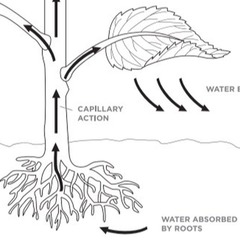
What is the process called when water 'climbs' by adhesion?
Capillary action
Which process maintains water droplet shape?
Cohesion
What occurs when atoms or groups of atoms break off from molecules and form ions?
Dissociation
What kind of bond is formed by NaCl in water?
Ionic bond

How will KCl dissociate in water?
The slightly negative regions of Oxygen will be attracted to K+; slightly positive regions of Hydrogen will be attracted to Cl-.

What is this called when ions are surrounded by water molecules?
Spheres of hydration
What kind of bond is formed by HCl in water?
Covalent bond

Is HCl polar or nonpolar? How do you know?
Polar; it has slightly positive and negative regions.
What do excess H+ ions mean?
High acidity, Low pH

What is ocean acidification?
A decrease in the pH of the ocean.
What is the range of the pH scale? What pH is neutral?
pH scale = 0-14; pH of 7 is neutral.
What is the difference between a base and a buffer?
A base reduces the H+ concentration, while a buffer reduces fluctuations in H+ concentrations.