CI 2 LEC 3 - Laboratory Evaluation of Immunoglobulin Function and Humoral Immunity
 Call Kai
 Learn
Learn Practice Test
 Spaced Repetition
 Match
Match Flashcards
 Knowt Play
1/147

There's no tags or description
Looks like no tags are added yet.
Name | Mastery | Learn | Test | Matching | Spaced | Call with Kai | Chat |
|---|
No analytics yet
Send a link to your students to track their progress
148 Terms
- y-shaped glycoprotein
immunoglobulin (Ig)
2 sites of an Ig
1. Fab region
2. Fc region
- antigen-binding site
- neutralization
Fragment antigen-binding (Fab) region
- site for complement activation/ cell surface receptors
- opsonization
Fragment crystallizable (Fc) region
holds the 2 polypeptide chains
disulfide bonds
- 110 amino acid residues at the N-terminal end
- 1 VL domain
- 1 CL domain
Variable region
- 1 CL domain
- 3 or 4 CH domain
constant region
5 Ig heavy chain isotypes?
2 Ig light chain isotypes?
IgM, IgD, IgG, IgA, IgE
kappa, lambda
Ig has 2 identical antigen-binding sites
bivalent
forms when there are >= 3 antigenic determinants
lattice
effects of lattice formation
- precipitation
- enhanced phagocytosis (opsonization)
- complement system activation
- B cell activation
provides flexibility due to hydrophilic amino acids and proline
hinge region
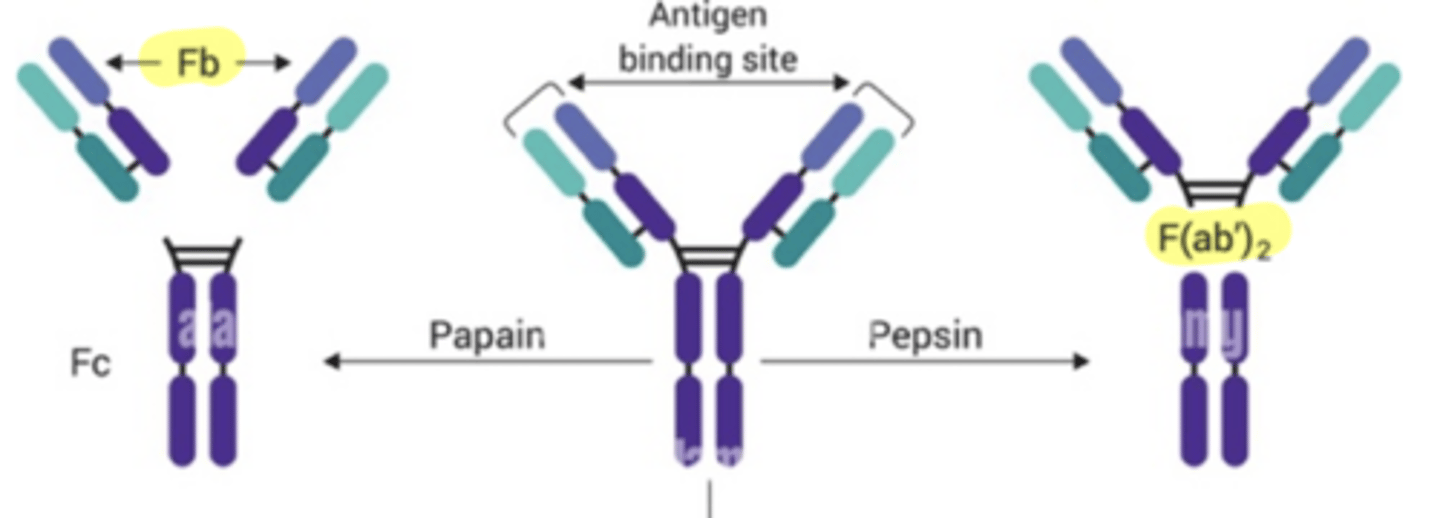
due to the hinge region, Ig is susceptible what enzymes?
papain
pepsin
Papain yields what?
2 Fab fragments
1 Fc fragment
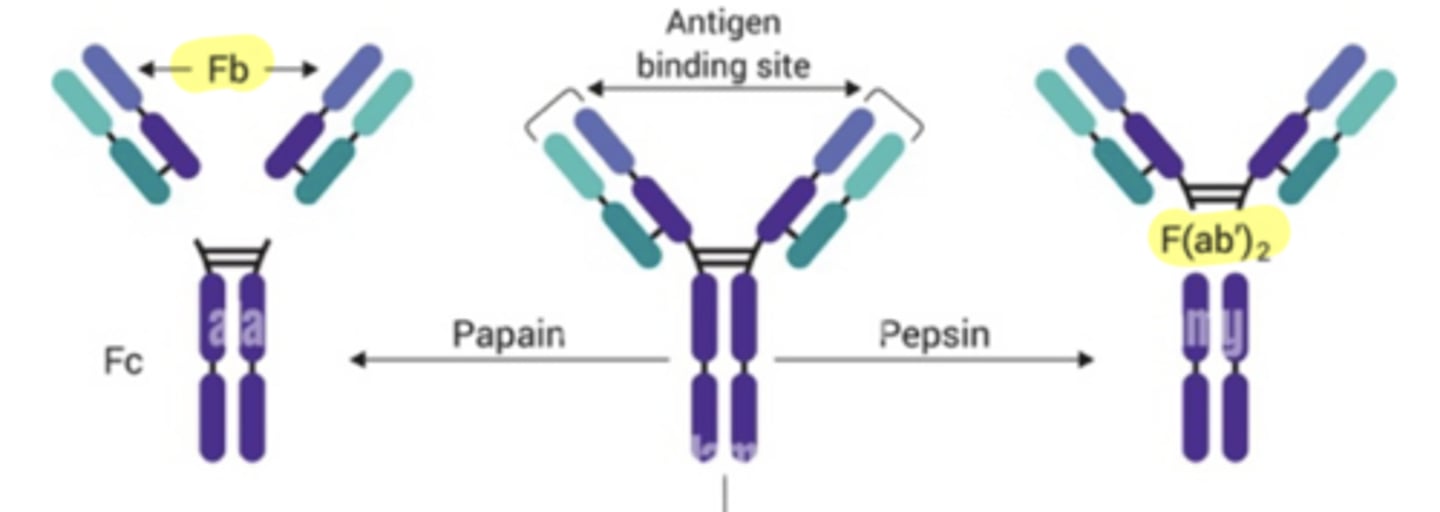
Pepsin yields what?
1 F(ab')2 fragment
1 Fc fragment
stages of B-cell response?
1. antigen recognition
2. activation
3. proliferation
4. differentiation
Naive B cells (IgM⁺, IgD⁺) bind antigens via BCR
antigen recognition
Signals from antigen + Helper T cell activate B cell
activation
activated B cell clonally epands
proliferation
- secrete antibodies
- early response = IgM
- late response = IgG
plasma cells
- long-lived
- rapid response upon re-exposure
memory B cells
- affinity maturation
- high-affinity IgG
High-affinity Ig-Expressing B cells
4 weak noncovalent forces?
hydrophobic interaction
hydrogen bonds
ionic interactions
Van der Waals forces
"HHIV"
tightness of fit between an antigenic determinant and antibody binding site
affinity
aka. antigenic determinant (part of the antigen)
epitope
>/= 2 antigenic determinants
multivalent
2 antigenic determinants
bivalent
- single antigenic determinant & single binding site
affinity
- overall binding strength of the multiple binding sites
avidity
the increase in the average affinity of Ab produced as time passes after immunization
affinity maturation
remain bound after adding chaotropic agent
high-avidity antibodies
dissociate and are not detected after adding chaotropic agent
low-avidity antibodies
- differentiates recent infections vs. previous infections
- IgM (not reliable)
measurement of IgG antibody avidity
size of antigen-antibody complexes depends on what?
1. Antigen valence
2. Relative concentrations
cross-linking of multivalent antigen by bivalent antibodies
Ag-Ab precipitation
no cross-linking
monovalent Ag
linear chains or small cyclic complexes
bivalent Ag
forms large 3D lattices
multivalent Ag
Only precipitate antigens with repeating identical determinants
monoclonal Ab
- Recognize different epitopes on the same antigen
- cross-linking
polyclonal Ab
- Ab conc. = Ag conc.
- largest complexes
Zone of equivalence
Excess antibody
prozone
(if Henry's = postzone)
Excess antigen
postzone
(if Henry's = prozone)
Humans can produce at least ___different antibody molecules
10⁶ to 10⁹
Constant, Variable, and Joining gene segments
Light chain
Constant, Variable, Diversity, and Joining gene segments
Heavy chain
heavy chain = Chromosome ___
kappa light chain = Chromosome ___
lambda light chain = Chromosome ___
heavy chain = Chromosome 14
kappa light chain = Chromosome 2
lambda light chain = Chromosome 22
- Confined to the variable regions of H and L chains, and the introns
- 1 mutation occurs per cell division
- B-cells
somatic hypermutation
somatic hypermutation results?
- diversity
- changes in affinity
- selective
- high-affinity
- more effective Abs
All B cells initially make IgM antibodies → IgG antibodies
class switching (idiotype)
Ensures each B cell expresses only one allele of light and heavy chains
Allelic exclusion
- primary antibody response
- First Ab made by B cells
- pentamer (aka macroglobulin)
IgM
present in autoimmune disorders (like SLE)
monomeric 7s IgM
IgM sedimentation rate = ___
IgM molecular weight = ___
IgM sedimentation rate = 19S
IgM molecular weight = 900 kDa
- 10 antigen-binding site
- highly efficient
- activates complement system
- cross-linking → lattice
- does not cross placenta
pentameric IgM
- rich in cysteine
- disulfide bonds: links Fc regions → pentamer
J (joining) chain
- most studied Ig
- major Ab class in blood
- secondary immune response
- activates complement system, but needs 2 molecules
- crosses placenta
- high diffusion coefficient
IgG
IgG number of molecules requires to activate the complement system
2
Significant quantities of IgG is transferred at ___ AOG
~12 weeks’
Adult IgG levels are reached at___ years old and remain constant
7
Fc region of IgG functions?
- opsonization
- antibody-dependent cell-mediated cytotoxicity (ADCC)
Dominant IgG subclass in adult humans
IgG1
IgG subclass that does not cross placenta
IgG2
Most effective IgG subclass binder of complement
IgG3
IgG subclass that does not bind complement
IgG4
most to least effectivity in binding complements
IgM > IgG3 > IgG1 > IgG2
IgG subclass: complement-fixing capacity via classical pathway
IgG1, IgG3
IgG subclass: negative for heterologous skin-binding capcity
IgG2
IgG subclass: negative for macrophage receptor
IgG2
IgG subclass: negative for reaction with protein A
IgG3
IgG subclass: positive for Anti-factor VIII
IgG4
IgG subclass: positive for:
- antidextran
- antilevan
- antiteichoic acid
IgG2
IgG subclass: highest number of inter-heavy chain disulfide bonds in hinge region
IgG3 (5)
major Ab in secretions
IgA
IgA 2 forms?
- monomers (4 chains)
- dimers (2 monomers)
IG classes containing J chains
- IgM (pentamer)
- IgA (dimers)
"JAM"
IgA secretory component (SC)?
70 kDa glycopolypeptide
cells that produce secretory IgA
- plasma cells
- epithelial cells
protects IgA from proteolytic enzymes
secretory component
dominant IgA form in secretions, though a minor component in serum.
IgA2
intestinal IgA system may be fully developed
2 years old
Serum IgA reaches adult concentrations
12 years old
- 1st line of defenses → external environment
- inhibits adherence
- reduces allergic reactions
- alternative pathway
- opsonin
- induces eosinophil degranulation → antiparasitic response
IgA functions
- minor component in serum
- major membrane-bound Ig on the surface of B lymphocytes (newborns)
IgD
- turning on/off/modulating (controls) B-cell division or differentiation (immunoregulation)
- No specific biological role as a humoral Ab
IgD
- detected at 6 months; remain low throughout life
- increased in chronic infection
- no specific disease association
- normal in allergies/ autoimmune disease
- absent in hypogammaglobulinemia
IgD
- lowest serum concentration
- homocytotropic antibody (attach to human skin)
- reaginic antibody (initiate allergic reaction)
- bifunctional
- produced in the respiratory & intestinal tract linings
IgE
contains the Fc region,
H (hinge) region
___: Found in blood and tissue fluids
___: Mainly in the blood
___: On epithelial surfaces
___: Bound to B cells
___: Bound to basophils and mast cell
IgG: Found in blood and tissue fluids
IgM: Mainly in the blood
Secretory IgA: On epithelial surfaces
IgD: Bound to B cells
IgE: Bound to basophils and mast cell
sex with lower IgM
males
have higher Ig levels
Darker-pigmented Individuals
- clonal expansion of a single Ig-producing lymphoid cell
- for a particular antigen
- restricted heterogeneity
monoclonal Ig
screening test for monoclonal gammopathy
protein electrophoresis (serum or urine)
monoclonal gammopathies?
- multiple myeloma
- Waldenstorm macroglobulinemia
- Burkitt lymphoma
- B-cell neoplasms
- B-cell ALL
Clinical syndrome due to interaction of an IgM paraprotein:
- Myelin-associated glycoprotein (MAG)
- Gangliosides
Paraproteinemic neuropathies
motor neuropathy?
sensory neuropathy?
GM1
GMd1b
- 75% of organ transplant patients
- immunosuppressive drugs
Transient monoclonal gammopathy
Monoclonal gammopathy present but (–) no malignancy features
Monoclonal Gammopathy of Undetermined Significance
differentiate with multiple myeloma
urine Bence Jones Protein
- Structurally different Ig
- expansion of multiple Ig-producing lymphoid cells
polyclonal immunoglobulins