7 SG: Carbohydrates and Glycobiology
 Call Kai
 Learn
Learn Practice Test
 Spaced Repetition
 Match
Match Flashcards
 Knowt Play
1/31

Name | Mastery | Learn | Test | Matching | Spaced | Call with Kai | Chat |
|---|
No analytics yet
Send a link to your students to track their progress
32 Terms
Carbohydrate
Organic compounds of carbon, hydrogen, and oxygen, typically with the formula (CH₂O)ₙ. Major source of energy for the body.
Oligosaccharide
Carbohydrates composed of 3-10 monosaccharide units linked by glycosidic bonds.
Aldose
A monosaccharide that contains an aldehyde group (-CHO).
Ketose
A monosaccharide that contains a ketone group (C=O).
Epimers
Stereoisomers that differ in configuration at only one specific carbon atom.
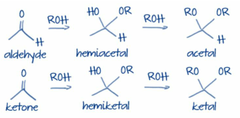
Hemiacetal
A functional group formed when an aldehyde reacts with an alcohol.
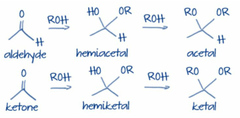
Hemiketal
A functional group formed when a ketone reacts with an alcohol.
Anomers
Isomers of monosaccharides that differ in configuration only at the anomeric carbon.
Anomeric Carbon
The carbon atom that was the carbonyl carbon (C=O) in the open-chain form of the sugar.
Mutarotation
The change in the optical rotation that occurs when an alpha (α) form of a sugar converts to a beta (β) form and vice versa.
Reducing Sugar
A sugar that can donate electrons to another chemical, reducing it, typically having a free aldehyde or ketone group.
O-Glycosidic Bonds
Bonds formed between anomeric carbon of a carbohydrate and hydroxyl group of another molecule.
Reducing End
The end of a carbohydrate chain that has a free anomeric carbon.
Hemoglobin Glycation
The non-enzymatic attachment of glucose to hemoglobin, used as a measure of blood sugar levels over time (HbA1c).
Glycan
Generic term for any sugar / assembly of sugars, in free form or attached to another molecule.
Starch
A storage polysaccharide in plants, consisting of amylose and amylopectin.
Glycogen
A storage polysaccharide in animals, similar to starch but more highly branched.
Cellulose
A structural polysaccharide in plants, composed of β-glucose units linked by β(1→4) glycosidic bonds.
Glycosaminoglycan
Long unbranched polysaccharides consisting of repeating disaccharide units, often found in the ECM.
Hyaluronan
A glycosaminoglycan that is a major component of the ECM, contributing to tissue hydration and elasticity.
Chondroitin Sulfate
A glycosaminoglycan found in cartilage, providing resistance to compression.
Heparan Sulfate
A glycosaminoglycan involved in cell signaling and found on cell surfaces and in the ECM.
Glyconjugate
Carbohydrates covalently linked to proteins or lipids.
Proteoglycan
A type of glyconjugate where glycosaminoglycans are attached to a core protein, found in the ECM.
Glycoprotein
Proteins with carbohydrate groups attached to the polypeptide chain.
Glycolipid
Lipids with carbohydrate groups attached, important for cell recognition and signaling.
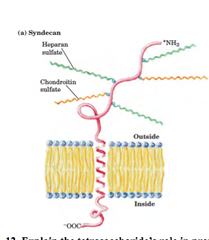
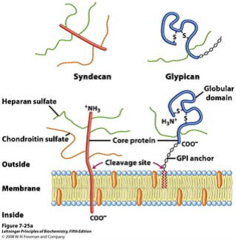
Syndecan
A type of proteoglycan found on cell surfaces, involved in cell adhesion and signaling.
Glypican
A type of proteoglycan attached to the cell membrane, involved in cell growth and development.
Glycomics
The comprehensive study of glycomes, including the structures and functions of carbohydrates in biological systems.
Ganglioside
A type of glycolipid that contains sialic acid, important in cell-cell communication and signal transduction.
Lectin
Proteins that bind specifically to carbohydrates, playing roles in cell recognition and signaling.
Selectins
A family of cell adhesion molecules that bind to carbohydrates on the surfaces of other cells, important in the immune response.