Geriatrics Part 2 HL Exam 4
 Call Kai
 Learn
Learn Practice Test
 Spaced Repetition
 Match
Match Flashcards
 Knowt Play
1/143

There's no tags or description
Looks like no tags are added yet.
Name | Mastery | Learn | Test | Matching | Spaced | Call with Kai | Chat |
|---|
No analytics yet
Send a link to your students to track their progress
144 Terms
Can AD or PD be cured?
No
What is early onset AD?
Age < 60 and accounts for 1% of cases which are usually genetic
What may cause early onset AD?
mutations in APP, PSEN1, or PSEN2
follows an autosomal dominant pattern in 50% of cases
What is late onset AD?
Age 80+ and is more environmental rather than genetic
What may cause late onset AD?
ApoE gene is a strong RF (especially E4 variant)
What is the primary NT shortage seen in AD?
Acetylcholine (ACh)
Why is there a ACh shortage in AD?
pathways are damaged by plaques and tangles which leads to learning and memory impairment
What role does cholesterol play in AD?
increased concentrations are associated with AD due to increased beta-amyloid protein synthesis which can lead to plaque formation + the ApoE4 allele is thought to be involved with cholesterol metabolism (higher risk)
What are the components of the DSM-5 diagnostic criteria for major neurocognitive disorders?
1. evidence of significant cognitive decline from baseline (complex attention, executive fxn, learning/memory, language, perceptual motor, social cognition)
2. cognitive deficits interfere with independence in everyday activities
3. cognitive deficits do not occur exclusively with delirium
4. cognitive deficits are not explained by another mental disorder
What are components of the DSM-5 diagnostic criteria for mild neurocognitive disorders?
same as major disorders, but modest cognitive decline is present (not significant)
What are the components of the DSM-5 diagnostic criteria for major/mild neurocognitive disorder due to AD?
1. criteria are met for major or mild neurocognitive disorder
2. insidious onset and gradual progression of impairment in 1+ cognitive domain (for major, 2+ domains must be impaired)
3. criteria are met for probable/possible AD
4. disturbance is NOT explained by cerebrovascular disease, another neurodegenerative disease, substance effects, or another mental/neuro/systematic disorder
What are the criteria for probably AD in major neurocognitive disorders?
3-1. evidence of causative AD genetic mutation from fam hx or testing
3-2. clear decline in memory/learning and 1+ other domain AND steadily progressive gradual decline in cognition without plateaus AND no evidence of mixed etiology
What are the criteria for probably AD in mild neurocognitive disorders?
Probable AD: diagnosed if evidence of causative AD genetic mutation from fam hx or testing
Possible AD: diagnosed if there is no evidence of causative AD mutation, but clear decline in memory/learning AND steadily progressive gradual decline in cognition without plateaus AND no evidence of mixed etiology
An older adult is having difficulty paying bills on time. Is this consistent with dementia? If so, what stage? (mild, moderate, severe)
Mild
A male assisted living facility resident with suspicions that the staff is stealing money from him and that his neighbor is having an affair with his wife. He became angry and hit his roommate today. Is this consistent with dementia? If so, what stage? (mild, moderate, severe)
Mod
A female nursing home resident who no longer remembers the names of or consistently recognizes her adult children or sometimes thinks her son is her deceased husband. Is this consistent with dementia? If so, what stage? (mild, moderate, severe)
Severe (consistent with dementia)
When should therapy for AD be started?
asap after diagnosis
What are the goals of AD treatment?
delaying disease progression
preservation of functioning as long as possible
secondary: treating psych and behavioral symptoms
What class of agents are first-line in treating cognitive symptoms of AD?
AChE inhibitors and/or NMDA antagonists (i.e., memantine)
What is a reasonable trial to determine efficacy?
3-6 months
What would you recommend if a AChE inhibitor is ineffective?
switch to another AChE inhibitor
What is a reasonable trial in terms of tolerability?
4+ weeks
What would you recommend if a patient experienced intolerable ADRs with cholinesterase inhibitors?
D/C and consider other treatment
What does MMSE stand for?
mini mental state exam
What indicates a mild score on a MMSE?
21-24
What indicates a moderate score on a MMSE?
10-20
What indicates a severe score on a MMSE?
< 10
Which class/medication is FDA-approved for moderate to severe AD only (not mild)?
memantine
What are first line options for AD?
donepezil, galantamine, rivastigmine
Which medication is used to treat mild, mod, and severe AD?
donepezil
What are common side effects of donepezil?
Mild - Mod GI symptoms:
N (least likely in class)
Diarrhea
HA
Insomnia
What is the titration schedule of donepezil?
5mg QPM
→ 4-6 weeks
→ 10mg
→ 3 months
→ 23mg
True or False: donepezil does not require renal adjustments
True
What are drug interactions of donepezil?
CYP 2D6 or 3A3/4 inhibitors (concern for peripheral side effects)
CYP 2D6 or 3A3/4 inducers (increase elimination rate of donepezil)
What does galantamine and rivastigmine treat?
mild-mod AD
What are the most common side effects of galantamine?
Cholinergic (common):
N (> Donep but < Rivas)
V
Diarrhea
Dizziness
What is the titration schedule of galantamine?
IR:
4mg BID
→ 4 weeks
→ 8-12mg bid
ER:
8mg QAM
→ 4 weeks
→ 16-24mg qd
When are dose adjustments indicated for galantamine?
Do not exceed 16mg for mod impaired hepatic/renal fxn
C/I in severe dysfxn
True or False: there are no important drug interactions of galantamine
True
What are common side effects of rivastigmine?
N/V >>> (compared to donep, galan)
Dizziness
Anorexia
Diarrhea
HA
What is the titration schedule of rivastigmine?
PO:
1.5mg BID
→ 2 weeks
→ 3-6mg BID
Patch: QD
4.6mg/24hr
→ 4 weeks
→ 9.5mg/24hr
When are dose adjustments indicated for rivastigmine?
Max dose of 4.6mg/24hr if...
- Mod-severe renal impairment
- Mild-mod hepatic impairment
- Low body weight (< 50kg)
When is memantine used for AD?
mod-severe (not mild)
What are common side effects of memantine?
Minimal!
Most common: dizziness, HA
Also:
Constipation
Confusion
Coughing
HTN
What is the dose titration of memantine?
IR:
5mg QD
→ 1 week
→ 10mg BID
ER:
7mg QD
→ 1 week
→ 28mg QD
When are dose adjustments indicated for memantine?
Severe renal impairment: target maintenance dose of 5 mg twice daily or 14 mg daily
When are anti-amyloid therapies used for AD?
mild AD
What are common side effects of anti-amyloid therapies for AD?
Infusion related rxns
Amyloid related imaging abnormalities (ARIA)
ARIA edema or effusions
HA
Falls
What are examples of anti-amyloid therapies?
lecanemab and donanemab
Why was vitamin E recommended for AD?
antioxidant properties, but not recommended much anymore and don't exceed 400IU daily (increases mortality)
Why are NSAIDs not used for AD?
not really any data and ADRs (gastritis, GI bleeds, increased CV events)
When are statins used in AD?
only if there's an indication for it
Would we recommend gingko bioba for AD?
sure, has long-term safety and efficacy, but recommend with caution
What is caprylidene?
medical food that increases ACh in the brain which is potentially useful in AD
How to reduce dementia risks?
Monitoring BP
Monitoring glucose
Monitoring cholesterol
Monitoring homocysteine
Initiating appropriate interventions
What should be considered as first-line treatment for behavioral symptoms associated with AD?
Nonpharm:
- Music
- Videotapes of family members
- Audiotapes of the voices of caregivers
- Walking and light exercise
- Sensory stimulation and relaxation
Pharm: Antipsychotics +/- Antidepressants
List most commonly used agents to treat psychosis associated with AD:
Atypical Antipsychotics:
- Olanzapine
- Aripiprazole
- Quetiapine
- Risperidone
How common is depression in AD patients?
50% of patients
What are S/S of depression in AD?
often similar to dementia
Poor appetite
Insomnia
Hopelessness
Anhedonia
Withdrawal
Suicidal thoughts
Agitation
What class is used for depression in AD?
SSRIs
What other agents are used to treat anxiety or agitation associated with AD?
Benzos (anxiety, agitation, aggression)
Anticonvulsants (alternatives for anxiety, agitation, aggression)
Buspirone (agitation and aggression)
Selegline (anxiety, depression, agitation)
Trazodone (insomnia, agitation, dysphoria, sundowning)
What are risk of benzos?
increased falls
Which anticonvulsants are used for anxiety/agitation in AD?
CBZ, VPA, gabapentin
True or False: buspirone has a ton of ADRs
False (minimal ADRs)
What is the MOA of selegline?
MAO inhibitor (this class is usually not tolerated well, but this particular one is okay for depression in AD)
What are monitoring parameters for AD treatment?
therapy success, develop plan, quality of life, functional performance/mood/behaviors, and evaluate ADRs/allergies/interactions
What part of the brain is affected in PD?
DA neurons in the substantia nigra are primarily affected → disruption in smooth motor control
What is the primary NT target for PD drug therapy?
As dopamine (DA) neurons die, DA relayed messages cannot communicate to other motor centers of the brain, and patients develop motor symptoms
List some common drugs that can cause drug-induced PD
It is essential to rule out drug-induced pseudoparkinsonism due to dopamine antagonists such as antipsychotics, metoclopramide, and antiemetics (prochlorperazine) before diagnosis
What are the four hallmark motor features of PD?
TRAP:
tremor at rest: "pill-rolling"
rigidity: stiff and cogwheel rigidity
akinesia (or bradykinesia)
postural instability (and gait abnormalities)
What are the nonmotor features of PD?
SOAP:
sleep disturbances
other (misc):
NA
Fatigue
Speech
Pain
Dysethesias
Vision problems
Seborrhea
autonomic:
Drooling
Constipation
Sexual dysfxn
Urinary problems
Sweating
Orthostatic hypotension
Dysphagia
psych:
Anxiety
Psychosis
Cognitive impairment
Depression
What are response fluctuations to PD?
MAD:
motor fluctuations (delayed on, wearing off, random off, freezing)
akathisia
dyskinesia (chorea, dystonia, diphasic dyskinesia)
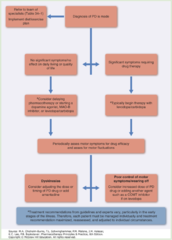
When should medication therapy for PD be initiated?
Pharm therapy depends on age, risk of ADRs, degree of physical impairment, and readiness to initiate therapy
**figure**
What is the role of a dietician in PD?
recommend appropriate caloric intake, meal selection, and protein consumption which may (a) improve constipation (b) decrease weight loss and aspiration (c) minimize erratic drug absorption
What is the role of a speech therapist in PD?
improve swallowing, articulation, and force of speech
What is the role of a physical therapist in PD?
improve strength, activity, sleep quality, and reduce fall risk
What is the role of an occupational therapist in PD?
educate on adaptive environment of home, specialized clothing, and personal training to maximize (a) independence (b) safety (c) ADRs toleration (d) driving ability
What are side effects seen in all PD meds?
N/V
hypotension
hallucinations
What is the MOA of benztropine?
anticholinergic
What are dosing notes of benztropine?
Good for tremor and drooling, but not other symptoms.
Not for elderly patients.
What are side effects of benztropine?
Cognitive impairment
Inhibition of GI motility
Worsen urinary retention and/or constipation
What is the MOA of selegiline and rasagiline?
MAO-B inhibitors that decrease DA metabolism
What are dosing notes of selegiline?
Available as ODT (avoids first-pass metabolism)
Avoid tyramine-containing foods
Has amphetamine like metabolite do not dose in evening
What are side effects of selegiline?
NA
Confusion
Hallucinations
Jitteriness
Insomnia
Orthostatic hypotension
What are dosing notes of rasagiline?
Avoid tyramine-containing foods
What are side effects of rasagiline?
similar to selegiline, but has LESS insomnia
What is the MOA of amantadine?
NMDA receptor antagonist: blocks glutamate transmission, promotes DA release, and blocks ACh
What are dosing notes of amantadine?
ER formulations approved specifically for dyskinesias
Some patients develop tolerance and need to be tapered off for a drug holiday
Niche: when everything else is not working → smoothes peak dose dyskinesias
What are side effects of amantadine?
NA
Dizziness
Livedo reticularis
Peripheral edema
Orthostatic hypotension
Hallucinations
Restlessness
ACh effects
Insomnia (ER limits this)
What is the MOA of ropinirole, pramipexole, and apomorphine?
DA agonists
What are dosing notes of ropinirole?
Delay levodopa therapy and decrease risk of motor fluctuations
CYP1A2 = metabolism induced by smoking
Hepatically metabolized
What are dosing notes of pramipexole?
Delay levodopa therapy and decrease the risk of motor fluctuations
Eliminated unchanged in the urine = no liver
What are dosing notes of apomorphine?
SQ injection for acute off episodes
SQ injection with quick onset (10 minutes)
Delay levodopa therapy and decrease the risk of motor fluctuations
USED PRN up to 5x daily
This drug does not allow us to decrease the dose of carb/levo
What are side effects of ropinirole and pramipexole?
Common:
NA
Sedation
Pedal edema
Orthostatic hypotension
Psychiatric effects (more than levodopa)
Nightmares
Confusion
Hallucinations
Excessive daytime sleepiness
Sleep attacks
Rare:
Painful reddish discoloration of skin (shins, pleuropulmonary)
Retroperitoneal
Cardiac fibrosis
What are side effects of apomorphine?
same as the other DA agonists, but you have to pre-medicate with antiemetic
What is the MOA of carbidopa/levodopa?
Carbidopa: peripheral AADC inhibitor
Levodopa: converted into DA in CNS
What are dosing notes of carbidopa/levodopa?
At least 75 mg carbidopa/day for effectiveness.
Start at a very low dose to minimize adverse effects.
May dose every 2 hrs in advanced PD.
What are side effects of carbidopa/levodopa?
Initial: take with nonprotein food to limit
Orthostatic hypotension
Anorexia
N/V
Urine discoloration
Late:
Dyskinesia
Sleep attacks
Impulse control disorders
Hallucinations
Nightmares
Confusion
Altered behavior
What is the MOA of entacapone and opicapone?
COMT Inhibitor: decreases metabolism of DA
What are dosing notes of entacapone?
ineffective as monotherapy