History, Approaches, & Methods (Module 1: CLEP Psychology)
 Call Kai
 Learn
Learn Practice Test
 Spaced Repetition
 Match
Match Flashcards
 Knowt Play
1/45

Earn XP
Description and Tags
Name | Mastery | Learn | Test | Matching | Spaced | Call with Kai | Chat |
|---|
No analytics yet
Send a link to your students to track their progress
46 Terms
What is Psychology?
Word breakdown: Psyche= soul/mind, Ology= study of
scientific study of the mind,scientific study of human behavior & mental processes
mental proccesses
thoughts
emotions
impulses
behavior
actions we can visibly see
Critical Thinking
QLOBS
(asking) Questions
Logical thinking
(making) Observations
(recognizing internal) Biases
(maintaining attitude of) Skepticism
Structuralism
key figure: Wilhelm Wundt
used introspection to break down consciousness into basic elements/components.
introspection
definition: examining one’s own conscious experience as objectively as possible
what’s involved in recording your own thoughts/feelings?
subjective and fell out of favor bc its low replicability(used very specific experimental conditions)
proposed that consciousness occurred when these basic elements combined in different ways to produce perceptions
what are the basic elements/structures of mental experiences or human experiences?
fell out of popularity once Wundt’s student (Edward Titchener) passed away in 1927.
Functionalism
key figure: William James
investigating operation of whole mind rather than individual parts
understand mind = understand what mind can accomplish
relied on both introspection AND more objective measures (recording devices, anatomy, etc.)
what do mental processes do? how do they help us adapt to our environment?
processes/functions of human condition
consciousness/behavior helps ppl adjust to environments
What are the 5 approaches to psychology (for the CLEP Exam)?
BBCHP:
Biological
Behavioral
Cognitive
Humanisitic
Psychodynamic
Biological Approach
physiological & biochemical explanations are root of behavior
genetics
hormones
neurotransmitters
neurochemicals
these bio functions -> ppl experience emotions, thoughts, etc
Behavioral Approach (Pavlov, Watson, Skinner, & Behaviorism)
learned responses to predictable patterns of external stimuli
we respond/behave based on the environment around us
behavior is dictated by genertics & enviornment
Key Figures:
Ivan Pavlov (1849-1936):
studied conditioned reflex, in which an animal/human produced a reflex (unconcious) response to a stimulus, and over time, was conditioned to produce THE SAME response to a differet stimulus (AKA classical conditioning)
John B Watson (1878-1958)
major proponent of BEHAVIORALISM, (focused on directly observable behavior/controlling that behavior)
focus on learned behavior & its interaction w/inborn qualities of the organism
behavioralist experiments commonly used animals
B.F. Skinner
studied how consequences impacted behavior (reward/punishment= main drivers)
developed operant conditioning chamber (aka. Skinner Box) which isolated subjects from exgternal enviornment and delivered positive, neutral, or negative reinforcements.
Humanistic Approach/Humanism (Maslow & Rogers)
Humanism: psychological perspective emphasizing the innate potetial for good in all humans
humanistic psychologists disagree with solely relying on experimentation without considering the “whole” human being
Key Figures:
Abraham Maslow (1908-1970)
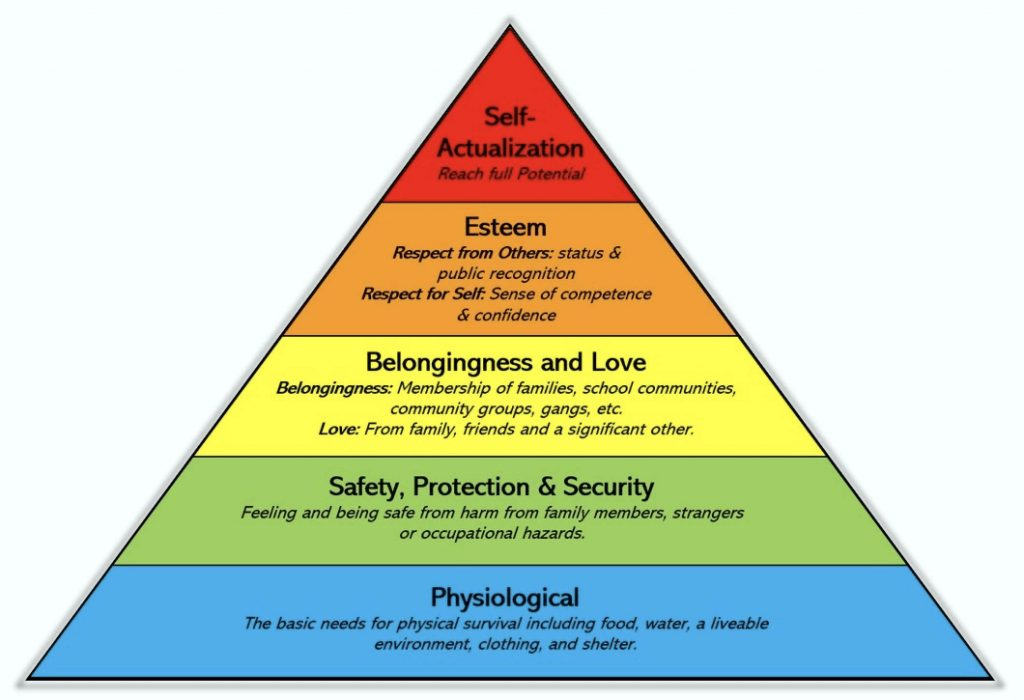
known for hierarchy of needs
Carl Rodgers (1902-1987)
used client-centered therapy w/his clients. in CCT, patients take lead role in therapy session
believed therapists needed to display 3 features to maximize effectiveness of CCT: GUPRE
Genuieneness
Unconditional Positive Regard
Empathy
therapists need to accept clients for who they are, no matter what they’re dealing with
Maslow’s Hierarchy of Needs
Cognitive Approach (Chomsky)
cognitive psych: things you can’t track/observe externally
memory
attention
thought processes
helped est communication between European & US psychologists bc EU psych wasn’t as influenced by behaviorism
stemmed in reaction to behaviorists (primarily focused on observable behavior/reactions to evnrionment), as well humanistic psychologists introduced interdisplinary methods of inquiry to psych
cognitive psychologists began to work w/other fields (eg. anthropology, linguistics, com sci, neuroscience)
Key Figure
Noam Chomsky
linguist, believed psych needed to include mental functioning, not just behavior, into study to truly understand behavior
Femenist Psych & Limitations of Scope
dominant psychologists: Western, white, & male
most core psych had been developed w/biases towards these individuals
women, ethnic minorities, lgbtq+, etc. had difficulties entering psych, influencing its development, & thus increasing scope of research done for these communities
they had little influenc eof what was studied
experimental subjects were mostly men. male psychologists assumed gender had no influence & that women weren’t sufficient ineterest to study
many men constructed the psych of women w/out experimental tests of women, often using outdated/untrue assumptions
key figure: Naomi Weisstein
her femenist psych attempted to be free of male cultural biases regarding the psychology of both men/women
APA (American Psychological Association)
represents psychologists in the US
largest org of psychologists around the world
mission: advance/disseminate psych knowledge for the betterment of the ppl
56 divisions w/variety of specialties (religion, sprot, behavioral neuroscience, etc)
members range from students to doctoral-level & come from various backgrounds
APS (Association for Psychological Science)
founded due to disagreements between members in APA’s scientific & clinical branches
activities
publishes 5 research journals
education/advocacy w/funding agencies
majority of members are from US, but signification protion are non-US psychologists
Psychodynamic Approach & Psychoanalytic Theory
Key Figure: Sigmund Freud (1856-1939)
Unconcious Mind:
proposed that ppl’s problems arose from unconcious mind, which play a role througout entire life
unconcious mind: repository of feelings/urges that we have no awareness of
according to Freud, we can access unconcious mind thru dream analysis, examining slips of tongue, and the first things that come to ppl’s minds
Psychoanalytic theory:
focuses on role of person’s unconsiousness & early childhood experiences, and how these things impact adulthood
3 focuses: ID, superego, & ego
ID= pleasure (want it/want it now)
superego= morals/values, follow rules, societal norms, avoiding danger/averse situations
ego= moderator (reality principle, moderator between ID & superego)
Defense Mechanisms play role in our personalities
repression, supression, and reaction formation
Biopsychology (Field of Psych)
definition: how does biology influence or behavior? (focusing on immediate causes of behavior)
bio psychologists seek to understand how structure/function of nervous system is related to behavior
example research interests: sensory and motor systems, sleep, drug use/abuse, ingestive behavior, reproducti behavior, neurodevelopment, neuroplaticity, etc
biopsychologists come from all different backgrounds; interdisciplinary approach = neuroscience
Evolutionary Psychology (Field of Psych)
definition: studying the ultimate biolgical causes of behavior
has had resurgance in recent decades
approach: predict outcome of bheavior in a particular situation based on evolutionary theory, then make observations/conduct experiments to determine whether results match theory
these studies aren’t not strong evidence bc behavior is not entirely genetic; a lot of it is influenced by cutlrual
very hard to demonstrate that human traits are naturally selected
traits we posess now evolved under very dated conditions, making predictivions about what is adaptive very difficult
we can make predictions abt many different areas of human behavior (eg. mate choice, family relationships, freindship, parenting, etc.)
Cognitive Psych (Field of Psych)
definition: area of psych focusing on studying cognitions (thoughts) and their relationship to our experiences/actions
broad, consists of collaborations from ppl of various backgrounds
research interests: attention, probelm solving, language, memory, etc.
Developmental Psychology (Field of Psych)
definition: scientific study of development across a lifespan
study physical maturation as well as changes in cognitive skills, moral reasoning, social behavior, etc.
early era:
primarily focused on changes up until addulthood
eg: Jean Piaget → young kids don’t demonstrate object permanence
now:
research expands to changes occuring later in life due to increasing lifespans
Personality Psychology
definition: focuses on patterns of thoughts/behaviors that make each indvidual unique
has taken more quantitative approach (idnetifying personality traits, measuring these traits, & determining how they’ll interact in specific contexts to determine how someone will behave in any given situation)
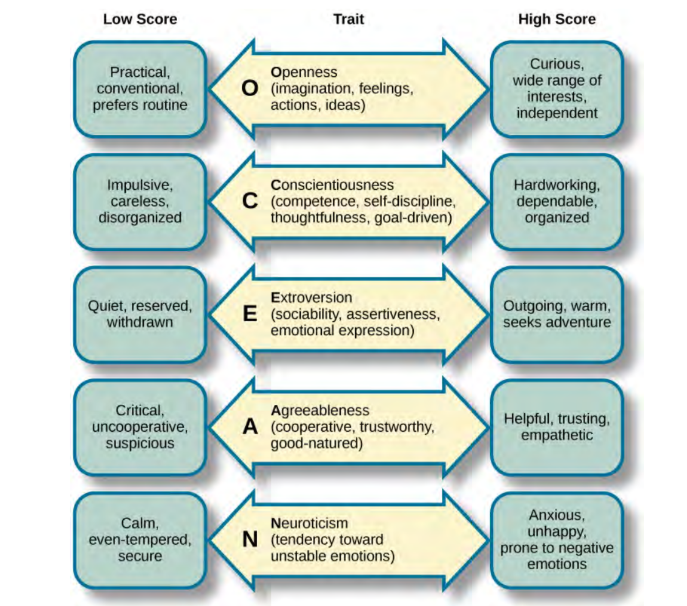
personality traits are pretty consistent w/thoughts & behavior → Big Five/Five Factor Model
Big 5/Five Factor Model of Personality Dimensions
OCEAN
Social Psychology (Field of Psych)
definition: how we interact with & relate to others
sample research topics: how we explain our own behavior vs behavior of others, prejudice, attraction, resolving interpersonal conflicts, how our thinking & behavior changes as we’re around others
Key Figure: Stanley Milgram
Milgram (1961)
2/3 of participants delivered “lethal” shocks to another person just bc another authority figure told them to do so
study catalyzed development of ethical guidelines for psych experiments (discouraing deception/potential emotional harm, getting informed consent, etc)
Industrial Psych (IO) (Field of Psych)
definition: applies psychological theories, principles, etc in industrial/organizational settings
deal w/personnel management, organizational structure, workplace enviornment, etc
some do scientific research on behavior in IO settings
Health Psychology
key definition: focuses on how health is affected by biological, psychological, AND sociocultural factors (biopsychosocial model)
health psychologists help ppl achieve better health thru public policy, education, intervention, research, and motivating ppl to address patterns of behavior that contribute to poorer health
Sport & Exercise Psychology (Field of Psych)
definition: psychological aspects of sport performance, motivation & performance anxiety, effects of sport on mental and emotional wellbeing
not just sports, but also mental/physical performance under demanding conditions (eg. fire fighting military ops, artistic perforamnces, surgery, etc)
Clinical Psych (Field of Psych)
focuses on diagnosis & treatment of psychological disorders and other behavior
some clinicians do research on the side
Counseling Psych (Field of Psych)
focuses on emotional, social, vocational, & health related outcomes in individuals considered psychologically healthy
Forensic Psych (Field of Psych)
deals w/psych in the justice system
roles of forensic psych
assess ppl’s competency to stand trial
assess defendant’s state of mind
act as consultant on child custody cases
consult on sentencing & treatment recs
advise eyewitness/children’s destimonies
used in witness protection & jury selection process
small portion work w/law enforcment as a criminal profiler
must have good understanding of law, not just psych
personality trait
consistent pattern of thought & behavior
What are the 3 ypes of research methods for psych (for the CLEP exam)?
Experimental
Clinical
Correlational
Research Method: Experimental
define
variables
groups
key concepts (3)
investigating a cause & effect relationship between 2+ variables
2 variables
Independent
Dependent
2 groups
Expermiental Group
Control Group
Key Concepts
Random Assignment
Blind & Double Blind Study
Placebo & Placebo Effect
Research Method: Clinical (3 types of studies)
Case Studies
Naturalistic Observation
Clinical Interview
Independent Variable
IV
variable that’s being manipulated
the “cause” in cause & effect relationship
eg: when investigating the impact of antideppresant pill on mood, giving the pill or placebo would be IV
Dependent Variable
variable that’s being measured for change
the “effect” in cause & effect relationship
eg: when investigating the impact of antideppresant pill on mood, the change (or lack of) mood would be DV
Experimental Group
group that is exposed to the cause of experiment
i.e receives the IV
eg. the group that recieves the antidepressant meds
Control Group
group that’s not exposed to cause of experiment
i.e receives NO treatment or a treatment that should have no effect
eg. group that recieves no treatment, medication, etc.
Random Assignment
participants should be randomly to experiemental group & control group to avoid selection biases
Blind & Double Blind Study
Blind Study
participants don’t know what level of IV they are recieving
eg. participants don’t know what type of pill they’re getting
Double Blind Study
neither party knows what level of IV they are receiving
eg. participants AND experimenters don’t know what type of pill they’re receiving
Placebo & Placebo Effect
Placebo
benign product/treatment tool that mirrors a real treatment tool
Placebo Effect
when a participant is given a benign treatment/tool but still has a response to the treatment
Case Study
individual cases of studying a behavior, condition, or emotion
Freud used these to develop psychoanalytic theory
pros: helpful to understanding individuals on a deep level
cons: hard to apply understandings from a single case to broader population
Naturalistic Observation
observe behavior of participants in their natural enviornment (eg. classroom, jungle, etc.)
Clinical Interview
interview someone 1 on 1 to get info on clinical presentation
note: participants may give different experimenters very different info depending on person, manner of asking questions, etc.
Research Method: Correlational
seeing how 2 variables relate to each other
NO MANIPULATION of either variable
doesn’t measure cause & effect; just observing
eg: looking at correlation between mood & # of exams you’re studying for
Correlation Coefficient (r)
ranges from -1.0 to 1.0
positive correlation: closer to 1
increase in variable A, increase in variable B
negative correlation: closer to -1
increase in variable A, decrease in variable B
no correlation: 0
Surveys
self reported measurements admistered by you
can reach large group of ppl
subject to dishonesty in scope of answers reported