Learn: AQA GCSE Physics Space
 Call Kai
 Learn
Learn Practice Test
 Spaced Repetition
 Match
Match Flashcards
 Knowt Play
1/35

There's no tags or description
Looks like no tags are added yet.
Name | Mastery | Learn | Test | Matching | Spaced | Call with Kai | Chat |
|---|
No analytics yet
Send a link to your students to track their progress
36 Terms
How do stars start?
they initially form from a cloud of dust and gas (hydrogen) called a nebula
- gravity causes dust + gas to collapse

What forms from the nebula and how?
- gravity causes dust + gas to collapse
- The potential energy (EP) lost by the dust and gas is converted into thermal energy
- temperature of the gas and dust rises.
- dust particles collide faster + more often
= PROTOSTAR
- when temp gets high enough, hydrogen nuclei undergo nuclear fusion to form helium nuclei = MAIN SEQUENCE STAR
- large release of energy = the core of the star is hot
Life cycle of a main sequence star W/ SAME MASS AS SUN
- outward radiation pressure less than gravity = collapses in
- temperature increases
- helium nuclei fuse to form heavier elements and explands
= RED GIANT
- hydrogen runs out, stops fusing helium
- star shrinks, leaving a hot, dense, solid core
= A WHITE DWARF
- because no longer carrying out fusion = cools down
- stops releasing energy
= BLACK DWARF
Life cycle of a main sequence star W/ LARGER MASS THAN SUN
- instead of forming a white dwarf when hydrogen runs out, star forms a RED SUPER GIANT (leave main sequence stage)
- helium nuclei fuse together to make heavier elements
- red super giant stops carrying out nuclear fusion
- supernova = high enough temperature to make elements heavier than iron
What happens to the exploding supernova? (2 scenarios)
- throws out layers of dust and gas, leaving behind a very dense core called a neutron star
- big enough = black hole

What is a black hole?
- (matter / mass) with such a high density / strong gravitational (field)
- electromagnetic radiation / light is pulled in
What is in our solar system?
all the stuff that orbits the sun

What does our solar system include?
- planets
- dwarf planets
- moons
- artificial satellites
What are planets?
Large objects that orbit a star

How many planets are in our solar system?
8
What does a planet have to be?
large enough to have "cleared their neighbourhoods"
meaning their gravity is strong enough to have pulled in any nearby objects apart from their natural satellites
What are dwarf planets?
Planet-like objects that orbit stars, but don't meet all of the rules for being a planet
They're basically too small to be a planet e.g. Pluto

What are moons?
types of natural satellites that orbit planets

What are artificial satellites?
Satellites that humans have built.
They generally orbit the Earth.

What is our solar system part of?
a tiny part of the milky way galaxy
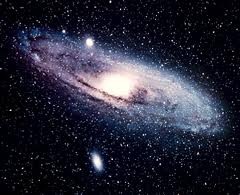
What is the Milky Way galaxy?
A massive collection of billions of stars that are all held together by gravity

What is the shape of a planet's orbit?
an ellipse

What is a satellite?
An object that revolves around another larger object in space
What are planets constantly doing and why?
They are constantly accelerating and changing velocity as they are constantly changing direction
What is the force that causes a planet to orbit?
- the gravitational force between the planet and the sun
- correct sideways speed
What does the fact that planet's are constantly accelerating mean?
there must be a force acting on it = centripetal force causes the acceleration of a planet
- direction of CF = centre of circle
- kinetic energy + speed is constant
3 changes which require an increase in centripetal force
- increase in mass
- increase in speed
- decrease in radius
For an object in a stable orbit, what must happen if the speed of the object increases?
the radius of the orbit decreases
higher speed = greater gravity required so moves closer to the Earth
What is the evidence for the continuous expansion of the universe
red-shift
What is red shift?
- light from most distant galaxies = wavelength has increased
- they have shifted towards the red end of the spectrum
- distant galaxies have a larger redshift so are moving away faster than closer galaxies

What does red shift suggest?
- distant galaxies have a larger redshift so are moving away faster than closer galaxies
- If galaxies are moving away from Earth, they must also be moving away from each other
- universe is expanding
- supports Big Bang Theory
How does red shift support the big bang theory?
- red shift suggests universe is expanding
- deduce universe was once smaller
- began from hot, dense, small region
What do observations of supernova from 1998 to the present day appear to show?
distant galaxies are moving away from us faster (the speed at which they are receding is increasing)
What do scientists currently think that most of the universe is made up of?
dark matter and dark energy which causes expansion
What is dark matter?
An unknown substance which holds galaxies together, but doesn't emit any electromagnetic radiation
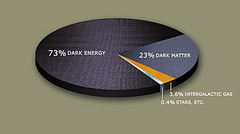
What is dark energy?
a mysterious force that appears to be causing the expansion of the universe to accelerate

Blue shift
- light waves are compressed when the galaxy is moving towards us
- wavelength is shortened or 'blue shifted'.
- galaxy is moving towards the Earth at high speed (Andromeda)
Cosmic Microwave Background Radiation
- evidence supporting the Big Bang
"Describe the Big Bang Theory" - 2 marks
- all matter began at a singular point in time
- explosion causes outward movement of matter = expansion
Explain why a star remains stable
- gravity and radiation pressure are balanced
Explain the difference between a protostar and a main sequence star
a protostar is at a lower temperature + does not emit radiation
- as no nuclear reactions have occurred