Muscular System
 Call Kai
 Learn
Learn Practice Test
 Spaced Repetition
 Match
Match Flashcards
 Knowt Play
1/66

There's no tags or description
Looks like no tags are added yet.
Name | Mastery | Learn | Test | Matching | Spaced | Call with Kai | Chat |
|---|
No analytics yet
Send a link to your students to track their progress
67 Terms
What are the three types of muscles?
skeletal, cardiac, and smooth
Which muscles are involved in voluntary movement and contain fibers with multinucleate cells?
skeletal
What are the filaments that are divided into sarcomeres?
myofibrils
What are the individual contractile units separated by a border?
sarcomeres (border is called Z line)
What liquid stores Ca2+ and surrounds myofibrils in muscle tissue?
sarcoplasmic reticulum
What is the same thing as cytoplasm, but located in muscle tissue?
sarcoplasm
What is the plasma membrane of muscle cells that can propagate action potentials?
sarcolemma
What are the channels for ion flow in the sarcolemma?
T-tubules
Sarcolemma wraps several myofibrils together to form what structure?
muscle cell (fiber)
What organelles are present in large amounts in myofibrils?
mitochondria
What is the structural unit of a myofibril in striated muscle?
sarcomere
A sarcomere is composed of what components?
thick and thin filaments
Thick filaments are composed of what unit?
mysoin
Thin filaments are composed of what units?
actin polymers
What is the boundary of a single sarcomere and anchors thin filaments?
Z line
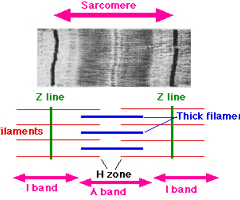
What is the center of a sarcomere?
M line
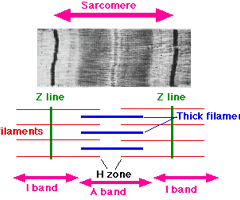
What is the region containing thin filaments (actin) only (on the ends) in a sarcomere?
I band
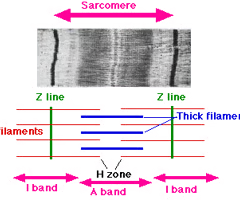
What is the region containing thick filaments (myosin) only (in middle) in a sarcomere?
H zone
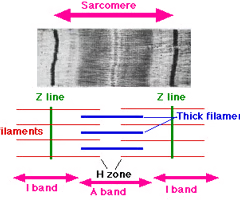
What is the area where actin and myosin overlap?
A band
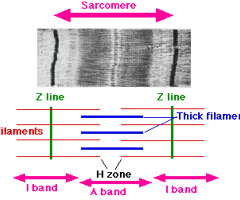
Which regions of the sarcomere reduce during contraction?
H and I (A does not)
Striations in muscle are the result of what?
alternating thin actin and thick myosin (I and A bands)
What action of the muscular system can aid in circulation?
contraction
(Note: squeeze blood and lymph vessels)
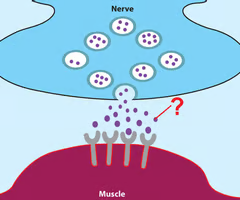
How does a neuronal action potential cross a neuromuscular junction to excite a muscle?
release acetylcholine across the cleft
When an action potential occurs on the sarcolemma, where does it propagate?
across the fiber and into T-tubules
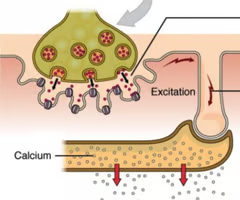
When an action potential travels down T-tubules, what does the sarcoplasmic reticulum release in response?
release Ca 2+
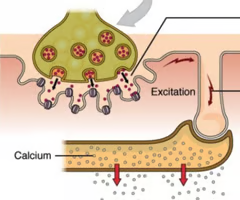
After the sarcoplasmic reticulum releases calcium, what occurs in the process of muscle contraction?
myosin cross-bridges form,
resulting in Ca2+ binding to
troponin on an actin helix
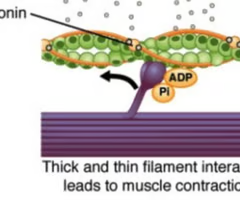
What happens to calcium at the end of each contraction cycle?
actively pumped back into the sarcoplasmic reticulum
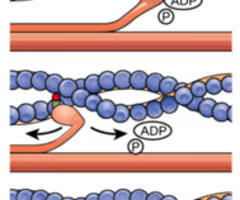
What are the steps of the sliding filament model?
1. ATP binds to myosin head
2. Ca2+ exposes binding sites on actin
3. Cross bridges between myosin heads
and actin filaments form
4. ADP + Pi are released
5. New ATP attaches to the myosin head,
causing cross bridges to unbind
What is a neuron and the muscle fibers it innervates?
motor unit
What depends on the number and size of active motor units and frequency of action potentials?
The force of contraction
What result occurs when a greater quantity of muscle fibers are activated by the brain rather than an increase in frequency of action potentials that stimulate muscle fiber contraction?
recuitment
What is the response of a single muscle fiber to brief stimulus?
simple twitch
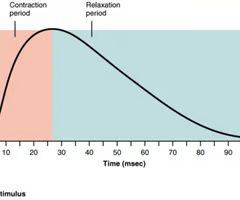
What are the steps of a simple twitch?
1. latent period
2. contraction
3. relaxation
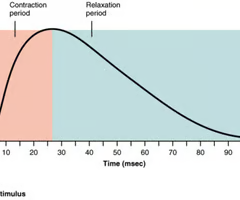
What step of a simple twitch is the time between stimulation and onset of contraction?
latent period
(Note: during this time, an action potential spreads on the sarcolemma and Ca2+ ions are released)
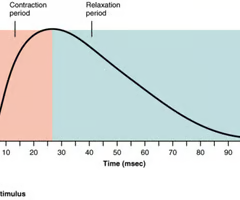
Which step of a simple twitch is the process of contraction following the sliding filament model?
contraction
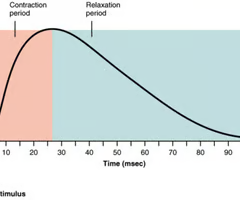
Which step of a simple twitch is the time where the muscle in unresponsive to a stimulus?
relaxation
(Note: absolute refractory period like neuron)
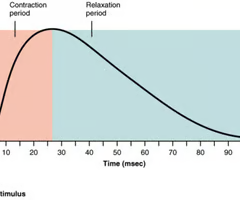
What is it called in a muscle when contractions combine and become stronger and more prolonged?
Summation
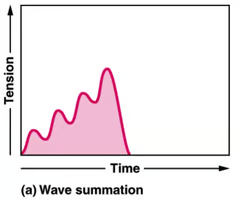
What is it called when a muscle experiences a continuously sustained contraction where a muscle cannot relax and will release if maintained?
tetanus
(Note: In tetanus, the rate of muscle
stimulation is so fast that twitches blend together into one smooth constant)
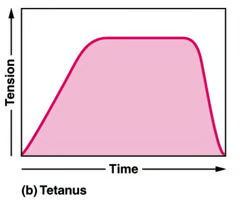
What is it called when a muscle is in a state of partial contraction where the muscle is never completely relaxed?
tonus
What stimulus causes no motor units to respond?
sub-threshold stimulus
What stimulus causes one motor unit to respond?
Threshold stimulus
what stim causes an inc number of motor units to respond?
sub-maximal stim
what type of stim causes all motor units to respond?
maximal stim
what components remain constant during an action potential?
Speed and amplitude (as stim intensity inc number of action potentials inc)
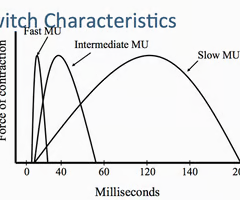
What type of twitch is type I skeletal muscle?
slow, lots of myoglobin storage, lots of mitochondria, aerobic endurance (split ATP at slow rate causing these fibers to be slow to fatigue but have slow contraction velocity), red, small diameter muscles
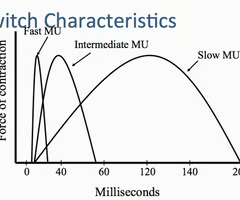
What type of twitch is type IIA skeletal muscle?
fast, lots of myoglobin storage, lots of mitchondria, aerobic and anaerobic unequally with split ATP at high rate and contract rapidly so faster to fatigue, pink, intermed diameter
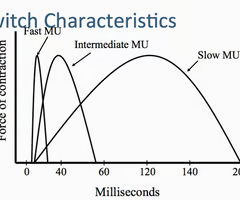
What type of twitch is type IIB skeletal muscle?
fast, low myoglobin so use glycolysis, low mitochondria, anaerobic endurance and split ATP fastest to fastest to fatigue, white, large muscle diameter
What happens during hypertrophy?
1. increase in diameter of muscle fibers
2. increased number of sarcomeres
3. increased number of mitochondria
4. increased sarcomere length
which type of muscle is mainly involuntary, contains one central nucleus, lacks striation, stimulated by the autonomic nervous system, and are slow to contract?
smooth muscle
(Note: lining of bladder, uterus, digestive tract, blood vessel walls, etc.)
What does smooth muscle rely on instead of sarcomere organization?
intermediate filaments are attached to dense bodies spread throughout the cell
how does contraction occur in smooth muscle?
Thick and thin filaments attached to intermediate filaments — contract — intermediate filaments pull dense bodies together — smooth muscle length shrinks
What type of smooth muscle is visceral; connected by gap
junctions, contract together?
single unit
(Note: found in stomach,
uterus, and urinary bladder)
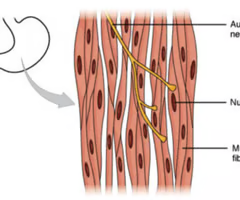
What type of smooth muscle describes when each fiber is directly attached to the neuron; can contract independently?
multi-unit
(Note: found in iris
and bronchioles)
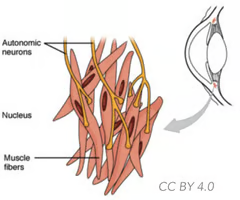
In addition to the neuronal response, smooth muscles can respond to what?
1. hormones
2. changes in pH
3. O2
4. CO2
5. temperature
6. ion concentration
What does smooth muscle use instead of troponin?
myosin light change kinase
(Note: Smooth muscle does not have T-tubules, striations, troponin, or tropomyosin)
What kind of muscle Has striations, can be multi-nucleated, has intercalated discs with gap junctions, contract involuntarily, and have lots of mitochondria?
cardiac muscle
What is the term describing the fact that both smooth and cardiac muscle are capable of contracting without stimuli from nerve cells?
myogenic
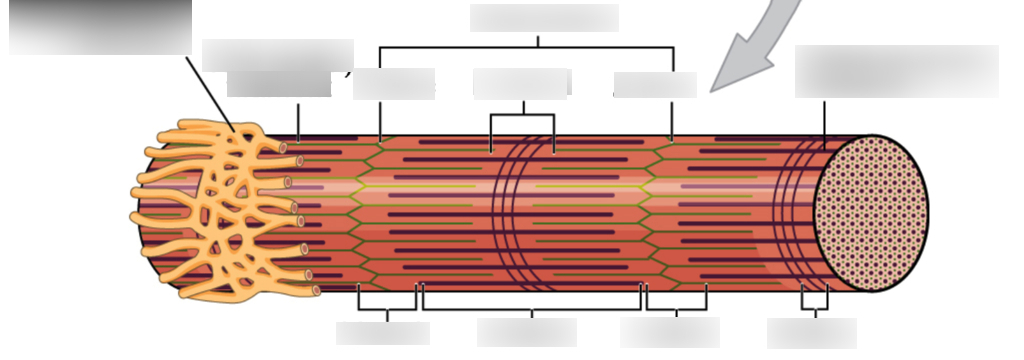
sarcoplasmic reticulum
(first box on top left)
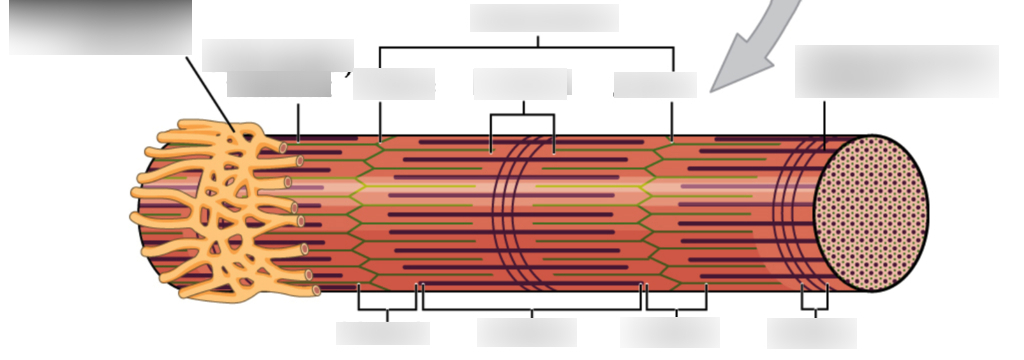
thin (actin) filament
(second box on top left)
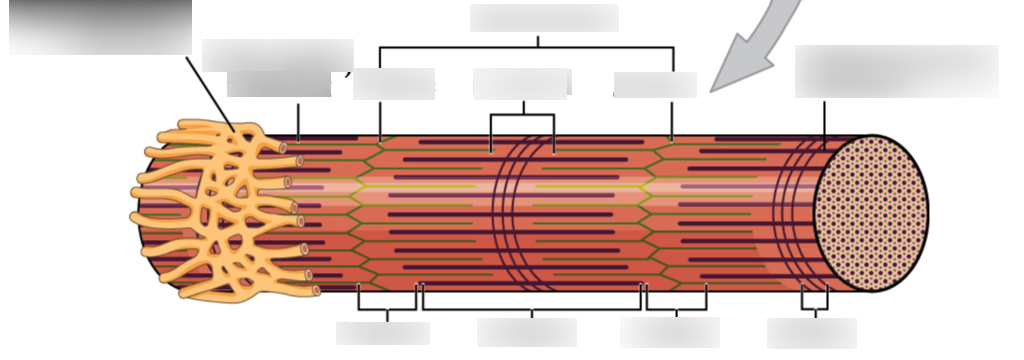
Z disc
(third box on top left)
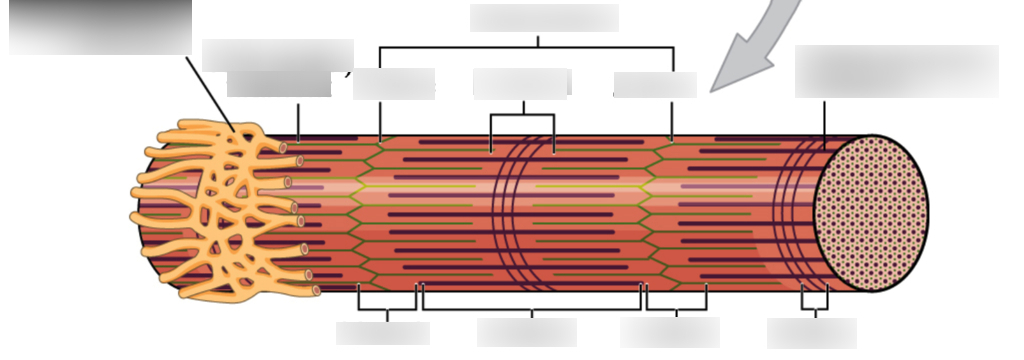
sarcomere
Middle uppermost top box
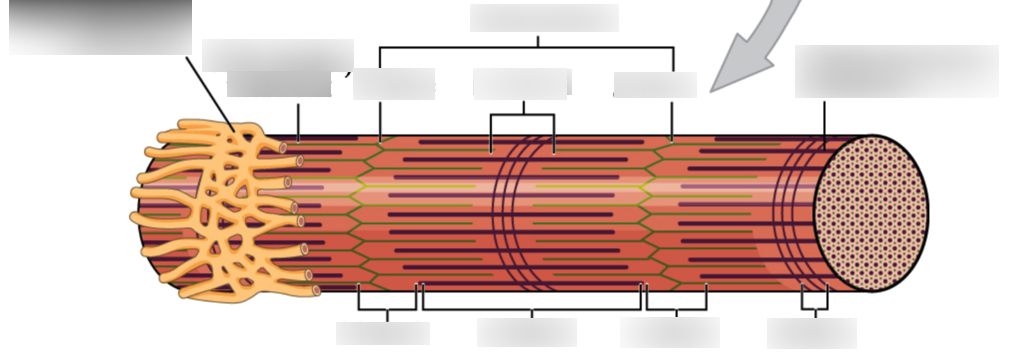
H zone
4th box from top left
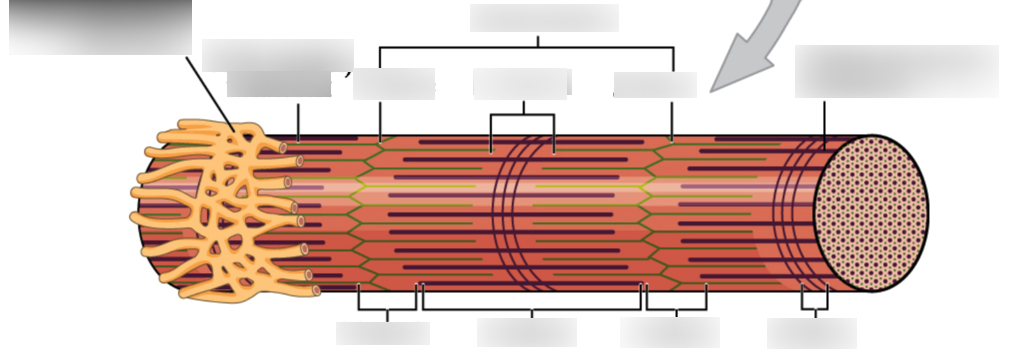
z disc
5th box from top left
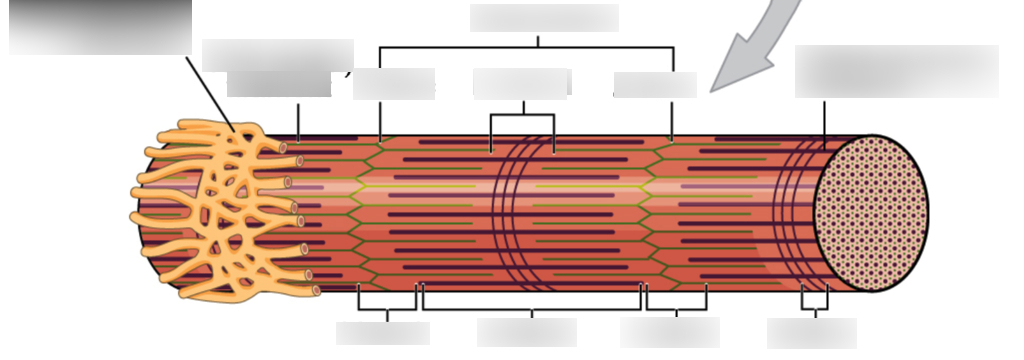
thick myosin filament
top right most box
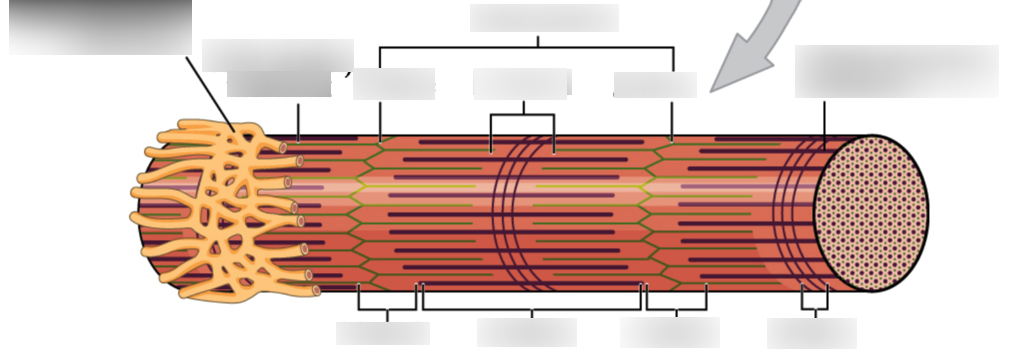
I band
Bottom left most box
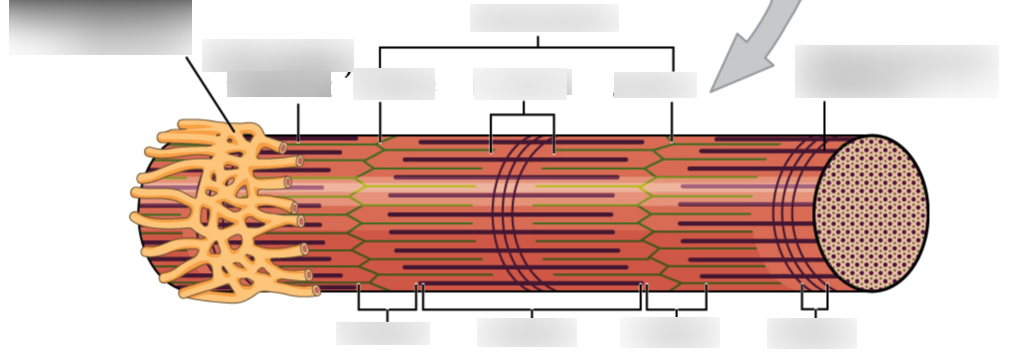
A band
bottom middle box
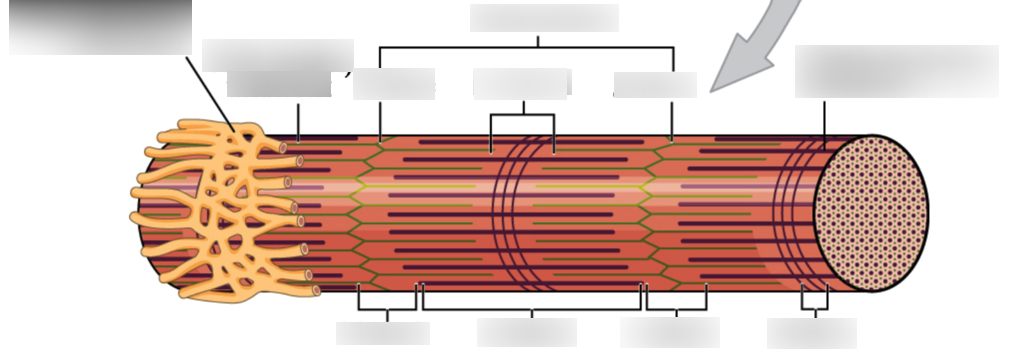
M line
bottom right most box