NPTE Final Frontier: Non-Systems Overview and Practice
 Call Kai
 Learn
Learn Practice Test
 Spaced Repetition
 Match
Match Flashcards
 Knowt Play
1/90

There's no tags or description
Looks like no tags are added yet.
Name | Mastery | Learn | Test | Matching | Spaced | Call with Kai | Chat |
|---|
No analytics yet
Send a link to your students to track their progress
91 Terms
Non-Systems
Categories of questions related to physical therapy that do not fall under specific systems.
Equipment, Devices, & Technologies
Assistive devices and technologies, prosthetic devices and technologies, protective, supportive, and orthotic devices and technologies.
Therapeutic Modalities
Thermal modalities, iontophoresis, electrotherapy, ultrasound, phonophoresis, mechanical modalities, biofeedback, intermittent compression.
Safety & Protection
Safety and injury prevention, lines, tubes, catheters, monitoring devices, mechanical ventilation/oxygen delivery, emergency preparedness, infection control, signs and symptoms of abuse and neglect.
Professional Responsibilities
Documentations, patient/client rights, legal issues, roles and responsibilities, ethics, billing, coding, reimbursement, laws and regulations, risk management and quality assurance, cultural, socioeconomic factors in patient care, health information technology, telehealth.
Research and Evidence Based Practice
Research methods and interpretation, data collection, measurements, accessing evidence, statistics.
Patient Rights
Health Insurance Portability and Accountability Act (HIPAA) ensures patient's right to continuity in healthcare.
HIPAA
Privacy and security of healthcare records, maintaining patient confidentiality in all forms, and requiring written consent before disclosing personal health information.
Core Values
Altruism, autonomy, professional judgment, and beneficence as guiding principles for physical therapists.
Altruism
PT shall adhere to the core values of the profession and act in the best interest of the patients over PT's interest.
Autonomy
PT shall provide all necessary information to allow patients to make informed decisions about care.
Professional Judgment
PT shall be accountable for making sound professional judgments.
Beneficence
Act of charity, mercy, and kindness with a strong connotation of doing good to others, including a moral obligation to do right.
Professional Responsibility
Responsibilities of healthcare providers to ensure trustworthy patient/client management and healthcare decisions.
Human Resources/Legal Issues
Includes concerns such as sexual harassment within the healthcare environment.
Roles and Responsibilities of Assistants
Duties and expectations of Physical Therapy Assistants (PTA).
Cultural Factors
Characteristics that affect patient/client management in healthcare.
Accrediting Bodies
Organizations such as state licensing entities, Joint Commission, CARF, and CMS that oversee healthcare standards.
Emergency Preparedness
Planning and readiness for potential emergencies in healthcare settings.
Infection Control
Practices to prevent the spread of infections in healthcare environments.
Data Collection
The process of gathering information for research and evidence-based practice.
Statistics
The study of data collection, analysis, interpretation, presentation, and organization.
Telehealth
The delivery of healthcare services through telecommunications technology.
SOB
Shortness of Breath
COPD
Chronic Obstructive Pulmonary Disease
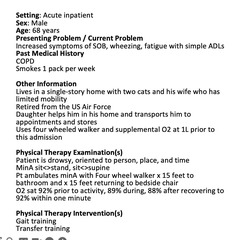
MinA
Minimal Assistance
O2 sat
Oxygen saturation level
Four wheeled walker
A mobility aid with four wheels used for support while walking
Gait training
Therapeutic intervention to improve walking ability
Transfer training
Therapeutic intervention to assist a patient in moving from one position to another
Power of Attorney
A legal document allowing one person to act on behalf of another
CVA
Cerebrovascular Accident, commonly known as a stroke
PT
Physical Therapist
PTA
Physical Therapist Assistant
PT Aide
Physical Therapy Aide, a support role in physical therapy
Professional Responsibility
The obligation of a PT to oversee the actions of a PTA in patient management
Plan of Care (POC)
A document outlining the treatment plan for a patient
Modify the POC
To change the treatment plan to include new modalities or exercises
Supervise a PTA student
The responsibility of a PT or PTA to oversee the training of a PTA student
Supervise a PT student
The responsibility of a PT to oversee the training of a PT student
PT Code of Ethics
Guidelines that govern the professional conduct of physical therapists
Trustworthy
Being reliable and dependable in professional practice
Compassionate
Showing empathy and concern for patients' needs
Accountable
Being responsible for one's professional judgments and actions
Informed Consent
The process of obtaining permission from a patient before treatment
Patient Refusal
When a patient declines to receive recommended treatment
Healthcare Record Access
The ability of individuals to view medical records of patients
Integrity in PT
PT shall demonstrate integrity in their relationship with patients/clients, families, colleagues, students, research participants, other healthcare providers, employers, payers and the public.
Legal and Professional Obligations
PT shall fulfill their legal and professional obligations.
Lifelong Learning
PT shall enhance their expertise through the lifelong acquisition and refinement of knowledge, skills, abilities and professional behaviors.
Organizational Behaviors
PT shall promote organizational behaviors and business practices that benefit patients/clients and society.
Health Needs Participation
PT shall participate in efforts to meet the health needs of people locally, nationally or globally.
Best PT Action for Patient in Crisis
Refer the patient immediately to mental health practitioner and stay there until help arrives.
Joint Commission on Accreditation of Healthcare Organizations (JACHO)
Accredits hospitals, SNF, home health agencies, PPO, HMO, mental health institutions.
Commission on Accreditation of Rehabilitation Facilities (CARF)
Accredits free standing rehabilitative programs/facilities.
Center for Medicare & Medicaid Services (CMS)
Determines what and how much will be reimbursed by Medicare for patient care.
Occupational Safety and Health Administration (OSHA)
Responsible for determining the safety of the work environment.
Safety and Protection
Refers to the critical issues involved in patient/client safety and protection and the responsibilities of health-care providers to ensure that patient/client management and health-care decisions take place in a secure environment.
Emergency Preparedness
Includes CPR, first aid, disaster response.
Infection Control Procedures
Includes standard/universal precautions, isolation techniques, sterile technique.
Signs of Abuse and Neglect
Includes signs/symptoms of physical, sexual, and psychological abuse and neglect.
Safety Factors
Factors influencing safety and injury prevention include safe patient handling, fall prevention, equipment maintenance, environmental safety.
Intravenous Lines and Devices
Function, implications, and related precautions of intravenous lines, tubes, catheters, monitoring devices, and mechanical ventilators/oxygen delivery devices.
PTA Precautions for Pneumonia
Airborne precautions, N-95 respirator.
Isolation Types
Contact, Droplet, Airborne.
Droplet Precautions Examples
Mumps (Rubella), Streptococcus A, Neisseria Meningitidis, Pneumonia, Influenza, Pertussis.
Airborne Precautions Examples
Measles, Tuberculosis, Varicella, SARS, Disseminated Herpes Zoster, Chickenpox, Smallpox.
Clinical Syndromes
MRSA, VISA, VRE, Clostridium difficile, Lice, Scabies, Impetigo, Gram Negative Bacteria, Uncontrolled Diarrhea, Aminoglycoside resistant, Hep-A, Hep-B, Dermatitis, Rota Virus.
Hand Hygiene
Hand Wash before entering and after leaving the room.
Hand Wash
Hand Wash upon entering and leaving the room.
PPE
Gloves and Gown only when in direct contact with patient or items in patient room. (Remove before leaving the room).
Mask
Mask when working within 3 feet of patient.
Contact precautions
Contact precautions only when skin lesions present.
N-95 Mask
N-95 Mask (Fit Tested).
Severe contamination precautions
Gown and Gloves if severe contamination.
Discard mask
Discard mask upon leaving the room.
Private room
Private room or cohort patient with same infection.
Private room without negative air flow
Private room without negative air flow.
Private room with negative air flow
Private room with negative air flow. Keep door closed.
Patient Transport
Minimize transport and patient washes hands if they leave the room.
Patient surgical mask
Patient wears a surgical mask when leaves the room.
Cough etiquettes
Patient follows cough etiquettes.
ABUSE
Infliction of physical or mental injury or the deprivation of food, shelter, clothing or services needed to maintain physical or mental health.
Sexual abuse
Sexual assault, sexual intercourse without consent, indecent exposure, deviate sexual conduct, or incest adult using a child for sexual gratification without physical contact is considered sexual abuse.
Physical abuse
Physical injury results in pain, impairment or bodily injury of any bodily organ or function, permanent or temporary disfigurement or death.
Emotional abuse
Anguish inflicted through threats, intimidation, humiliation isolation, embarrassing, blaming or rejecting behaviors from adult towards child, withholding love affection and approval.
Mental abuse
Impairments of a person's wellbeing, intellectual or psychological functioning.
Lifting Guidelines
Always attempt to increase your base of support, maintain a proper lumbar curve while you lift, pivot your feet while lifting; do not twist your back, maintain a slow and consistent speed while lifting.
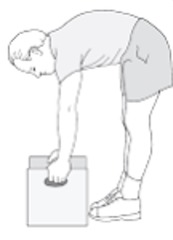
Compression forces
The MOST significant factor in increasing compression forces on the spine in addition to the weight of the wine box is the distance of the wine box from the base of the spine.
Ergonomic Guidelines
Workstation Recommendations: 18-20-monitor, monitor display should be 10 degrees below the horizontal, should be 20 inches away from the eyes, wrist rest should match the front edge of the keyboard for maximal comfort, use a mouse that contours the hand, space under the desk should be at least 30 inches wide, 19 inches deep, 27 inches in height, should be 2-3 inches between the top of the thighs and desk.
Low back pain intervention
Patient education to take multiple breaks throughout the day, obtain a chair with proper lumbar support, and move monitor closer to client.