Art History Survey 1 Test 1
 Call Kai
 Learn
Learn Practice Test
 Spaced Repetition
 Match
Match Flashcards
 Knowt Play
1/10

There's no tags or description
Looks like no tags are added yet.
Name | Mastery | Learn | Test | Matching | Spaced | Call with Kai | Chat |
|---|
No analytics yet
Send a link to your students to track their progress
11 Terms

Venus of Willendorf
ca. 28,000–25,000 BCE
• Natural material and small size reflect
nomadic, hunter-gather way of life.
• Large breasts, swollen stomach, bent knees
suggest childbirth or at least fertility.
• Lack of individual identity (no face!) argues
against the idea that it representing a specific
person or divinity.
Paleolithic
Paleolithic 30,000-9,000 BCE
Paleolithic art is found deep within the caves and wherever they leave it
Subjects in paleolithic art? pregnant women, animals, animal/human hybrids
How does the art function in paleo. Society?
Art maybe being pagan ritualistic magic?
Maybe controlling fertility?
Maybe food?
Neolithic
Neolithic 8,000-2,300 BCE
How did they live? they were more settled like walls of Jericho
How did they feed themselves? Farming, hunting animals, domesticating them.
what materials did they use to make art? Plasters and they constructed their own materials.
Where was the art found? Where they lived
Common subject matter? People's faces, hunting, Building themselves agricultural sun dome
How did the art function in society? To make and control things
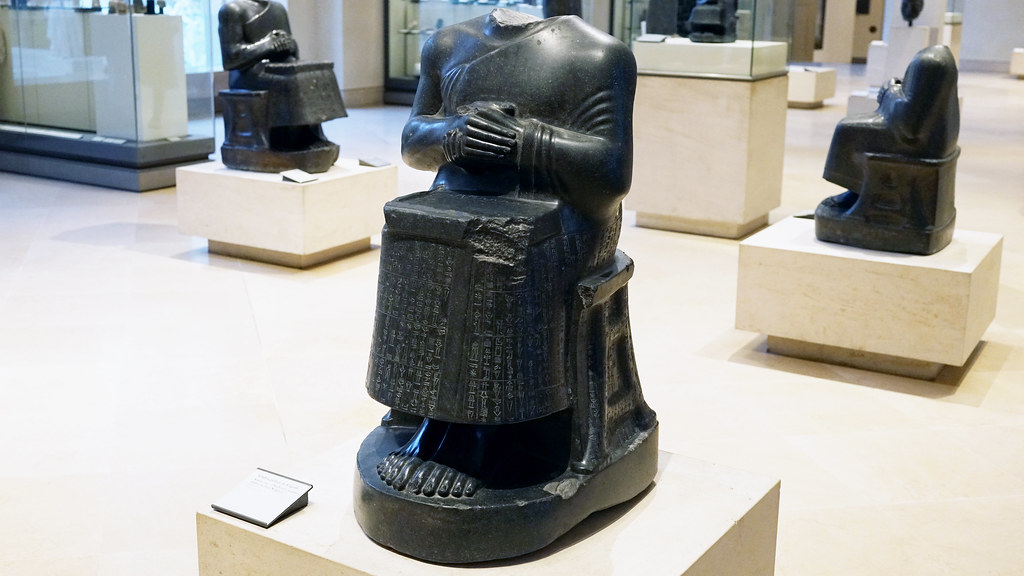
2-16 Neo-Sumerian, Gudea with Temple
Plan, ca. 2100 BCE
The name Neo-Sumerian indicates how this culture attempted to revive Sumerian culture after the end of Akkadian rule. This statue was a temple dedication and recalls Sumerian temple dedication in their folded hands and inscription indicating that they were offerings to the gods (fig. 2-5). This temple offering was made by the Neo-Sumerian leader wearing Sumerian style clothing with there is no indication that he considers himself divine (which parallels Sumerian leadership and is a contrast to Akkadian kings). However, it would be difficult to mistake this work as Sumerian. This statue is large and made of expensive imported stone, and his offering to the gods is not just this statue, but the temple whose plans are depicted on his lap. Indeed, Gudea claims to have constructed more than fifteen temples.
Part of a conscious revival of Sumerian culture after rule by divine Akkadian leaders
Traditional Sumerian temple dedication in clothing, folded hands, and inscription
Larger, more expensive stone, and offers a much grander gift to the god than in Sumerian culturTe
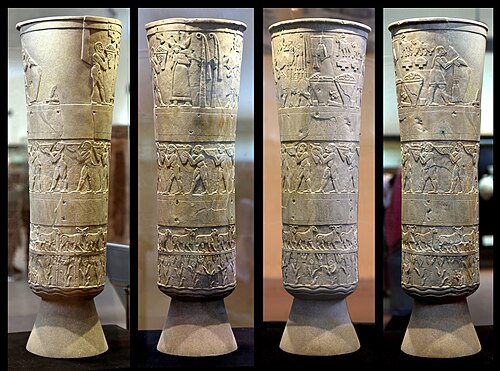
2-1 Sumerian, Warka Vase, ca. 3200–3000 BCE
he Warka Vase, a Sumerian piece made of alabaster between the years of 3200-3000 BCE, has an interesting way of depicting nature and offerings while also being a religious gift. The bands around the vase are stacked on top of each other and each representing a heirarchy, but theyre all still important gifts to worship the goddess, Inanna, that this vase was made for. The bands of grain and animals might be what they are asking for, while most of the actual vase has pictures of the people worshiping the goddess to make sure she keeps the people in her prayers when she is distributing gifts. The vase shows people actively bringing baskets of goods to the Goddess from the high priest?king to sort through.
Style- the vase shows humans depicted nudely except for the important figures like the king and the goddess. Though the art has more detail in comparison to earlier art pieces, the figures still look flat with profile faces and bodies. The layered art that tells a story is very common in the Mesopotamian period.
Context- the high priest was the mouth of the gods and was the one who could speak to them directly and repeat their wishes. The Summarians beleived in the multiple gods who all had roles and distracts of power. Inanna was the goddess of love, sex, war, and political power.
Meaning-This vase was used as a religious artifact what could hint at what powers the Sumarians treasured the most and gives us an insight to their roles. This was a written record of what they beleived and how they depicted themselves as well as their political structures.

2-13 Akkadian, Victory Stele of Naram-
Sin, 2254–2218 BCE
Originally erected in Mesopotamia (likely Sippar) and later seized by Susa, Iran, as war booty, it stands about 2 meters tall and now resides in the Louvre.
This picture shows us an earlier Mesopotamian use of horizontal registers; instead of a singular diagonal mountain slope, it carries a dynamic, upward march.
Naram-Sin dominates the composition in hierarchical scale, striding up the mountain over defeated enemies often identified as the Lullubi while his disciplined troops advanced below.
He wears a horned helmet, a divine attribute, signaling the Akkadian ideology of sacral kingship and the ruler's exceptional status.
The stele functions as royal propaganda, uniting military conquest with divine sanction and orders. Above him, the star-like symbols signify divine favor.
Lullubi (mountain people of the Zagros region).
3-5 bullet points
Pink sandstone that is approximately 6'7 high.
Horned helmet on the king.
The star symbol represents divine favor.
Hierarchical scale places the king above soldiers and enemies, portraying symbols suggesting divine approval.
During earlier times with the Sumerians, they used a single, ascending diagonal ground line to create a continuous narrative hierarchy and movement.
Divine kingship: by wearing a horned helmet and towering above all others, Naram-Sin presents himself as the chosen one or even as one defied by the Gods. The stele thus limits his rule.

- figure 1-20 (Stonehenge) Salisbury Plain, England 2250-1600 BCE
Stonehenge is located in the Salisbury Plain, England and was crafted around 2550 to 1600 BCE. During this time, farmers were trying to create a way to control or understand the weather in order to make crops grow.
The Neolithic period was a farming era, where many people largely depended on crops rather than hunting, so their need for a reliable source for when to plant crops was extremely important.
Stonehenge is made up of dozens of large rocks called bluestones (9000 pound stones arranged in the center of the site) and sarsan stones (hard stones around 55000 pounds that were shaped for the structure) . The circle has a diameter of 97‘ and the trillithons are 24‘ high.
the stones were used for solar alignments, the heel stone in specific marks the point where the sun rises at summer solstice. This is shown when the light passes through the heel stone (two stones with a gap in the center)
bullet points
massive 55 ton stones were arranged to show solar and lunar alignments.
The stones were transported large distances specifically for the purpose of creating Stonehenge, with the bluestones (smaller 9 ton stones) coming from about 125 miles away and the sarsan stones (larger 55 ton rocks) coming from about 18 miles away.
Stonehenge is made up of large upright stones arranged in circles with horizontal stones connecting some of the upright stones. This is one of the most widely known structures crafted in the Neolithic period.
the careful placement of the stones shows the Neolithic peoples close attention to the natural world and observation to lunar and solar alignments.
Researchers have a theory that the people who created Stonehenge may have used it for spiritual or religious practice, with some scattered graves in the nearby area, it is plausible that the community that Stonehenge belonged to used it as a highly significant part of their lives in a spiritual or traditional way.

Fig. 1-11, Paleolithic, ", Aurochs, Horses, and Rhinoceroses at Chauvet Cave" (Location Vallon-Pont-d’Arc, Ardèche, France) ca. 30,000-28,000 BCE (or 15,000-13,000 BCE)
* This painting was made quite early in the paleolithic, being painted deep within the Chauvet cave (as most cave paintings were). Since paleolithic people did not reside deep in cave systems, the Chauvet cave painting's location suggests a special ritual meaning rather than decorative or instructional purposes, considering the effort required to get to its location.
*Animals depicted in the Chauvet cave paintings have horns facing the 'correct way' via modern artistic standards, differentiating itself from the 'twisted angle' of other paintings (like the Lascaux cave system). However, notice how the date is actually near the beginning of the paleolithic, and much earlier than 16,000-14,000 BCE (the date of the Lascaux cave system). Because the 'artistic improvement' occurred at an earlier date, such differences can be chalked up to personal style rather than a trend of improvement in artistic skill. Furthermore, one can assume from the lack of change in artistic style over thousands of years that paleolithic 'artists' were more focused on cultural purposes rather than artistic ones (material culture).
*Animals depicted in the Chauvet cave were large game unlikely to be hunted by paleolithic peoples. Therefor, it was unlikely these paintings were meant for improving hunting of those animals. Rather, the pictures could be 'spirit animals', or potentially capturing migration patterns/seasons (location of animals was dependent on season).
Bullet points-
*Deep in caves, not mouth of cave. Not for decoration, probably significant ritual
*Animals depicted were strong, not typically hunted. Potentially spirit animals (strength of a rhino, speed of a horse) or tracking animals in location, not hunting luck.
*Forward facing horns, not twisted perspective! Made earlier in paleolithic though, so not a sign of artistic improvement, rather of personal style and material culture.
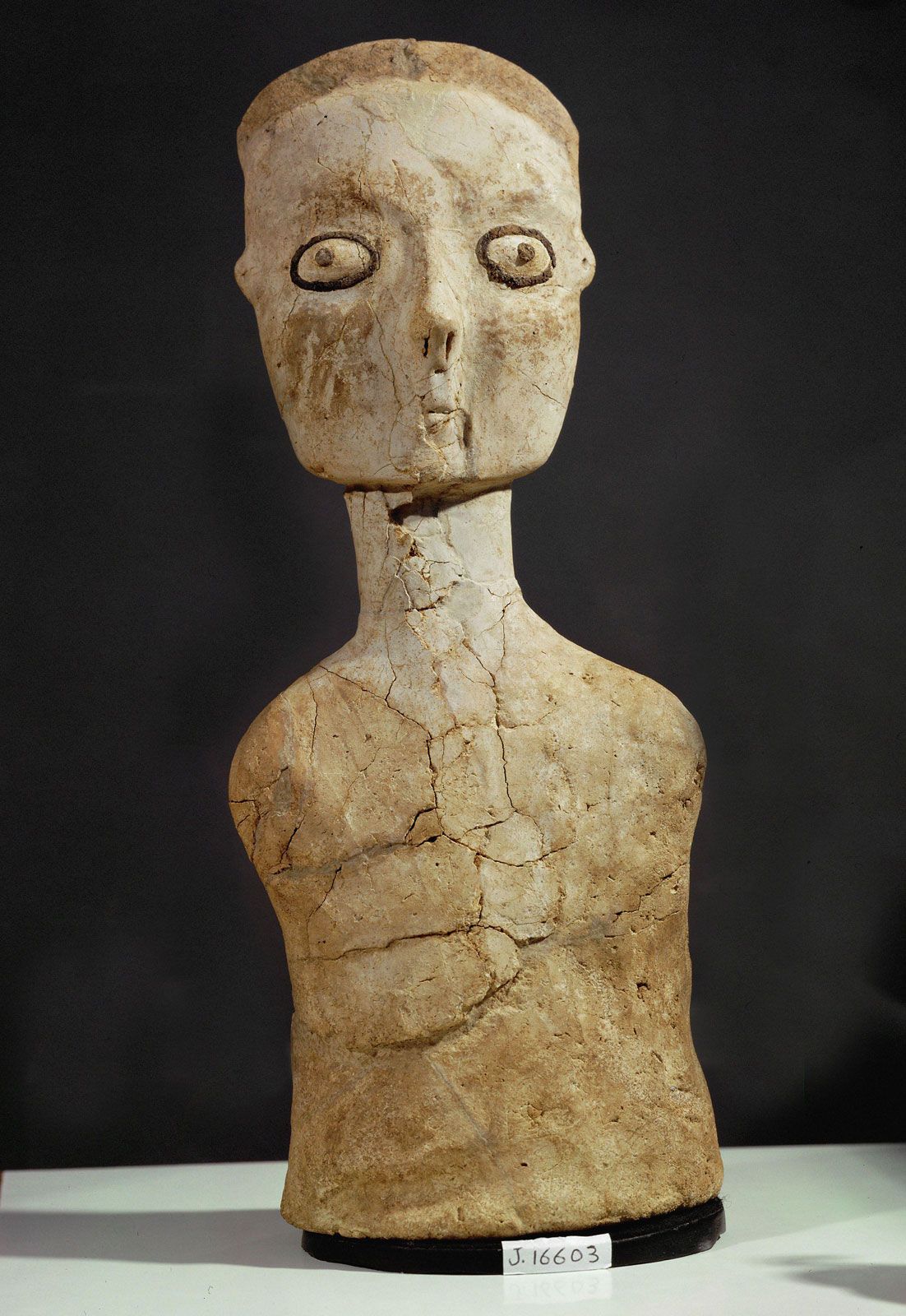
Neolithic, Human figure from Ain Ghazal, ca.
6750–6250 BCE
The Neolithic region where this sculpture was created was called, Ani Ghazal, located in ancient Palestine from 7200-5000 BCE. The people who occupied Ain Ghazal mainly used plaster, reed, and twine for the construction of their settled towns and farms. The Neolithic Period also introduced the practice of creating pottery and detailed sculptures.
The Human Figure is heavily detailed with fingers, a full face with ears, and a painted scalp, contrasting the simple cave painting and faceless sculptures found in the Paleolithic period. However, the sculpture is in a static pose, so it is clear the human figure was created in the early years of the Neolithic Period.
This Human figure surpasses the 1-foot feline-headed human sculpture. These sculptures could have been used as a monument in the town of Ain Ghazal, representing leaders or its population.
Bullet Points-
Heavily detailed human sculpture with a face, emphasizing developed craftsmanship
Displayed in the town of Ain Ghazal as a monument, or figure of worship.
Influenced detailed human-like sculptures in Mesopotamia and was buried for a ritual confirming its importance to the Ain Ghazal people.

Fig. 2-5, Sumerian, "Statuettes of Worshipers" (from the Square Temple at Eshnunna/Tell Asmar, Iraq), ca. 2700 BCE
-The statues were found inside a temple, and were made of somewhat expensive limestone which would be hard to come by, suggesting these pieces were offerings for the gods who 'resided' in the square temple.
-An important thing to note is what the subjects of the piece are doing. They are standing attentively, looking upwards (with wide eyes) holding offerings. This was part of a trend in Sumerian offerings where the sacrifices would depict the act of sacrifice itself (i.e the Warka vase), almost as if they are reminding the gods of their piety and gifts to hopefully receive favor.
-The statuettes also demonstrate a hierarchy of size and material present in Sumerian artwork. The materials used to depict the worshipers had worth, and they were sizeable (2'6'' high). However, the Sumerian female head (ca. 3200-3000 BCE, likely a cult statue of the Goddess Inanna), would have been of much greater scale when in full repair, and was made using much more expensive gems and marble. The difference between these two pieces suggests 'status' was represented by size (being physically larger) and material (using more expensive stuff in depiction)
Bullet Points:
Statuettes likely offering to some god based on temple location and materials used
Represented trend of depicting the act of offering in offerings.
Potentially suggests more transactional relation between humans and gods
Difference and size and material between statuettes and other pieces suggests size and material represent status of subject.

Babylonian, Stele of Hammurabi, ca. 1780 BC
The figure from 1780 depicts a leader being granted authority by a god, specifically (more than likely) the laws of Hammurabi's Code. This piece is reflective of the common law of the region. The Babylonians created it to show the king's authority after the sun god extended the right to govern, build, and judge. The Babylonian king is raising his hand out of respect for the god sitting on the throne, additionally gifting the king a rod and a ring. The actual laws are inscribed on the stone on the back/bottom/sides of the sculpture, which explains how King Hammurabi ruled every part of a Babylonian's life. It is important to note that they are shown wearing headdresses and beards, which makes them automatically seen as a higher authority.
Individuals wearing headdresses and beards to show authority/upper class
The king is gifted authority to rule by the god with rod and ring
Hammurabi's Code is inscribed on the sculpture to elevate the degree to which the king rules