DAT Biology: Excretory System
 Call Kai
 Learn
Learn Practice Test
 Spaced Repetition
 Match
Match Flashcards
 Knowt Play
1/32

There's no tags or description
Looks like no tags are added yet.
Name | Mastery | Learn | Test | Matching | Spaced | Call with Kai | Chat |
|---|
No analytics yet
Send a link to your students to track their progress
33 Terms
Excretion
Process by which metabolic wastes are filtered out of the blood and removed from the body as urine
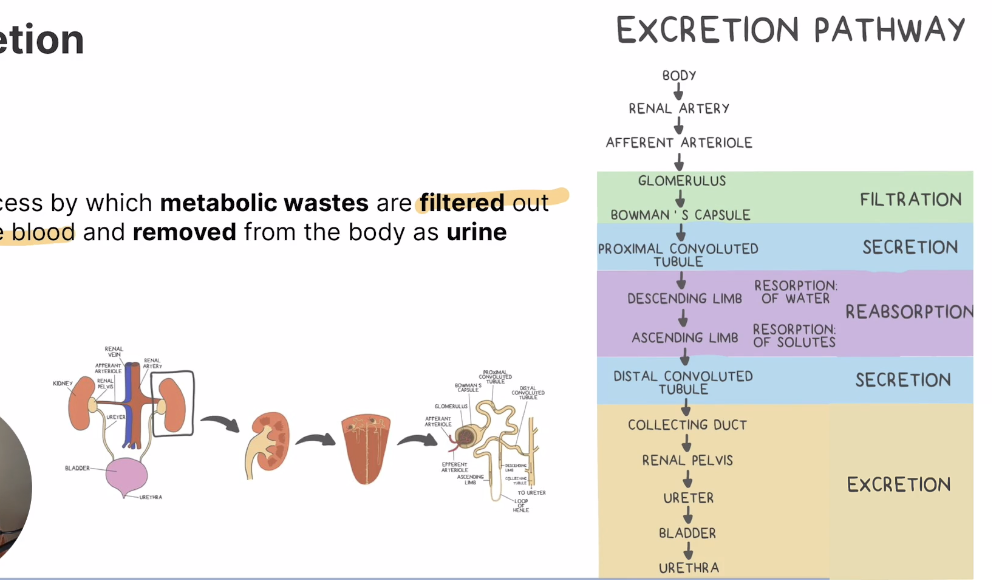
Kidney
Responsible for the filtration of the blood and the preparation of a urine product for excretion
Regulates blood pressure, pH, and stimulates generation of red blood cells
Structural Components: Outer Cortex and Inner Medulla
Nephron
Functional unit of the kidney
Main Structures: glomerulus, proximal convoluted tubule, loop of henle, distal convoluted tubule, collecting duct
Renal Corpuscle
First structure of the nephron containing the glomerulus and Bowman’s capsule
Site of filtration within the renal CORTEX
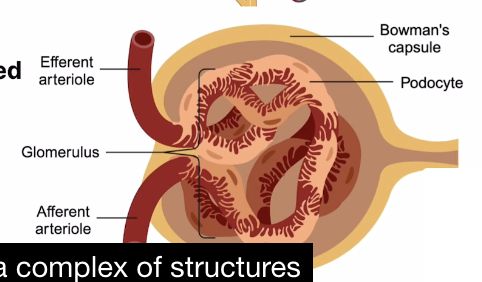
Glomerulus
Series of capillaries existing within the renal corpus, surrounded by Bowman’s capsule
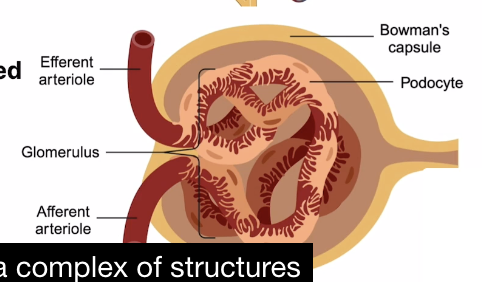
Bowman’s Cpasule
Surroundings the glomerulus, part of the renal corpuscle, where you see some filtration of the blood
Afferent Arteriole
Blood vasculature that enters the renal corpuscle providing nutrient-rich blood for filtration
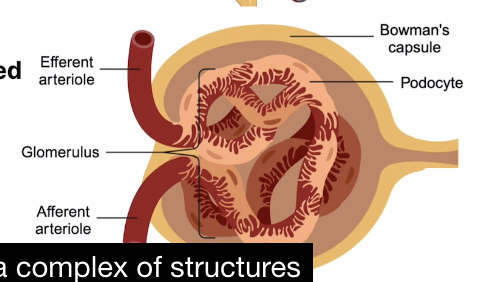
Podocytes
Foot-like processes that form a fenestrated filtratino barrier, providing specificity to filtration. increasing filtration selectivity in the renal corpuscle
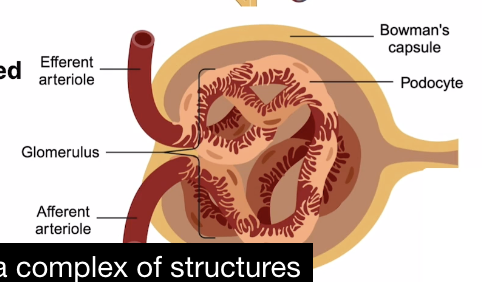
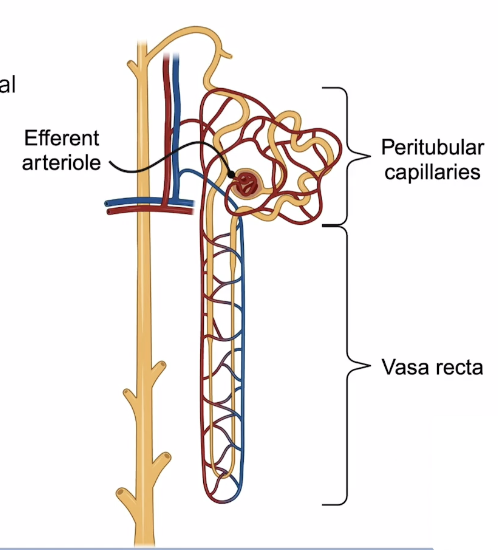
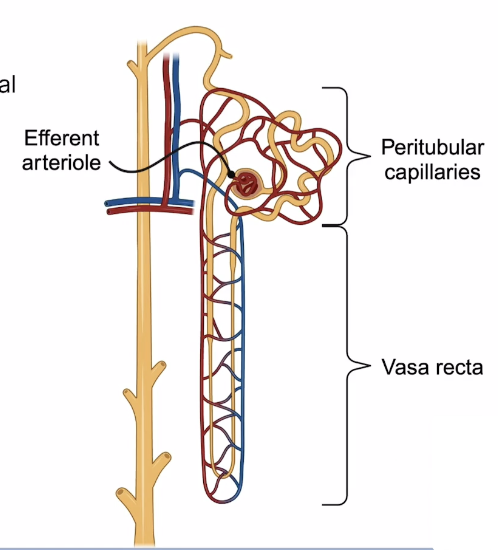
Efferent Arteriole
Blood vasculature that exits the renal corpuscle, can form the peritubular capillaries or the vasa recta
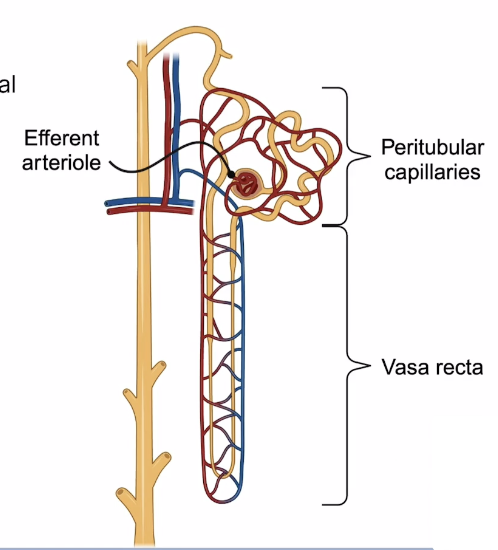
Peritubular Capillaries
Blood vessels surrounding the convoluted tubules
Convoluted Tubules
Winding, coiled sections of the kidney’s plumbing system that processes fluid after blood is filtered in the Bowman’s capsule
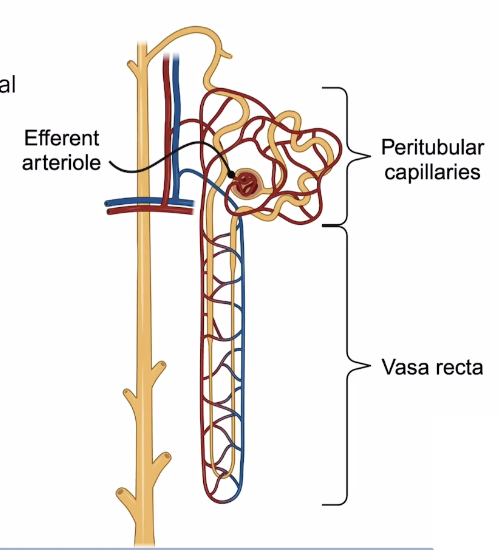
Vasa Recta
Blood vessels surrounding the loop of Henle
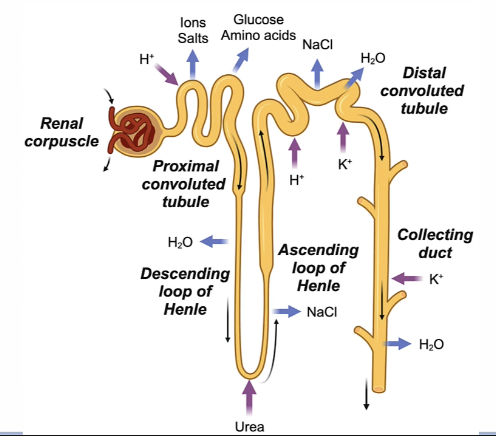
Proximal Convoluted Tubule
Site of the majority of reabsorption via active transport and cotransport
Reabsorbed: Na+, Cl-, 100% of reabsorbed glucose and amino acids
Secreted: H+
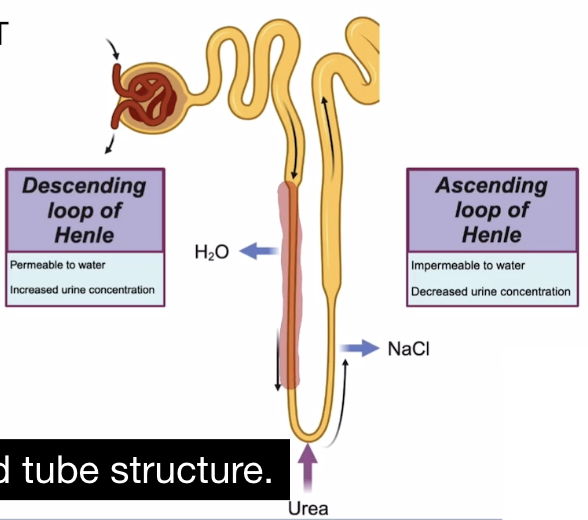
Loop of Henle
After proximal convoluted tubule, it is the nephron tube that descends into the kidney medulla and exists between the convoluted tubules
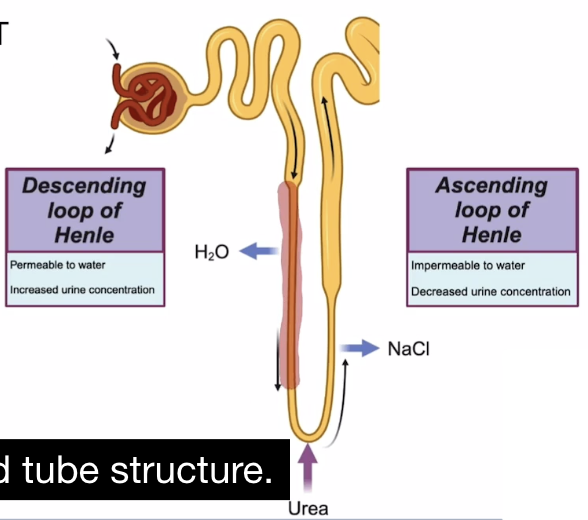
Contains a descending and ascending limb
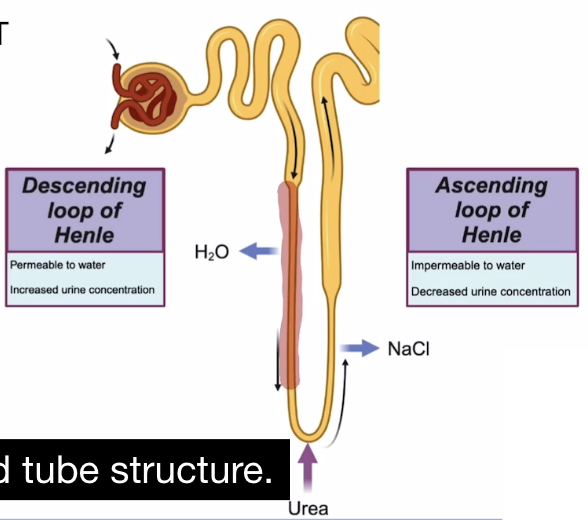
Descending Limb
Descends into the medulla from the proximal convoluted tubule, first part of loop of Henle
Permeable to water, water flows out of the urine into the blood and urine concentration increases
Ascending Limb
Ascends out of the medulla connecting to the distal convoluted tubule, second part of the loop of Henle
Impermeable to water, ions and salts flow out of the urine so urine concentration decreases
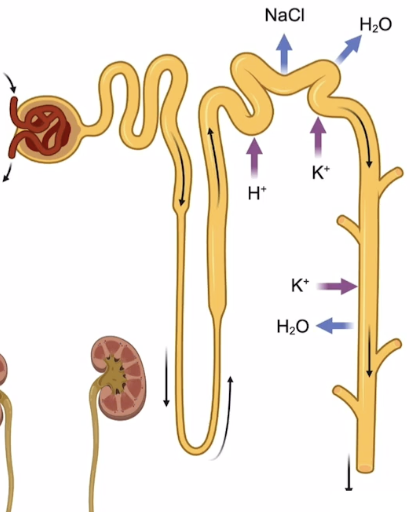
Distal Convoluted Tubule
Reabsorption of Na+ and Cl-, secretion of K+ and H+, water passively follows reabsorbed salts
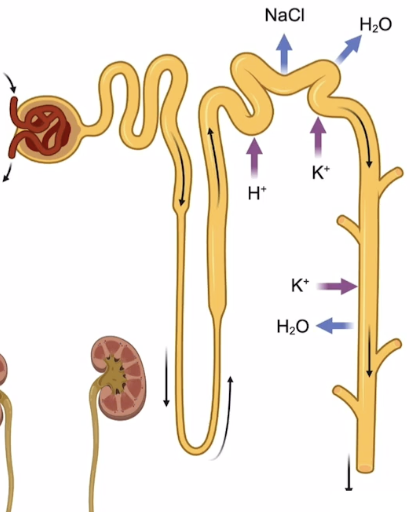
Collecting Duct
Bulk passive reabsorption of water, secretion of K+
Urine concentration increases
Excretory Hormones
Capable of maintaining blood volume and blood pressure as well as the relative concentrations of molecules and substrates within the blood and the filtrate
Renin-Angiotensin-Aldosteron System
System of hormones, tissues, and organs capable of increasing blood pressure in response to detected low blood pressure
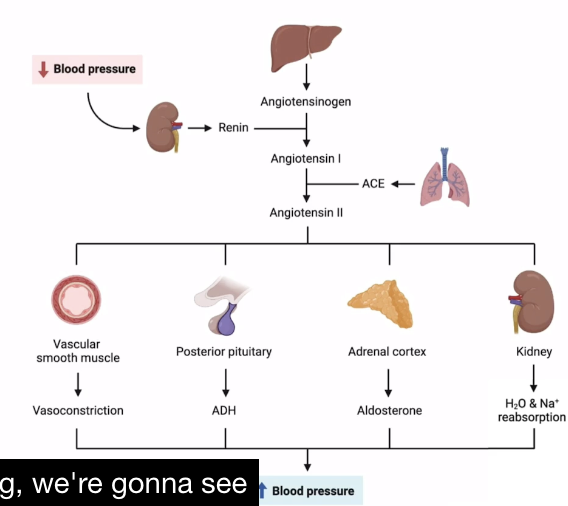
Juxtaglomerular Cells
Modified smooth muscle cells associated with the afferent arteriole
Capable of detecting changes in bp and blood volume
Release renin in times of low blood pressure
Renin
Enzyme capable of converting angiotensinogen (released from the liver) into its activated form, angiotensin I, also often stimulated by fight/flight response
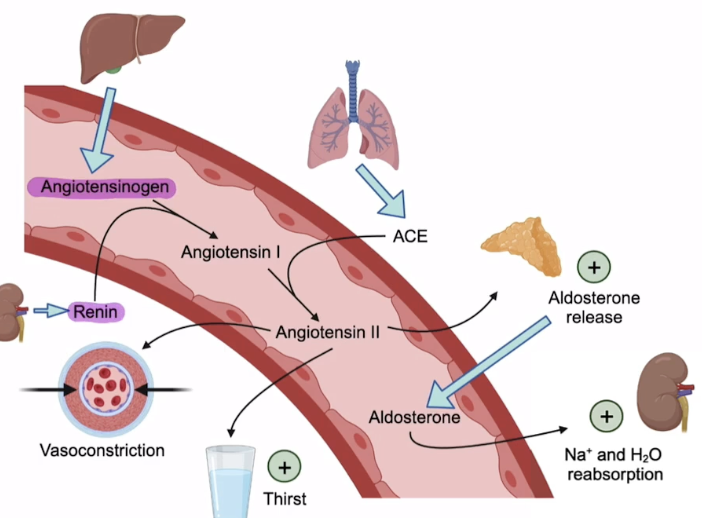
Angiotensin Converting Enzyme (ACE)
Enzyme capable of converting angiotensin I into angiotensin II, released from walls of blood vessels in the lungs
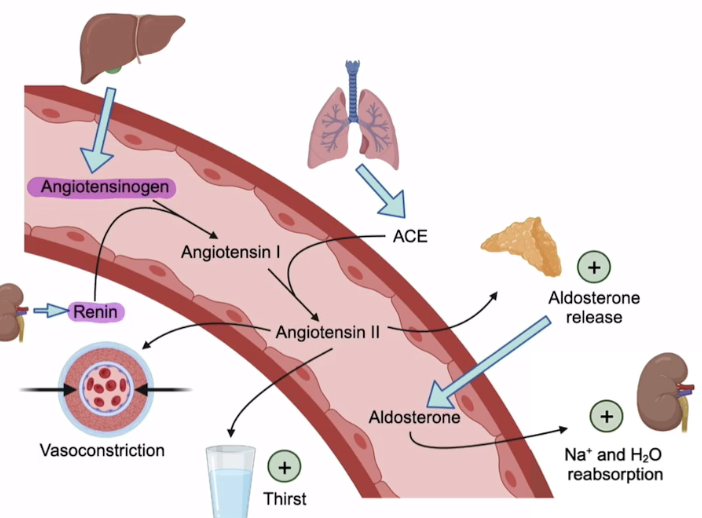
Angiotensin II
Increases blood pressure and blood volume
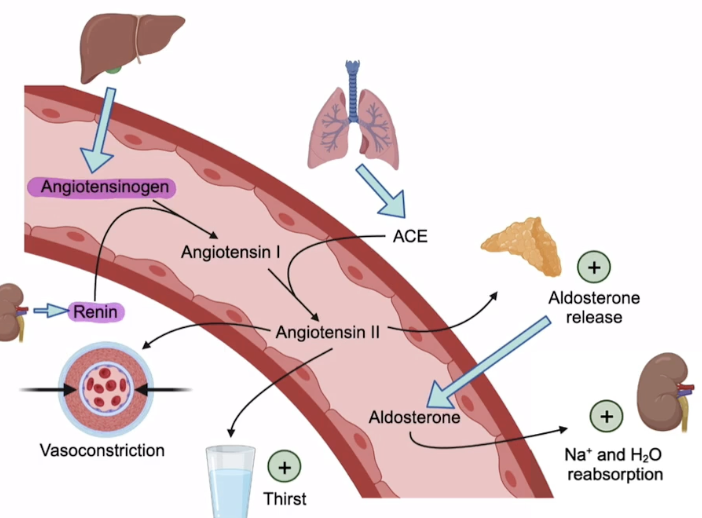
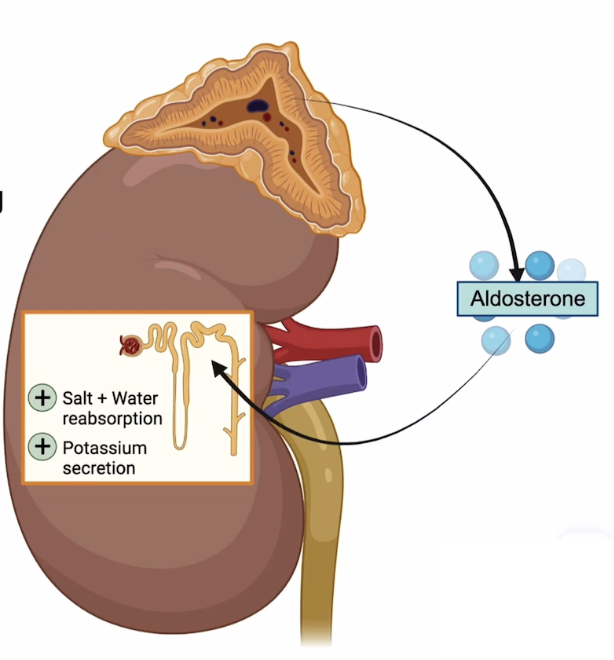
Aldosterone
Mineralcorticoid released from the adrenal gland that affects the kidney, acting on distal tubules and collecting ducts of nephrons
Actions at Nephron: increase water and soidum reabsorption and increases potassium secretion
Antidiuretic Hormone (ADH or V asopressin)
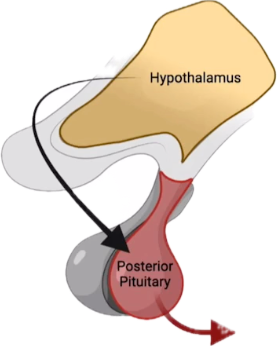
Produced in hypothalamus
Stored and released by the posterior pituitary gland
Capable of increasing blood volume and pressure
Effect: increases aquaporin channel presence within the collecting ducts, increasing water absorption
Alcohol
Inhibitor of ADH, less water is reabsorbed, causing increased urination
Atrial Natriuretic Peptide (ANP)
Produced by the cells of the heart atrial cells in response atrial distension caused by increased blood volume and pressure
Atrial Distension
Stretching or enlarging of an upper heart chamber (atrium), when too much blood/pressure pushes against inner walls of heart.
Over time, stretching can change the heart’s shape and lead to rhythm problems.
Osmoregulation
Maintenance of internal water balance by an organism, achieved by absorption and secretion of water and solutes
Impacted by water/solute concentrations of the surrounding environment
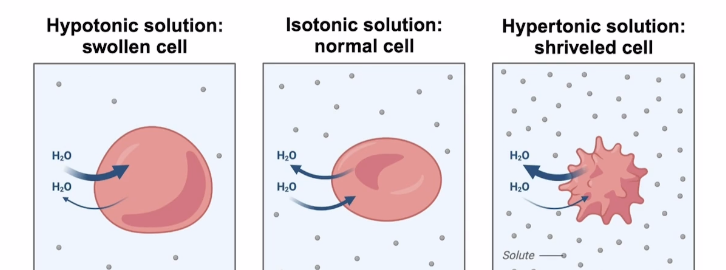
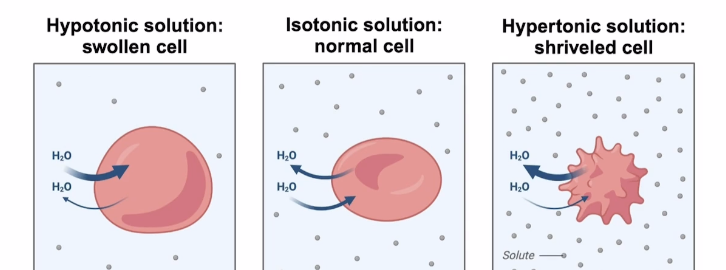
Hypotonic Solution
Lower solute concentration than inside of the cell, causing water to rush into the cell, making the cell swell and potentially burst (lysis)
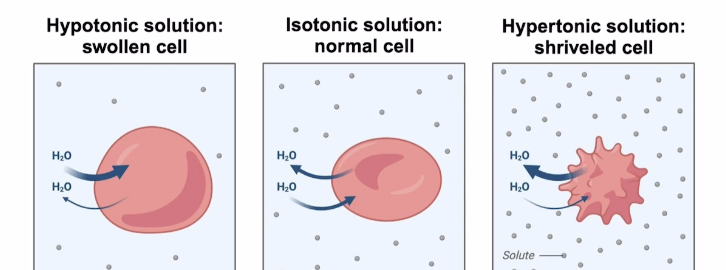
Isotonic Solution
Same solute concentration as cell, resulting in no net movement of water across the cell membrane, and cell maintains normal shape and volume
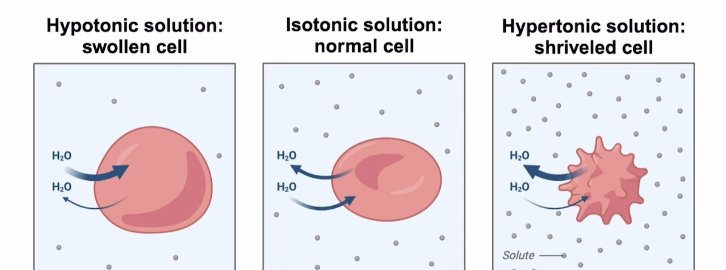
Hypertonic Solution
Has higher solute concentration than inside of the cell, pulling water out of the cell via osmosis, causing the cell to shrink and shrivel.