PHARM: Pharmacokinetics and Pharmacodynamics
 Call Kai
 Learn
Learn Practice Test
 Spaced Repetition
 Match
Match Flashcards
 Knowt Play
1/95

There's no tags or description
Looks like no tags are added yet.
Name | Mastery | Learn | Test | Matching | Spaced | Call with Kai | Chat |
|---|
No analytics yet
Send a link to your students to track their progress
96 Terms
drug
any agent used to diagnose, prevent, treat or cure a disease or a condition
what does the drug include
synthetic organic molecules, peptides, proteins, RNA, DNA, vitamins, minerals, etc
pharmacology
the study of drugs and their interaction with living systems.
what is the focus on pharmacology on
the mechanism of action of drugs as the rational basis for the therapeutic use of drug
what does pharmacology include
knowledge of the use of drugs, adverse effects, toxicities, abuse etc.
Pharmacokinetics
what the body does to the drug
Pharmacodynamics
what the drug does to the body
pharmacokinetics: movement of the drug=
changes the drug
the changes in the drug during pharmacokinetics depends on
chemical properties of the drug
the body acts on drugs by what process
ADME process
ADME
– Absorption: drug movement into the body.
– Distribution: drug movement within the body.
– Metabolism (biotransformation): drug is
chemically changed to an inactive molecule.
– Excretion: drug is removed from the body.
pharmacodynamics long def
• Change in body caused by the drug
• Mechanism of action
• Drug activity/ action
• Therapeutic or adverse effe
when will a drug not be absorbed
when administered by IV because the medicine is already in the blood.
pharmacokinetics photes
metabolism= liver excretion= kidney
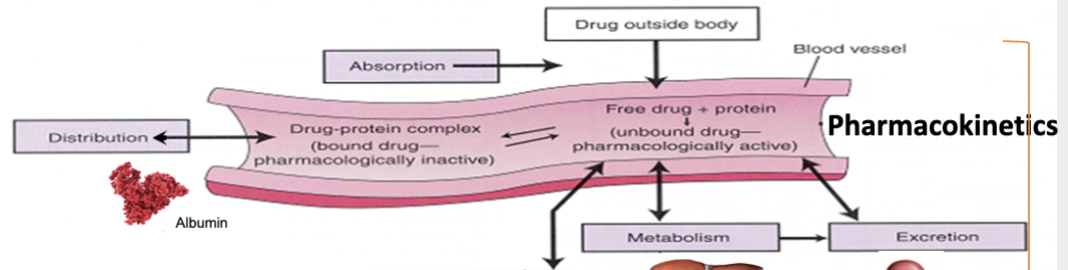
pharmacodynamics pic

efficacy
how effective is the drug in giving therapeutic affect
what do you need to make the drug for it to be excreted
polar/ hydrophobic
absorption
Movement of drug from outside the body to inside the body
Process by which a drug moves across cell membranes from its site of administration into the bloodstream
first pass effect
Drugs given orally first pass through the liver before circulating to other tissues and organs
basically if the drug disappears/ is eliminated before getting to blood stream med cant be given orally.
drug has to be what to be absorbed
lipophillic
what are some factors that affect oral absorption
drug charge and solubility in water and lipids
stability of drugs in acid
GI motility
foods: some inhibit absorption while some drugs irritate the stomach so they can be taken with food
factors that affect oral absorption: drug charge and solubility in water and lipid
• Drug absorption depends on the chemical nature of the drug itself.
• The drug must dissolve in the aqueous digestive tract and cross lipid cell membranes
• pH affects whether a drug is charged or not
charged drugs are
ionized or polar
charged drugs (polar or ionized ) are
poorly absorbed
non-charged drugs are
neutral or nonpolar
nonchargeable/ neutral or non-polar are
well absorbed
factors that affect oral absorption: stability of drugs in acid
Peptides/proteins and some other drugs are destroyed by acid in stomach.
factors that affect oral absorption: GI motility
Diarrhea and vomiting - fast and poor absorbtion.
Constipation - too slow, risk of toxicity.
drug distribution
After entrance into the blood, the drug is distributed to most regions of the body.
what affects the amount od drug reaching the organs
the local blood flow
what will make the drug easier to be distributed in the body
more fat soluble
Sites of Preferential Drug Accumulation
Fat – Benzodiazepines, cannabinoids (THC): Bone and Teeth – tetracycline
distribution: Plasma protein (Albumin) binding
• Only free drug (drug not bound to plasma proteins etc.) produce effects.
• In addition, only free drug is metabolized or excreted.
distribution: drug-drug interactions
Plasma protein binding can cause drug-drug interactions – one drug can displace another drug from plasma protein to increase free (active) drug concentration in the blood (changes equlibrium)
what is the goal of the body when dealing with meds
make meds more/ polar/waterloving/hydrophillic
primarily organ involoved in drug metabolism/ biotransformation
LIVER
what may you need to do in hepatic dysfucntion/failure
reduce dose of drug eliminated by liver metabolism
liver drug metabolism is a…
chemical change of the drug
liver drug metabolism process
• Hepatocytes (liver cells) contain enzymes (cytochrome P450 [CYP450] enzymes) that metabolize drugs. CYP3A4, CYP2D6, etc. > 50.
• Usually, results in metabolites that are inactive
• Infants and elderly have reduced liver enzymes
CREATES ACTIVE DRUG TO INACTIVE DRUG (inactive= more polar)
drug metabolism: inhibition of metabolism
Competition of one drug with another drug for the same metabolic enzymes reduces the drugs metabolism and plasma levels increase.
one drug inhibiting another drug in cyp450 class

what is a major cause of drug-drug interactions
inhibition of metabolism
prodrug
The administered drug is inactive and is metabolized to an active drug
which organ is the primary route of drug excretion
kidney
decreased GFR (Glomerular Filtration Rate (GFR)=
GFR is decreased when renal blood flow is decreased. Decreased GFR means less drug is filtered into the kidney
drugs- reabsorption vs excretion
Some drugs can be reabsorbed from renal tubules by passive diffusion. Some drugs remain in the urine and are excreted.
what will happens with renal dsyfunction/faoilure
For drugs eliminated by the kidney, the dose given should be reduced
more hydrophilic=
greater the extent of excretion= less likely to be reabsorbed
plasma half lite
time needed for the plasma concentration of a drug to fall to 50% (or one-half) of its previous concentration
what is plasma half lite determined by
drug elimination
what is there no effect on in half life
no effect of the route of administration or absorption
how long does it take to remove the drug from blood or body
4-5 half lives
what does half life deterine
duration of action of a drug and how often the drug is given.
when is the next dose usually given when dealing with halflife
once the previouse dose reaches it half life
most drugs produce their effects by interacting with
receptors (drug targets)
what do receptors interact with
drug to produce its affects
what are receptors and where are they usally located
Receptors are often cellular proteins and are often located on the cell surface membrane
what does the specific shape of the receptor determine
what specific drug molecules interact with it (like a lock and key)
what are receptors named according to
the type of neurotransmitter, hormone or drug with which it interacts,
for a drug to fit a chiral…
it has to have to right sterochemistry
agonist are
Drugs that bind to a receptor and activate some biologic process to produce an effect, or response
where are agonist found
either naturally within the body or made synthetically by chemists
antagonists
Drugs that bind with the cell receptors but do not cause a response.
what do antagonists block
endogenous molecules in the body from interacting with the receptor.
most agonist and antagonist bind to receptor
in the same location so they compete with each other for the receptor (competitive).
second messengers
molecules that relay signals from receptors to targets inside cell to cause a response
dose response curve
For all drugs, as the dose increases, the response (effect) also increases until a maximum response is reached. The dose which causes 1/2 maximal response is called the ED50
ED 50
effective dose of 50% of the effect
potency
The dose of drug needed to cause a certain level of response. The smaller the ED50, the more potent is the drug.
Efficacy (Effectiveness)
Provides information about the magnitude, intensity or size of the response.
basicaaly tells us what it did
what is more important potency or efficacy
Often, efficacy is more important than potency.
side effect
A secondary drug effect seen at therapeutic doses.
adverse reaction
An undesirable or harmful effect of a drug.
toxicity
An adverse reaction seen at excessive drug doses or any very severe adverse drug reaction
what is the goal of drug treatment
optimize therapeutic effectiveness and minimize adverse reactions.
therapeutic index/ margin of safety
an indicator of how safe a drug is.
therapeutic index
the ratio of the Toxic Dose (TD50) compared to the Effective Dose (ED50) of a drug
the wider/ bigger number in the therapeutic index
the safer the drug
drugs with a narrow/small number on the therapeutic index
the less safe the drug is and it requires attention
some meds that help with life threntening condition
have a narrow ti
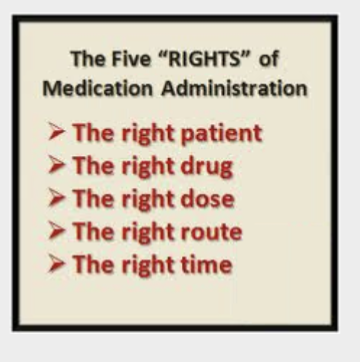
the 5 rights to medication
plasma drug concentrations over time

absorption characteristics of oral med administration
Variable absorption depending on many factors:
• Chemistry of drug
• Gut pH and motility
• Timing of dose with respect to meals
• possible first pass effect
oral administration route advantages
• Convenient
• Economical
• Good for self-administration
oral administration route disadvantage
Self-administration requires good patient compliance
• Unsuitable for drugs that are insoluble or with poor oral absorbed
• Usually unsuitable for infants and may be unsuitable for children or adults unable to swallow - unconscious patients or patients with frequent vomiting
intravenous absorption characterisitics
absorption is immediate
IV administration advantages
• Ideal for emergency use since desired effects usually appear quickly
• Useful for large volumes of drug, or irritating drugs if suitably diluted
IV aminstration disadvantages
Adverse effects appear rapidly (unable to make adjustments quickyly to medication)
• Effects may be of short duration, requiring frequent administration - infusion
• Insoluble substances (eg. suspensions) cannot be given
• Risk of infection, pain, vasculitis, extravasation
• Not suitable for self-administration.
Subcutaneous, Intramuscular absorption characterisitcs
• Rapid if aqueous solutions are used
• Slow and prolonged if oily or other depot preparation or suspension is used
• Absorption speed depends on local blood flow
Subcutaneous, Intramuscular absorption advantages
• Requires administration by nursing or other medical personnel or training of patient for self- administration;
• Small to moderate drug volumes
Subcutaneous, Intramuscular absorption disadvantages
• May be painful
• IM - Chance of muscle damage, increase bleeding risk during anticoagulant therapy
• Risk of infection
inhalation administration absorption characterisitcs
Rapid absorption unless drug is specifically formulated for local effects in respiratory tract (eg. steroids used for asthma)
inhalation administration absorption advantages
• Common route for bronchodilators to relax airways
• Route for some general anesthetics to give a gaseous or volatile liquid drug that cannot be given in another form
inhalation administration absorption disadvantages
• Drugs for self-administration require training, and dexterity for optimal effect
• Some inhaled drugs may cause coughing/wheezing
• Inhalational drugs given by professional personnel (i.e. anesthetics) may require advanced training, special equipment
sublingual administration absorption characterisitcs
Absorption is usually rapid, complete (same with nasal insuflation)
sublingual/ nasal insufflation administration absorption advantages
A preferred route for drugs that are inactivated by first-pass metabolism in the liver when they are given orally because they arent going in the GI tract
sublingual/ nasal insufflation administration absorption disadvantages
• Efficacy, speed, duration of effects depend on retaining tablet at administration site
• Eating or drinking may interfere with absorption