Microbial Life: Origin, Discovery, and Environmental Roles
 Call Kai
 Learn
Learn Practice Test
 Spaced Repetition
 Match
Match Flashcards
 Knowt Play
1/125

There's no tags or description
Looks like no tags are added yet.
Name | Mastery | Learn | Test | Matching | Spaced | Call with Kai | Chat |
|---|
No analytics yet
Send a link to your students to track their progress
126 Terms
What is a microbe?
A living organism that requires a microscope to be seen, consisting of a single cell or multicellular, ranging in size from 0.2 mm to 5 mm.
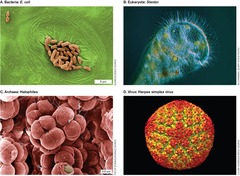
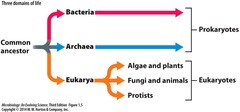
What are the three domains of life that microbes belong to?
Prokaryotes (bacteria, archaea), Eukaryotes (algae, fungi, protists), and Viruses.
What is the significance of marine microbes?
They were the first life forms on Earth and dominated the planet for two billion years.
What is a genome?
The total genetic information contained in an organism's chromosomal DNA.
Who developed the first method of DNA sequencing?
Fred Sanger at the University of Cambridge.
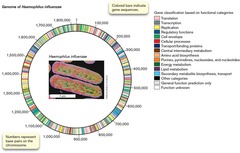
What was the first bacterium to have its genome sequenced?
Haemophilus influenzae in 1995.
How have microbes shaped human history?
They have yielded fermented foods, caused diseases, and aided in metal mining.
What disease was caused by Yersinia pestis?
The plague in the fourteenth century.

What is the role of Florence Nightingale in medical statistics?
She recognized the significance of disease in warfare and founded medical statistics.
Who built the first compound microscope?
Robert Hooke.
What did Antonie van Leeuwenhoek first observe?
Single-celled microbes, which he called 'small animals.'
What is spontaneous generation?
The theory that living creatures could arise spontaneously without parents.
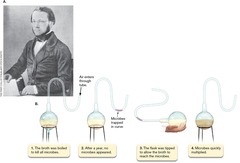
Who disproved spontaneous generation?
Louis Pasteur, using a swan-necked flask experiment.
What did Robert Koch contribute to microbiology?
He founded the scientific method of microbiology and provided proof of the germ theory of disease.
What is a pure culture?
A culture grown from a single 'parental' cell.
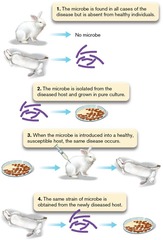
What is Koch's postulates?
An ordered set of criteria to establish a causative link between an infectious agent and a disease.
What is the role of agar in microbiology?
It is a gelling agent used to solidify liquid culture medium.
Who developed the double-sided Petri dish?
Julius Petri.

What are lithotrophs?
Bacteria that feed solely on inorganic minerals, specifically used in metal mining, can deteriorate ancient stone monuments.
What is the impact of microbes on food?
They are involved in the production of fermented foods and can spoil food.
What is metagenomics?
The collection of sequences taken directly from the environment, representing the DNA of all microbes in a community.
What is the significance of the AIDS Memorial Quilt?
It commemorates those lost to AIDS and was displayed in 1992.
What disease is caused by the human immunodeficiency virus (HIV)?
Acquired immunodeficiency syndrome (AIDS).
What virus caused the COVID-19 pandemic?
SARS-CoV-2.
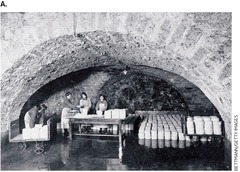
What is the role of microbes in cheese production?
They are essential for the ripening and fermentation of cheeses.
What percentage of microbial species have been identified?
Only 0.1-1% of the estimated 10^12 species.
Who worked with anthrax?
Robert Koch
What principle of epidemiology did Robert Koch demonstrate?
The chain of infection
What disease did Edward Jenner's cowpox vaccination prevent?
Smallpox
What is the causative agent of smallpox?
Variola virus
What is the milder disease related to smallpox?
Cowpox caused by the vaccinia virus
Who developed the first vaccines based on attenuated strains?
Louis Pasteur
What disease does fowl cholera affect?
Chickens
Who discovered penicillin?
Alexander Fleming
What was the first commercial antibiotic?
Penicillin
Who studied tobacco mosaic disease and discovered viruses?
Dmitri Ivanovsky
What did Martinus Beijerinck propose about the causative agent of tobacco mosaic disease?
It is not bacteria and used the word 'virus'
Who purified and crystallized the tobacco mosaic virus?
Wendell Stanley
What do microbes cycle that is essential for life on Earth?
Nutrients
Who built the Winogradsky column?
Sergei Winogradsky
What do endosymbiotic bacteria like Rhizobium do for legumes?
Induce the formation of nodules for nitrogen fixation
What type of bacteria help ruminant animals digest cellulose?
Bacteroides
What did Robert Whittaker propose about the kingdoms of life?
Five kingdoms: bacteria, protists, fungi, plants, animals
What did Carl Woese discover about prokaryotes?
They live in hot springs and produce methane
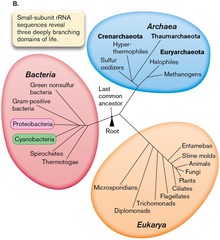
What are the three domains of life proposed by Woese?
Bacteria, Archaea, Eukarya
What did Rosalind Franklin discover about DNA?
It forms a double helix
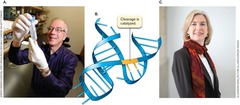
Who discovered catalytic RNA?
Thomas Cech
What are the main groups of microbes?
Bacteria, archaea, fungi, algae, protists, and viruses
What did Pasteur disprove?
Spontaneous generation
What did Koch develop?
The Four Postulates
What are the organelles that evolved by endosymbiosis?
Mitochondria and chloroplasts
What is the typical size range for a microbe?
0.2 μm to 5 mm
How do viruses compare in size to the smallest cellular microbes?
They are ten times smaller.
Which specific marine microbe is responsible for producing a significant portion of the Earth's O2?
Prochlorococcus.

What is the total genetic information contained in an organism's chromosomal DNA called?
Genome.
Who was awarded the 1980 Nobel Prize in Chemistry for developing the first method of DNA sequencing?
Fred Sanger.
In 1995, which bacterium became the first to have its entire genome sequenced?
Haemophilus influenzae
What is the term for a collection of DNA sequences taken directly from an entire microbial community in the environment?
Metagenome.
Microbes that lack a distinct nucleus are collectively categorized as?
Prokaryotes.
Which domain of life includes algae, fungi, and protists?
Eukarya.
What are the three distinct domains of life evolved from a common ancestral cell?
Bacteria, Archaea, and Eukarya.
Under the five-kingdom system proposed by Robert Whittaker, which kingdom contained all bacteria?
Monera (Bacteria).
What specific characteristic of the Eukarya domain distinguishes it from Bacteria and Archaea regarding internal structure?
The presence of a nucleus and membrane-bound organelles.
Organisms known as 'rock-eating' bacteria that feed on inorganic minerals are called?
Lithotrophs.
Which bacterium is the causative agent of the bubonic plague that devastated the 14th-century population?
$Yersinia ext{ } pestis$.
What is the causative agent of tuberculosis?
Mycobacterium tuberculosis
Who is recognized as the founder of medical statistics for using polar area charts to track soldier mortality?
Florence Nightingale.
What did Florence Nightingale identify as the leading cause of death for British soldiers during the Crimean War?
Infectious disease.
Who built the first compound microscope and published the first illustrations of microscopic objects in *Micrographia*?
Robert Hooke.
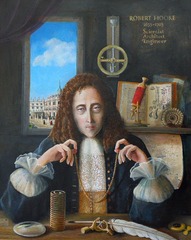
Robert Hooke coined the term 'cell' after observing the microscopic structure of which material?
Cork.
Who was the first person to observe single-celled microbes, which he described as 'small animals'?
Antonie van Leeuwenhoek.
What is the theory that living organisms can arise from non-living matter without parents called?
Spontaneous generation.
Which scientist definitively disproved spontaneous generation using a 'swan-neck' flask?
Louis Pasteur.
What is the biochemical basis of microbial growth discovered by Louis Pasteur that is used to make beer and wine?
Fermentation.
Which scientist established the scientific method of microbiology and provided the first proof of the germ theory of disease?
Robert Koch.
A culture grown from a single parental cell, containing only one species of microorganism, is a?
Pure culture.
What are the distinct populations of bacteria that grow on a solid surface from a single cell called?
Colonies.
Which individual suggested using agar as a solidifying agent for bacterial culture media?
Angelina Hesse.
From which source is agar derived?
Red algae (seaweed).
Agar is chemically defined as a polymer of the sugar?
Galactose.
Why is agar preferred over other gelling agents for microbial culture regarding bacterial metabolism?
Bacteria lack the enzymes required to digest it.
Who developed the double-sided container used for holding solid culture media?
Julius Petri.
According to Koch's first postulate, where must the suspected microbe be found?
In all cases of the disease, and absent from healthy individuals.
What is the second step in Koch's Postulates after observing a microbe in a diseased host?
The microbe must be isolated and grown in pure culture.
In Koch's third postulate, what happens when a pure culture of a microbe is introduced into a healthy host?
The host becomes sick with the same disease.
What is the final step required by Koch's Postulates to confirm a causative link?
The same microbe must be re-isolated from the newly diseased host.
Which bacterium, causing anthrax, was used by Robert Koch to demonstrate the chain of infection?
$Bacillus ext{ } anthracis$.
Who discovered that cowpox infection could protect humans against smallpox?
Edward Jenner.
What is the origin of the term 'vaccination'?
The Latin word *vacca*, meaning 'cow'.
A microbial strain that has been weakened to eliminate its ability to cause disease is described as?
Attenuated.
Who developed the first attenuated vaccines for diseases such as fowl cholera and rabies?
Louis Pasteur.
Who is credited with the accidental discovery of the first antibiotic, penicillin?
Alexander Fleming.
Which mold species naturally produces the antibiotic substance that kills *Staphylococcus* bacteria?
Penicillium notatum.
Which two scientists are credited with the first commercial purification of penicillin in 1941?
Howard Florey and Ernst Chain.
Who first discovered that the causative agent of tobacco mosaic disease could pass through a 0.1 μm filter?
Dmitri Ivanovsky.
Who coined the term 'virus' to describe non-bacterial filterable agents of disease?
Martinus Beijerinck.
Which scientist earned the 1946 Nobel Prize in Chemistry for purifying and crystallizing the tobacco mosaic virus?
Wendell Stanley.
What are the two primary components of a virus particle like TMV?
An RNA or DNA genome surrounded by a protein capsid.
The use of selective growth media to support specific microbial metabolisms while excluding others is known as?
Enrichment culture.
Who developed the enrichment culture technique and discovered lithotrophs?
Sergei Winogradsky.