2.4 structure and bonding chem
 Call Kai
 Learn
Learn Practice Test
 Spaced Repetition
 Match
Match Flashcards
 Knowt Play
1/57

There's no tags or description
Looks like no tags are added yet.
Name | Mastery | Learn | Test | Matching | Spaced | Call with Kai | Chat |
|---|
No analytics yet
Send a link to your students to track their progress
58 Terms
Drawing lewis structure (example NH3)
Count total VE present
Choose least electronegative atom as the central atom (never choose H)
Create a single bond between the center atom and each outer atom. (each bond represents 2 electrons)
Place remaining electrons in pairs around outer atoms, then only central atoms. (using octet rule)
Check that each atom has the correct number of full VE. If not, change the lone pair on the outer atom to create double/triple bonds.
should look like this… (for nh3)
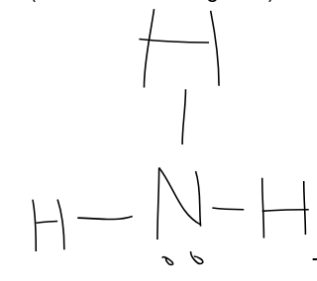
Electronegativity
- Electronegativity increases from left to right across the table, and decreases down a group.
- δ+ = lowest electronegativity
- δ− = highest electronegativity
4 regions names + bonding angles
Tetrahedral (four regions of negative charge, all regions bonded and a bond angle of approximately 109/109.5 degrees).
Bent 4 regions (four regions of negative charge, two bonded and two unbonded, and a bond angle of approximately 109/109.5 degrees)
Trigonal Pyramidal (four regions of negative charge, three bonded and one unbonded, and a bond angle of approximately 109/109.5 degrees)
3 regions + bonding angles + name
Trigonal Planar (three regions of negative charge, all regions bonded and with a bond angle of approximately 120 degrees)
Bent 3 regions (three regions of negative charge, two bonded and one unbonded, and a bond angle of approximately 120 degrees)
2 regions
Linear - 2 regions of negative charge, all bonded, 180 degrees
justifying molecule shape
Identify regions (each outer atom + lone pairs) AROUND CENTRAL __ ATOM
Maximise separation to minimise repulsion, giving parent geometry + bond angle
Bonded / non-bonded regions, giving overall shape
In NH3, there are four regions of electron density around the central nitrogen atom. These regions of electron density maximise separation to minimise repulsion according to the Valence Shell Electron Pair Repulsion (VSEPR) Theory, giving NH3 a parent geometry of tetrahedral with a bond angle of 109.5 degrees. There are three bonding regions and one non-bonding region (one lone pair), therefore the overall shape of NH3 is a trigonal pyramid.
state why __ has the same bond angle as __
First say:
The bond angles are determined by the number of electron density regions around the central atom, which are arranged to minimise repulsion by maximising separation.
Then do everything in justification for both molecules
Then say:
Both and have (same number of) regions of electron density, which gives them bond angles of (the angle for the number of regions) even though their shapes are different.
Explaning why molecules are polar or non-polar by looking at bond dipoles and symmetry
Identify polar bonds in terms of electronegativity difference
In CH3Br, there are three polar C–H bonds due to the difference in electronegativity between carbon and hydrogen (carbon being more electronegative), and one polar C–Br bond due to the difference in electronegativity (Br being more electronegative).
Give regions of electron density
Max repulsion, giving parent geometry + bond angle
bonded/non-bonded regions, giving overall shape
“There are four regions of electron density around the central carbon atom. These regions of electron density maximise separation to minimise repulsion according to the Valence Shell Electron Pair Repulsion (VSEPR) theory, giving CH3Br a tetrahedral parent geometry with a bond angle of 109.5 degrees. All four regions are bonded with no non-bonding regions, therefore the overall shape of CH3Br is tetrahedral.”
Symmetry of molecule
Effect of bond dipoles will/will not cancel
Has molecular dipole, therefore polar (opposite if non-polar)
Asymmetrical molecule (has another atom) polar or non-polar
example ch3Br (full answer)
In CH3Br, there are three polar C–H bonds due to the difference in electronegativity between carbon and hydrogen (carbon being more electronegative), and one polar C–Br bond due to the difference in electronegativity (Br being more electronegative).
There are four regions of electron density around the central carbon atom. These regions of electron density maximise separation to minimise repulsion according to the Valence Shell Electron Pair Repulsion (VSEPR) theory, giving CH3Br a tetrahedral parent geometry with a bond angle of 109.5 degrees. All four regions are bonded with no non-bonding regions, therefore the overall shape of CH3Br is tetrahedral.
The bonds in CH3Br are not identical due to the presence of the Br atom, meaning it is an asymmetrical molecule. Therefore, the effect of the bond dipoles do not cancel out. CH3Br has a molecular dipole, and is therefore a polar molecule.
Asymmetrical molecule with lone pair polar or non-polar (just step 5-7)
Due to the presence of a lone pair on the central __ atom, the molecule is asymmetrical, therefore the effect of the bond dipoles do not cancel out. __ has a molecular dipole, and is therefore a polar molecule.
you think it’s Symmetrical but not linear polar or non-polar (just step 5-7)
Due to __ having a bent shape, it is asymmetrical, therefore the effect of the bond dipoles do not cancel out. __ has a molecular dipole, and is therefore a polar molecule.
symmetrical polar or non-polar (just step 5-7)
The bonds in __ are symmetrical, therefore the effect of the bond dipoles cancel out. __ does not have a molecular dipole, and is therefore a non-polar molecule.
IF it only has one bond and it is the same atom, you can say:
there is no difference in electronegativity between the two __ atoms, so __ does not have a molecular dipole and is therefore a non-polar molecule.
Ionic substance structure
__ is an ionic substance. It consists of alternating positively charged X ions (letter form) and negatively charged X ions (letter form). These oppositely charged ions are held together by strong electrostatic forces of attraction (ionic bonding) in a regular 3D crystalline lattice structure.
metal + non-metal
strong electrostatic force (ionic bond)
ions
Metallic substance structure
__ is a metallic substance. It is made of positively charged metal ions/nuclei in a 3D crystalline lattice arrangement, surrounded by a ‘sea’ of delocalised valence electrons. They are held together by the strong electrostatic attraction between the positively charged ions/metal nuclei, and the sea of delocalised valence electrons surrounding them, resulting in metallic bonding that is non-directional.
metal
cations + delocalised electrons
strong, non-directional electrostatic force (metallic bond)
Molecular substance structure
__ is a molecular substance composed of X discrete molecules. Within these molecules, there are strong covalent bonds; however between these [compound] molecules, there are weak intermolecular forces holding them together.
molecules
weak intermolecular forces
primarily non-metal
Intramolecular force
forces WITHIN the molecule are very strong covalent bonds that link atoms within individual molecules.
Covalent bonds = intramolecular bonds!
For my understanding: H2 linking to O to form H2O
Intermolecular force
forces BETWEEN the molecule are weak intermolecular forces that link individual molecules to each other.
For my understanding: H2O being linked to another H2O
Covalent Network - linear chain structure
Carbon polymers consist of long, straight linear chains of __ ??, allowing them to be packed closely together.
atoms
covalent bonding
Covalent Network - 2d layer (graphite) structure
Graphite is a covalent network composed of 2D layers of carbon atoms. Each carbon atom is covalently bonded to three other carbon atoms in a hexagonal lattice, forming flat sheets. The layers are held together by weak intermolecular forces.
atoms
covalent bonding
Covalent Network - Diamond/SiO2 (3D network) structure
Diamond/SiO2 is a covalent network composed of atoms covalently bonded together in a tetrahedral 3D crystalline lattice structure.
diamond = carbon atoms (just say atoms)
sio2 = just atoms (not carbon)
covalent bonding
Ionic solid bp and mp
A lot of heat energy is required to overcome these strong ionic bonds, therefore X has a relatively high melting and boiling point.
Ionic solid hardness and britleness
__ is very hard because the ions are held strongly together by ionic bonds in their closely packed 3D crystalline lattice structure. __ is brittle although it is very hard. When the force applied to the ionic solid exceeds the strength of the electrostatic forces holding the ions together, ions of like charges come in contact and the repulsive electrostatic forces between the ions of like charges will make the ionic solid shatter.
ionic solid electrical conductivity
Solid __ does not conduct electricity because its ions (charged particles) are in a fixed position and unable to move freely. However, molten __ conducts electricity because its ions are able to move.
ionic solid solubility
Ions are attracted electrostatically to polar solvents (usually water). Solvents that are non-polar will not dissolve in ionic substances. Dissolving occurs when the attraction between solvent molecules and the oppositely charged ions is strong enough to overcome the attraction between the oppositely charged ions in the ionic lattice.
example answer for ionic solid properties
describe what it’s made of
BP and MP
brittle/hardness
electrical conductivity
solubility
molecular solid BP and MP
Because the intermolecular forces of attraction between the molecules are relatively weak, not much heat energy is required to overcome these weak forces of attraction and separate the molecules. Therefore __ has a relatively low melting and boiling point.
molecular solid brittleness / hardness
__ is usually soft, brittle, and dull because they are made of discrete molecules held together by relatively weak intermolecular forces. The __ is brittle because the weak intermolecular forces between the molecules break easily under stress.
molecular solid conductivity
Since __ consists of discrete, mobile molecules, and has no charged particles (ions or delocalised electrons) available to carry an electrical charge, they show no electrical conductivity.
molecular solid solubility
Molecular solids have variable solubility. It will depend on the relative strength of the intermolecular forces between molecules, and the attractive forces of the solvent molecules.
Also the rule “like dissolves like”.
example answer for molecular solid properties
describe what it’s made of
BP and MP
brittle/hardness
electrical conductivity
solubility
metallic BP and MP
There are strong, non-directional electrostatic attractions between the delocalised electrons and the positively charged metal nuclei of the atoms. This metallic bonding is difficult to overcome, meaning __ has a relatively high melting and boiling point.
metallic malleability and ductile
__ is usually malleable (able to be shaped using force) and ductile (able to be drawn into thin wires) due to its non-directional bonding. When a force is applied to the __ ,the positively charged metal nuclei are able to change positions and still experience strong metallic bonding to nearby delocalised valence electrons. This makes the metal malleable and ductile as layers of atoms can slide over each other without disrupting the bonding. __ is hard due to its strong metallic bonding in a closely packed 3D lattice structure.
metallic electrical conductivity
__ has high electrical conductivity. This is because the delocalised valence electrons of metal atoms are free to move throughout the metal lattice, allowing them to carry an electrical current when voltage is applied to the metal. As these electrons are free to move, __ metal will conduct electricity as a solid and when molten.
metallic substance structure answer properties
explain what it’s made of
BP and MP
malleability
electrical conductivity
graphite brittleness/ leaving marks answer
Graphite is soft and slippery because sheets of graphite can move over each other due to the weak intermolecular forces holding the sheets together. When graphite is applied to the paper, the weak intermolecular forces holding the sheets together break, and a graphite layer is left on the page.
graphite bp / mp
Due to the strong covalent bonds between the carbon atoms within each layer, a very high amount of heat energy is required to break these bonds, therefore graphite has a high melting point.
graphite electrical conductor + solubility (i can’t be bothered to make another card)
Graphite is an electrical conductor as each carbon atom has one remaining electron that becomes delocalised within the layer, allowing it to carry an electrical charge. Graphite is insoluble as the force of attraction between the carbon atoms is greater than the force of attraction between the carbon atoms and the solvent molecules.
Diamond/SiO2 structure + brittleness answer
Diamond/SiO2 is composed of atoms covalently bonded together in a tetrahedral 3D crystalline lattice structure. (say carbon atom covalently bonded to 4 other carbon atoms for diamond in a tetrahedral 3D lattice). There are only strong covalent bonds in the structure so the atoms cannot be easily removed so they do not leave a mark on paper (very hard).
Diamond/SiO2 solubility
Diamond/SiO2 is insoluble in all liquids as the force of attraction between the atoms is greater than the force of attraction between the atoms and the solvent molecules. Diamond/SiO2 is also non-polar (so unable to dissolve in water as water is a polar solvent, like dissolves like rule).
Diamond/SiO2 BP/MP + electrical conductivity
Because Diamond/SiO2 has strong covalent bonds holding the atoms together in a 3D array, a very high amount of heat energy is required to break these bonds, therefore it has a high melting point.
Diamond/SiO2 is an electrical insulator as there are no free charged particles within the network.
Endothermic
This is because more energy is taken in as the bonds of the reactants break, than is released when the bonds of the product are formed. Temperature decreases in endothermic reactions as the surroundings of the reactants lose heat energy (reactants gain heat energy). It has a positive ΔH.
Example: 2H2O → 2H2 + O2 (more energy is required to break the bonds in the water molecules than is released when the reactants form.)
Phase changes: Endothermic = melting, boiling (energy is absorbed to weaken/break bonds)
Graph:
Starts low, goes high, goes medium
“When the [some sort of change], it means that the reactant bonds are broken, therefore an endothermic reaction. The temperature of the reactant also increases/product decreases.”
Exothermic
Exothermic reactions are reactions that release heat energy, meaning bonds are formed.
This is because more energy is released as the bonds of the product are formed, than is taken in when the bonds of the reactants are broken. Temperature increases in exothermic reactions as the reactants lose heat energy to their surroundings (surroundings gain heat energy). It has a negative –ΔH.
Example: 2H2 + O2 → 2H2O (Four covalent bonds forming between hydrogen and oxygen atoms release more energy than is required to break the bonds in the reactants)
Phase changes: Exothermic = freezing, condensing (energy is released when bonds form or strengthen)
Graph:
Stars medium, goes high, goes low
“When the [some sort of change], it means that bonds in the product are formed, therefore an exothermic reaction. The temperature of the reactant also decreases/product increases.”
Activation energy (Ea)
The minimum amount of energy that must be absorbed by reactants to initiate a chemical reaction.
ΔrH
the difference in enthalpy between reactants and products.
Measured in kJ mol-1
ΔH
change in enthalpy
Measured in J or kJ
Bond Energy Calculations
Formula: ΔrH = Σbreaking – Σmaking (reactants - products)
You will be given a bond table (it will show X–X bonds = X kJ mol-1)
Try drawing the lewis structure if you can.
Write the equation given in the form of how many bonds there are. (ΔrH becomes the answer to the equation). Change the arrow into a minus symbol.
Write the equation as numbers according to the bond table.
Calculate the left side of the equation (energy required to break reactant bonds)
Calculate the right side of the equation (energy released when bonds in the product are formed)
Input answers into the formula (ΔrH = Σbreaking – Σmaking,)
N2 reacts with H2 to produce NH3. Calculate the average bond enthalpy of N–H bond in NH3.
You are given: N2 + 3H2 → 2NH3 | ΔrH = -92.0 kJ mol-1
Bond table:
N≡N : 945 kJ mol-1 H–H = 436 kJ mol-1
N2 = 1N≡N bond 3H2 = 3H–H bonds 2NH3 = 6N–H bonds (1 NH3 = 3 N–H bonds, 2 NH3 = 3x2 = 6 N–H) write bonds out
N≡N + 3(H–H) – 6(N–H) = -92.0 kJ mol-1 —> becomes (–) sign!
945 kJ mol-1 + 3 x 436 kJ mol-1 – 6 (N–H) = –92.0 kJ mol-1
Bond breaking = 945 + 3 x 436
= 945 + 1308
= 2253 kJ mol-1
2253 kJ mol-1 – 6(N–H) = –92.0 kJ mol-1
– 6(N–H) = -92 – 2253 kJ mol-1 move 2253 to the other side to solve for N–H
N–H = –2345 kJ mol-1 / –6 divide by -6
N–H = 390.83 kJ mol-1
N–H = 391 kJ mol-1 (3 SF) MUST ROUND!!
Estimate the ΔH for CH4 + 2Cl2 → CH2Cl2 + 2HCl
Bond table:
H–C = 414 kJ mol-1 H–Cl = 431 kJ mol-1 Cl–Cl = 243 kJ mol-1 C–Cl = 327 kJ mol-1
CH4 = 4H–C bond 2Cl2 = 2Cl–Cl bond CH2Cl2 = 2H–C bond, 2C–Cl bond 2HCl = 2H–Cl bond
4(H–C) + 2(Cl-Cl) – [2(H–C) + 2(C–Cl)] + 2(H–Cl)
4 x 414 + 2 x 243 – [(2 x 414) + (2 x 327)] + 2 x 431
Bond breaking: 4 x 414 + 2 x 243
= 1656 + 486
= 2142 kJ mol-1
Bond making: [2 x 414 + 2 x 327] + 2 x 431
= 828 + 654 + 862
= 2344 kJ mol-1
2142 – 2344 = –202 kJ mol-1
mole
A mole is represented by the symbol (n), measured in (mol)
molar mass
Molar mass is the mass of one mole of a substance (element/ compound).
Molar mass is represented by the symbol (M), measured in g mol-1
Molar mass and the atomic mass number are different concepts, but they have the same values. (e.g. Cl has a mass number of around 35.5, and has a molar mass of 35.5 g mol-1)
Molar mass of a compound can be calculated by adding together the molar masses of all the elements in the compound. (e.g. molar mass of NH3 = molar mass of N + molar mass of 3 x H).
The molar mass of an ion is the same as the mass of the original atom. (e.g. M(Na+) = M(Na) )
Thermochemical calculations
Calculate the number of moles in the mass of the substance stated.
Determine how many moles of the substance releases ΔrH for equation (just look if there’s a coefficient in front of the substance) “__ mole of __ releases [number]”
Multiply the number of moles (in step 1) by ΔrH, and divide the answer by step 2, to find the amount of energy released/absorbed.
State whether the energy was released or absorbed, and whether it is endothermic or exothermic. (DO NOT include the – symbol when stating this. The unit is also kJ, NOT kJ mol-1)
round things to 3 sf
‘__ kJ (without minus if have) of energy is released/absorbed (3 SF)’
C2H5OH + 3O2 → 2CO2 + 3H2O | ΔrH = –1235 kJ mol-1
Calculate the energy released when 23.0g of ethanol (C2H5OH) is burned
You are given: M(C2H5OH) = 46.0 g mol-1
n = m/M
= 23 g / 46.0
= 0.5 mol
1 mole of C2H5OH releases 1235 kJ of energy there’s no coefficient in front!
(0.5 x –1235) / 1
= –617.5 / 1
= –617.5 kJ
617.5 kJ of energy was released when 23.0g of ethanol was burned. This is an exothermic reaction.
Table particle stuff
Metal + non-metal = ionic substance
particles = ions
bonding = ionic bonding (strong electrostatic force)
Metal = metallic substance
particles = cations + delocalised electrons
bonding = metallic bonding (strong, non-directional electrostatic force)
Covalent network
particles = atoms
bonding = covalent bonding
primarily non-metal (or has metalloid idk) = molecular substance
particles = molecules
bonding = weak intermolecular forces
Explain why ethanol readily evaporates, and why the evaporation of ethanol results in the student’s hands feeling cool. (just an example question)
evaporate = phase change
why easily phase change = molecular substance so weak intermolecular forces, which is why only a small amount of heat energy is required to break bonds, therefore readily blah blah
why evaporation = hands cool (endothermic or exothermic part)
As the evaporation is endothermic, this heat energy is absorbed from the student’s hand, therefore making their hand feel cool
just remember think about the phase change, and then just go what happens in endothermic reaction or liek wtv vice versa
By referring to the attractive forces between particles, explain why lithium bromide, LiBr(s), is unable to dissolve in non-polar solvents such as cyclohexane, C6 H12(l), but can dissolve in polar solvents such as water, H2 O(l).
In order for a substance to dissolve, the solute and solvent particles need to form sufficiently strong attractive forces to overcome the already existing forces of attraction. As cyclohexane is a non-polar molecule, the attractive forces it forms with the ions in the ionic lattice of lithium fluoride are insufficiently strong to overcome the strong ionic bonds. This means the ionic lattice remains intact, and the lithium fluoride does not dissolve. However, as water is a polar molecule, it has a negative pole, which can attract the positive ions in the lattice, and a positive pole, which can attract the negative ions in the lattice. These attractive forces are strong enough to overcome the ionic bonds present, allowing the substance to dissolve.
basically just say how dissolving occurs
state non-polar, and insufficiently strong to overcome forces, so will not dissolve, opposite for polar
explaining solubility stuff
always state that the strength of the attractive forces between the (non-polar) solute and polar solvent are not sufficient to overcome existing strength of attractive forces between (solute) and (solvent)
state for ionic compound the partially negative (molecule) will attract partially positive (from solvent) and then do the other way
always state that the strength of attractive force between polar solute and polar solvent is strong enough to overcome attraction within each thingy, allowing to dissolve
idk why they asked to draw a diagram but they did
unit of mass in molar mass question stuff
ALWAYS BE CAREFUL TO CONVERT TO GRAMS!!!!! IF ITS KG CONVERT!!!