Lecture 10: DNA Replication
 Call Kai
 Learn
Learn Practice Test
 Spaced Repetition
 Match
Match Flashcards
 Knowt Play
1/34

There's no tags or description
Looks like no tags are added yet.
Name | Mastery | Learn | Test | Matching | Spaced | Call with Kai | Chat |
|---|
No analytics yet
Send a link to your students to track their progress
35 Terms
How are Okazaki fragments synthesized?
By DNA polymerase on the lagging strand
What is the difference between the leading strand and the lagging strand in DNA replication?
The leading strand is synthesized continuously in the 5'→ 3' direction, while the lagging strand is synthesized discontinuously in the 5'→ 3' direction.
What is polymerized in 5′→3′ during DNA synthesis?
Leading Strand
Lagging Strand
Okazaki fragments
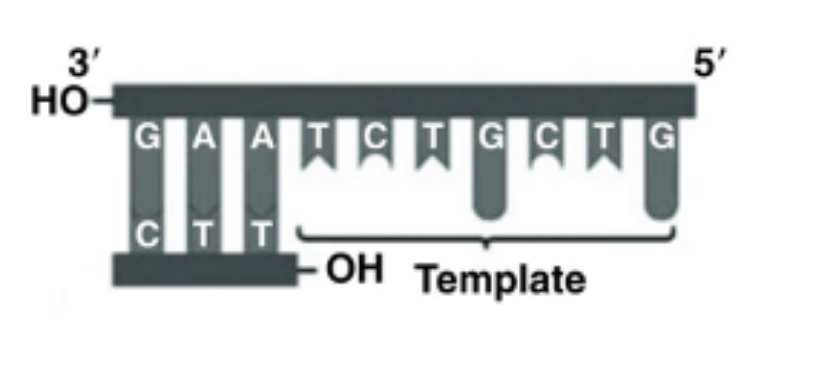
Referring to the figure, what bases will be added as DNA replication proceeds on the bottom strand?
5′ A G A C G A C 3′
T/F: DNA replication is always semiconservative
True
T/F: DNA replication takes place inside the nucleus in Eukaryotes
True
T/F: DNA replication is necessary for cell division
True
T/F: Topoisomerase is the main DNA-replicating enzyme
False; DNA polymerase
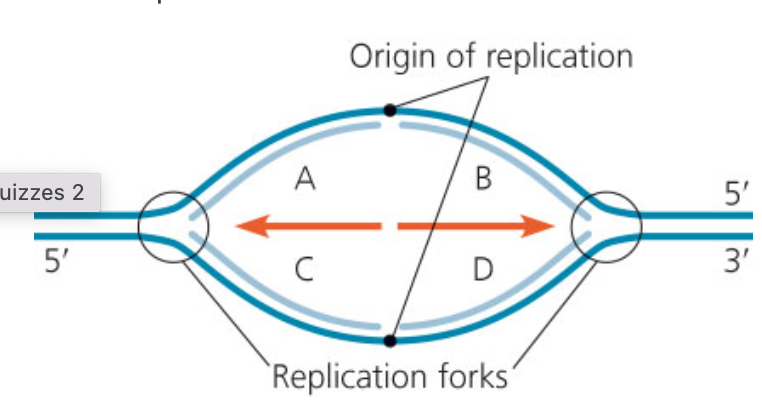
Which of the four segments of new DNA (lighter blue) could be leading strands?
B and C
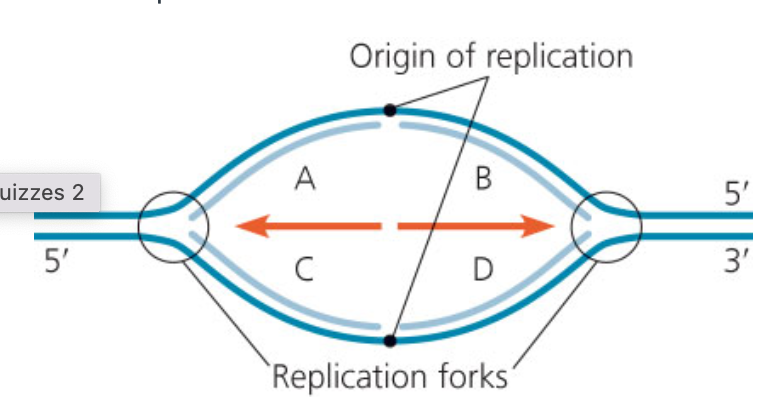
Which of the segments of new DNA (lighter blue) would be lagging strands, synthesized as a series of smaller Okazaki fragments?
A and D
What is the function of DNA polymerase I in DNA replication?
Removes nucleotides from the RNA primer that is used for initiation DNA synthesis
What is the function of Topoisomerase in DNA replication?
Relieves the strain in the DNA ahead of the replication fork caused by the untwisting of the double helix
What is the function of DNA polymerase II in DNA replication?
Adds nucleotides to the 3' end of a growing DNA strand
What is the function of DNA ligase in DNA replication?
Plays role in the elongation of the lagging strand during DNA replication, joining Okazaki fragments together
What is the function of Helicase in DNA replication?
Unwinds the DNA double helix at the replication fork
What is the function of Single-strand DNA binding protein in DNA replication?
Helps to hold the DNA strands apart while they are being replicated
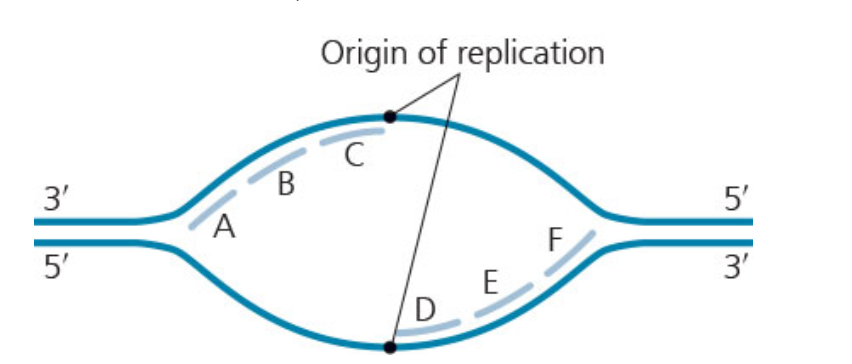
Which of the labeled Okazaki fragments would be the first two to be synthesized? (The leading strands are nor shown)
D and C
What is the enzyme order required for nucleotide excision repair?
Nuclease, DNA polymerase, DNA ligase
Semiconservative replication involves a template. Describe the template molecule.
One strand of the DNA molecule
A protein that binds to the unpaired DNA strands during DNA replication, stabilizing them and holding them apart while they serve as templates for the synthesis of complementary strands of DNA.
A protein that breaks, swivels, and rejoins DNA strands. During DNA replication, topoisomerase helps to relieve strain in the double helix ahead of the replication fork.
The process by which a DNA molecule is copied; also called DNA synthesis
A short polynucleotide with a free 3′ end, bound by complementary base pairing to the template strand and elongated with DNA nucleotides during DNA replication.
A discontinuously synthesized DNA strand that elongates by means of Okazaki fragments, each synthesized in a 5' to 3' direction away from the replication fork.
Type of DNA replication in which the replicated double helix consists of one old strand, derived from the parental molecule, and one newly made strand
A linking enzyme essential for DNA replication; catalyzes the covalent bonding of the 3′ end of one DNA fragment (such as an Okazaki fragment) to the 5′ end of another DNA fragment (such as a growing DNA chain)
The cellular process that uses specific enzymes to remove and replace incorrectly paired nucleotides.
An enzyme that cuts DNA or RNA, either removing one or a few bases or hydrolyzing the DNA or RNA completely into its component nucleotides.
A repair system that removes and then correctly replaces a damaged segment of DNA using the undamaged strand as a guide. Nucleotide ...
An enzyme that untwists the double helix of DNA at replication forks, separating the two strands and making them available as template strands.
A short segment of DNA synthesized away from the replication fork on a template strand during DNA replication. Many such segments are joined together to make up the lagging strand of newly synthesized DNA
The new complementary DNA strand synthesized continuously along the template strand toward the replication fork in the mandatory 5' to 3' direction
A Y-shaped region on a replicating DNA molecule where the parental strands are being unwound and new strands are being synthesized.
An enzyme that catalyzes the elongation of new DNA (for example, at a replication fork) by the addition of nucleotides to the 3′ end of an existing chain.
An enzyme that joins RNA nucleotides to make a primer during DNA replication, using the parental DNA strand as a template