Microstructure and mechanical properties
 Call Kai
 Learn
Learn Practice Test
 Spaced Repetition
 Match
Match Flashcards
 Knowt Play
1/19

Earn XP
Description and Tags
topic 4
Name | Mastery | Learn | Test | Matching | Spaced | Call with Kai | Chat |
|---|
No analytics yet
Send a link to your students to track their progress
20 Terms
Polycrystaline
A metal solid made up of many small crystals.
Process: Baby crystals/nuclei —→ nuclei grows —→ becomes crystal —→ grain ——> solid metal
equiaxed grain
grains that are roughly equal size
Heterogeneous Nucleation
solid crystal starts forming on pre existing surfaces. More likely to occur than Homogeneous Nucleation
Homogeneous Nucleation
solid crystal forms spontaneously within bulk of liquid
Grain Boundaries properties
High energy regions - due to free atomic bonds
Grain Structure development diagram (Chill, Columnar Crystals)
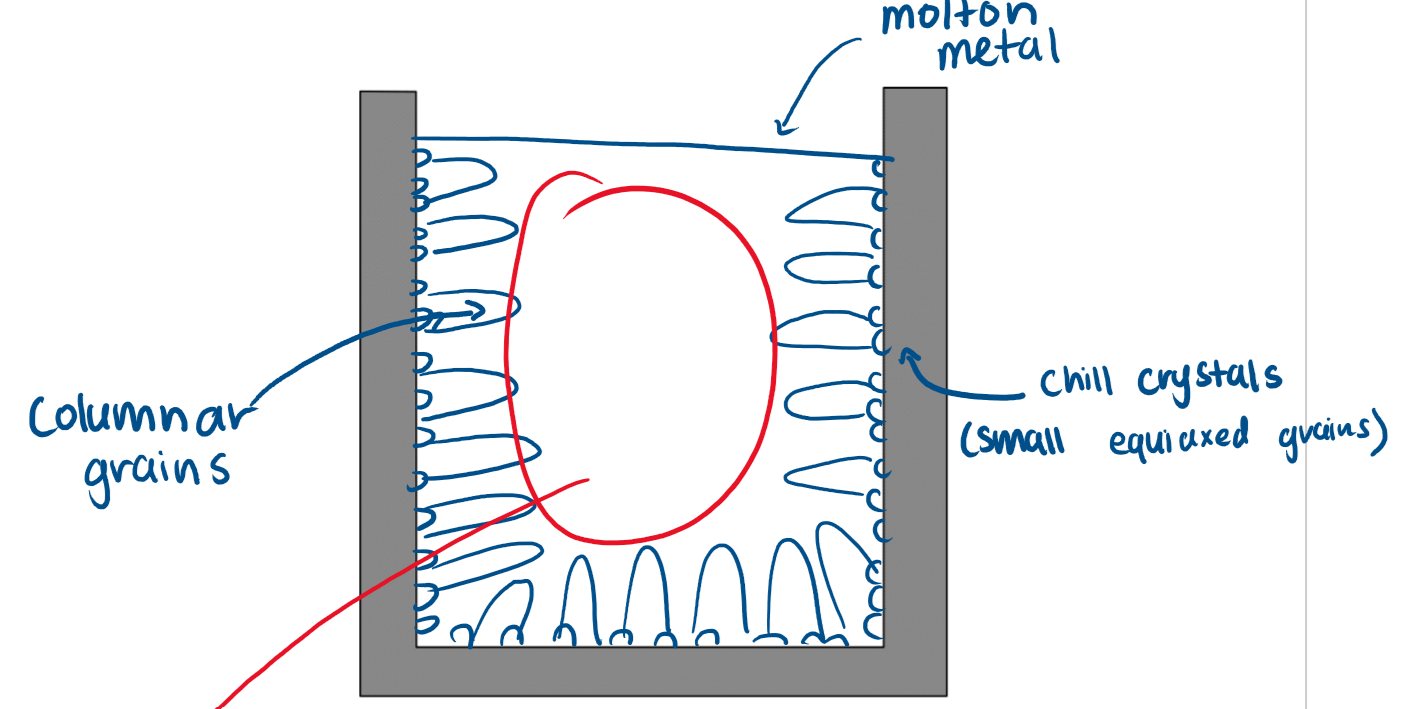
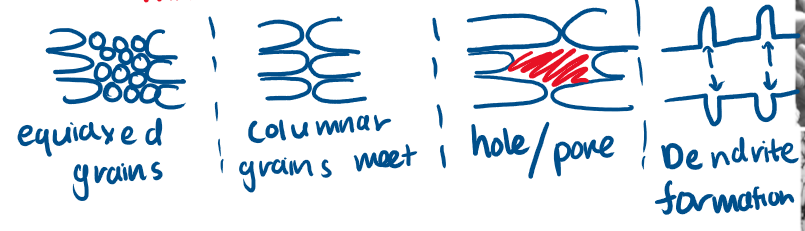
Types of middle grain structure development
Equiaxed Grain, Columnar Grains meet, Hole/Pore, Dendrite Formation
How to get an equiaxed grain structure (lab 1)
1) use grain refiners
2) Annealing (heat treatment)
Metallography
A process used in order to reveal grain boundaries of a metal
Metallography processes
1) Grinding - removes big scratches
2) Polishing - removes small scratches. Done with diamond paste
3) Etching - reveals grain boundaries through etching grooves. Done with acid/alkali
How does grain size affect mechanical properties of metals?
Big grains - Fewer Grain boundaries, lower Grain boundaries density, materials weaker, materials more ductile
Small grains - More Grain boundaries, higher Grain boundaries density, materials stronger, materials less ductile
Hall Patch Effect
Describes how the strength of a metal/ceramic increases as its grain size decreases.
yield Stress = Friction stress + Hall patch constant x (Grain size ^-0.5)
Grain Deformation
When a metal is plastically deformed the individual grains are permanently deformed. Eg equiaxed grains changes into elongated grains.
Working Hardening
When a metal is plastically deformed it becomes stronger.
Work Hardening and the process with dislocations
As dislocations move —→ dislocations multiply —→ dislocations density increase —→ causes traffic jam of dislocations —→ material becomes stronger
Cold-worked
Metal is plastically deformed at a temperature below its recrystallisation temperature.
Cold-worked Rolling process
%CW = (initial thickness - final thickness)/(initial thickness) x 100%
Assumption = width does Not change
Cold-worked Extrusion process
%CW = (initial area - final area)/(initial area) x 100%
Hardness property
The materials resistance to localised plastic deformation
How to test hardness property
Indentation test: harder material = smaller indent