Landmarks and Body Habitus
 Call Kai
 Learn
Learn Practice Test
 Spaced Repetition
 Match
Match Flashcards
 Knowt Play
1/27

Earn XP
Description and Tags
All info from Bontragers (organ positions, topographic landmarks and vertebral levels, skull landmarks)
Name | Mastery | Learn | Test | Matching | Spaced | Call with Kai | Chat |
|---|
No analytics yet
Send a link to your students to track their progress
28 Terms
What percentage of PTs are Sthenic?
50%
What percentage of PTs are Hyposthenic?
35%
What percentage of PTs are Asthenic?
10%
What percentage of PTs are Hypersthenic?
5%
Hypersthenic patient: how are the lungs and abdominal organs situated?
Short lungs, broad and deep thorax
––––––––––––––––––––––––––––––
High diaphragm
Large intestine on periphery
Stomach and gallbladder are high and transverse
stomach T9-12
pylorus T11-12
duodenal bulb T11-T12

Asthenic patient: how are the lungs and abdominal organs situated?
Long lungs, narrow and shallow thorax
––––––––––––––––––––––––––––––
Low diaphragm
Large intestine in low abd/pelvic cavities
J-shaped stomach, low in abd cavity (T11-L5)
Pylorus L3-L4
Duodenal bulb and gallbladder L3-L4

Hyposthenic patient: how are the abdominal organs situated?
Low diaphragm
Large intestine in low abd/pelvic cavities
J-shaped stomach, low in abd cavity (T11-L5)
Pylorus L3-L4
Duodenal bulb and gallbladder L3 or L4
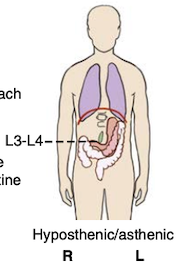
Sthenic patient: how are the abdominal organs situated?
J-shaped stomach, lower in abd cavity compared to hypersthenic (T10-L2)
Pylorus L2
Duodenal bulb L1-L2
Gallbladder less transverse than hypersthenic, midway between LAT abd wall and midline
Splenic (left colic) flexure often high under left diaphragm
What level are the mastoid processes?
C1
What level is the gonion?
C2-C3
What level is the thyroid cartilage (the most prominent part)?
C5
(This level can vary between C4-C6)
What level is the vertebra prominens?
T1
What level is the jugular notch?
T2-T3
What level is the sternal angle?
T4-T5
How far is the sternal angle from the jugular notch?
5 cm
2 inches
How far is the xiphoid process from the jugular notch?
8-10 cm
(3-4 inches)
What level is the xiphoid process?
T9-T10
What level is the lower/inferior costal margin?
L2-L3
What level is the iliac crest?
L4-L5
What level is ASIS?
S1-S2
What other anatomy can be used to find the level of the pubic symphysis?
Greater trochanters
What landmark is found between the eyebrows?
Glabella
What landmark is found where the nose and forehead connect?
Nasion
What landmark is where the nose and upper lip meet?
Acanthion
What landmark is at the angle on each side of the jaw?
Gonion
What landmark is the midpoint and most anterior portion of the chin?
Mental point
What line runs from the glabella to a point anterior to the alveolar process of the maxilla?
Glabelloalveolar line
What is the inion?
Most prominent portion of the external occipital protuberance
Can be approximated by extending the IOML posteriorly