Unit 1 Chapters 1-3 BIOL 304
 Call Kai
 Learn
Learn Practice Test
 Spaced Repetition
 Match
Match Flashcards
 Knowt Play
1/174

There's no tags or description
Looks like no tags are added yet.
Name | Mastery | Learn | Test | Matching | Spaced | Call with Kai | Chat |
|---|
No analytics yet
Send a link to your students to track their progress
175 Terms
Define macromolecules
Large biological molecules
Define metabolites
Smaller molecules involved in bchem rxns
Define a cell
Smallest unit of life, can reproduce, genetic material holds code for all proteins, capanle of response to environment, and metabolism
Define plasma membrane (eukaryotic organelles)
encloses cell body, limits transport of molecules
Define nucleus (eukaryotic organelles)
contains genetic info
Define mitochondria (eukaryotic organelles)
aspects of metabolism, production of ATP
Define endoplasmic reticulum (eukaryotic organelles)
synthesis and storage, modify protein
Define golgi apparatus (eukaryotic organelles)
processing and sorting, attach lipid + other group
Define lysosomes (eukaryotic organelles)
removal of old organelles, processing of ingested material, garbage disposal
Define peroxisomes (eukaryotic organelles)
breakdown of catabolites, breakdown proteins
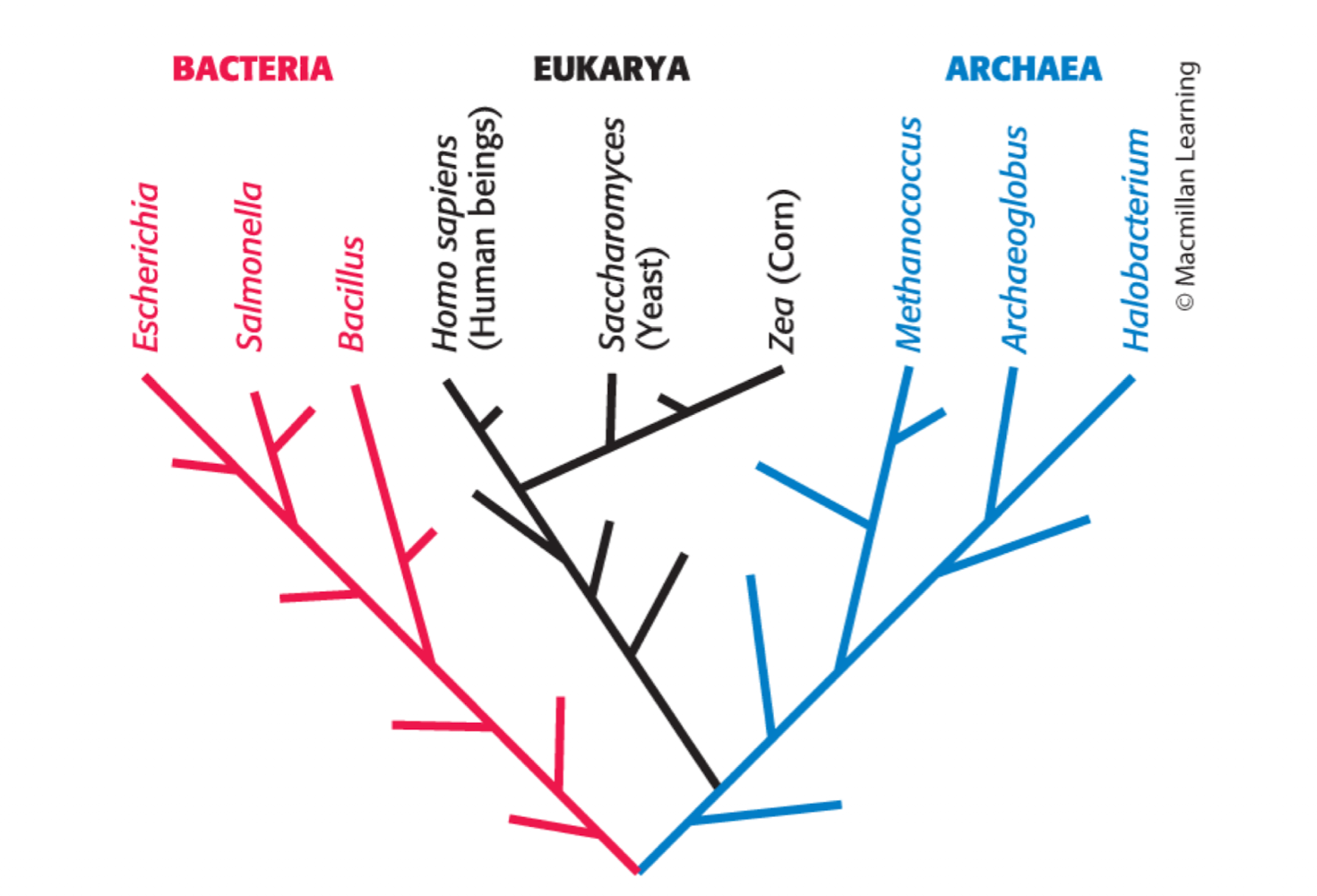
What does the phylogenetic tree of life look like?
Define covalent bonds
Formed by electron sharing between atoms
Define resonance
Shifting of bonds/e-s which adds stability
Multiple covalent structures
Define ionic interactions
Noncovalent interactions (don’t share e-s) that occur between fully charged atoms/molecules
Charge, distance, and surrounding solvent matter (water weakens electrostatic attractions)
What are electric dipoles, how do they form? Can they interact?
Molecules with no overall charge can have regions where electron distribution is uneven
Electrons may be distributed unevenly, resulting in dipole charge
Dipoles CAN interact with ions and other dipoles

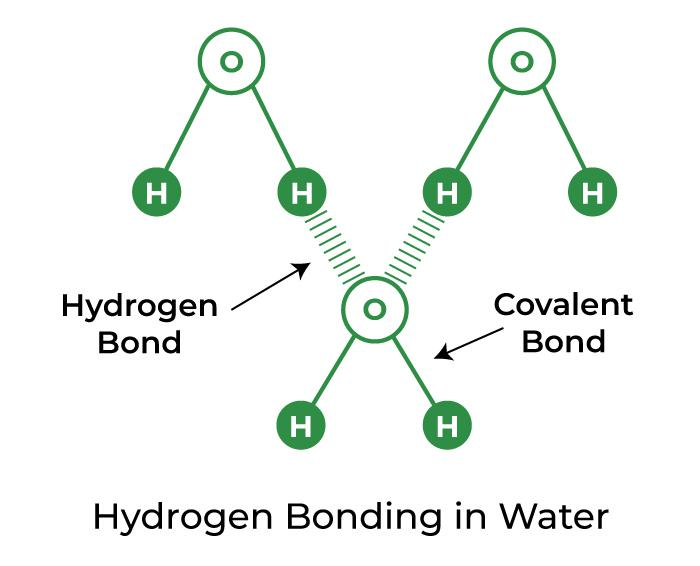
Define hydrogen bond
When H attached to EN atom interacts with another EN atom
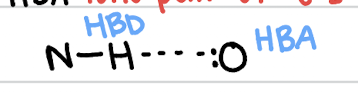
Define hydrogen bond donor
Group that includes atom that the H atom is covalently attached to and the H atom itself (includes both EN bonded atom and H atom)
Define hydrogen bond acceptor
Lone pair of e-s that is on the atom less tightly linked to the H atom
Define van deer Waals interactions
Interaction between neighboring atoms, temporary uneven e- distribution → temporary partial charges → nearby attraction
E’s constantly moving → may become unevenly distributed in atom → temporary imbalance impacts neighboring atom → creates attraction

For VDW forces, what does it mean if they are too far, proper distance, and too close?
Too far apart → little interaction
Proper distance → attractive interaction
Too close → strong repulsion
What are the forces ranked from strongest to weakest
Covalent > ionic > H-bonding > VDW
What are the properties of water?
Polar molecule (unequal e- sharing), highly cohesive
Max # of H-bonding formed in crystalline ice (large # in liquid water)

What is the hydrophobic effect/Why do hydrophobic interactions take palce?
Hydrophobic: water avoiding
Nonpolar (share e- equally) molecules doesn’t interact favorably with water → NP molecules in water can be driven together by hydrophobic effect (powered by the increase in entropy of water) → associated interactions are called hydrophobic interactions
Water prefers interacting with itself, NP molecules cluster together, reducing their contact with water and increase the freedom of water molecules

What do hydrophobic interactions lead to?
NP molecules are not water soluble → water interacts with itself and excludes the NPM →
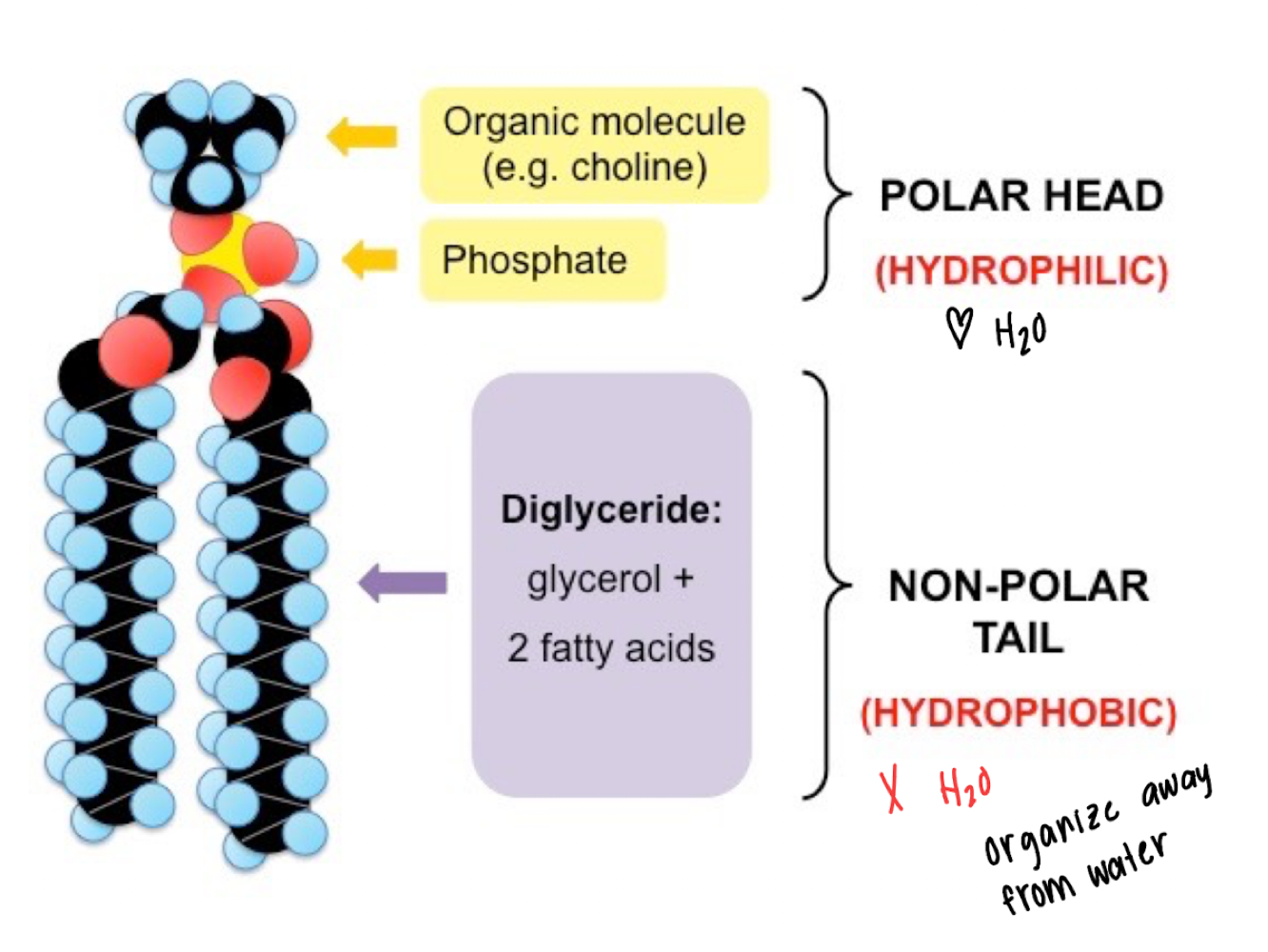
PHOSPHOLIPIDS FORM BIOLOGICAL MEMBRANES IN WATER BECAUSE OF HYDROPHOBICITY OF FATTY ACIDS
Draw out the organic molecules (alkane, alkene, alkynes, alcohol, ketone, aldehyde, carboxylic acid, amine)

Define reduction & oxidation
Basis for most metabolic rxns and pathways
Reduction: gain of e-
Oxidation: loss of e-
In biological systems, enzymes often perform redox rxns with a coenzyme to donate/accept e- pair to/from a carbon skeleton
Define acyl links and how they are formed
A chemical bond that connects an acyl group (R-C=O) to another atom or molecule
Condensation of carboxylic acids with other EN functional group form acyl linages
Define condensation
Builds acyl linage, WATER AS P
Define hydrolysis
Breaks acyl linkage, WATER AS R
What is the 1st law of thermodynamics
Total E of a system and its surroundings is constant
What is the 2nd law of thermodynamics
Total entropy (disorder) of a system plus that of its surroundings ALWAYS INCREASES
Entropy can decrease locally in system if there is a corresponding increase in entropy in surroundings
What is the thermodynamics equation for change in entropy of surroundings?

Overall change in entropy equation?

Define gibbs free energy (and its equation)
Describes the energetics of biochemical reactions

What does positive versus negative G indicate, when will entropy increase?
Entropy will increase when G is negative
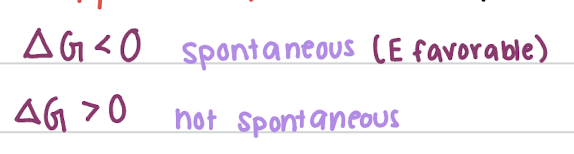
Define reaction coupling (in terms of G)
Energetically unfavorable rxn with positive G gets driven by pairing it with favorable negative G
Define acid base reactions
Involve addition/removal of a hydrogen (H+ atom)
Define pH and its equation
Measure of H+ concentration
pH = -log[H+]
What does more H+ ions mean for pH, less?
Increase H+ → lower pH, acidic
Decrease H+ → higher pH, basic
How do you find proton/hydroxide ion concentration?
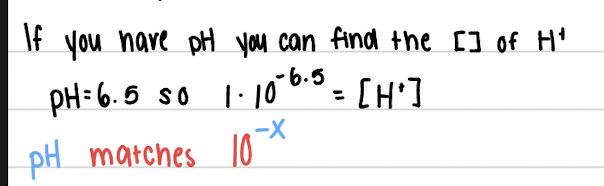
What does it mean for protonation/deprotonation when pH is above, below, and equal to pKa?
pH below pKa = group tends to stay protonated
pH above pKa = group tends to become deprotonated
pH = pKA = equal amounts of protonated and deprotonated forms
pKa = tells you how strong an acid is and how easily it gives away a proton
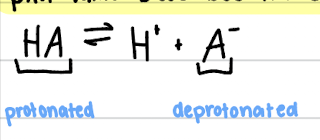
Define buffer (what does it do)? When are they most effective?
Resist changes in the pH of a solution, regulate pH
Most effective at pH near its pKa
What is the Henderson-Hasselbalch Equation?
Weak As are most effective as buffers at pH near pKa value of its acid component
the buffer has its maximum capacity to resist changes in pH because the concentrations of the weak acid and its conjugate base are equal (or nearly equal) in the solution

Why is phosphoric acid an important buffer in biological systems?
pH typically near 7.4
Inorganic phosphate exists as a nearly equal mixture of H2PO4- and H2PO4 2-
Define polymers
Large molecules built from repeating smaller units (monomers)
Define proteins
Linear polymers composed of monomers (amino acods)
What are characteristics of proteins
Contain wide range of functional groups → reactive properties are essential to function of the protein (PROPERTIES INFLUENCE HOW THE PROTEIN BEHAVES)
Can interact with one another and other macromolecules to form complex assemblies
Can be rigid (underlying tissue) or flexible (enzymes, to change shape) [depends on structure]
Responsible for physical structures within cells as well as catalysts for rxns
What does amino acid composition dictate?
Amino acid composition → protein structure → protein function
Proteins are built from 20 amino acids, what is the structure of a amino acid? What are the two resulting isomers?
Chiral protein:
Amino group, CA group, H atom, specific R (amino) group
L Isomer & D isomer
Living organisms use L-amino acids almost exclusively to build proteins and peptides

7/20 AAs have readily ionizable side chains
Dont have to memorize

What is a peptide bond? What does a peptide bond formation involve?
Peptide bond = a type of covalent chemical linkage where a carbonyl carbon (C=O) binds directly to a nitrogen atom (N)
Involves:
Linking of alpha-carboxyl group (COO-) of one amino acid to the alpha-amino group (R) of another AA through acyl linkage
Loss of water molecule (reacting AAs lose H and OH as they form peptide bond)

Define residue, how many are present in polypeptide chains
Single amino acid unit in a polypeptide
50 - 2000 AAs residues
How do you read polypeptide chains?
Read from the N terminus (amino group) to the C terminus (Carboxyl group)
Polypeptide chain: string of amino acids linked together

Define oligopeptides
Polypeptide chains made of small number of amino acids (short chain)
Define lipids and its characteristics (in terms of solubility)
Water-insoluble biomolecules, highly soluble in organic solvents (most lipids come from fatty acids)
Hydrophobic due to fatty acids
Define fatty acids and its characteristics
Long hydrocarbon chains that terminate with CA groups
Vary in length and degree of saturation (= affect physical properties)
Hydrocarbon chain = largely hydrophobic
CA group: ionizable (can act as an acid and shed a hydrogen ion into the surrounding liquid) → leads to be shown in COO- form
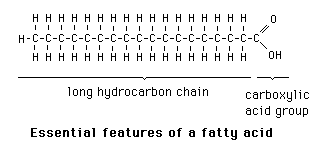
How do unsaturated and saturated fatty acids differ?
Unsaturated: double bond
Saturated: no double bond
How to name fatty acids?
Based on their parent hydrocarbons
First # = carbons
Second # = double bonds
18:1 = 18-C chain, 1 double bond
What are the two different ways of naming a fatty acid cuain
Carbons can be numbered starting at carboxyl (COO-) terminal carbon atom
Position of double bond represented by Δ following subscript number
Start at last methyl carbon atom (omega (w) carbon)
Position of double bond represented by counting from end

Characteristics of fatty acids in biological systems
Even # of C atoms (16/18 most common)
Animal fatty acid usually have unbranched chains
Unsaturated fatty acids generally have cis double bonds
How does chain length and saturation of fatty acids impact fluidity?
Shorter chain + More unsaturated = More fluid
Because more double bonds creates more bends → poorer packing → greater fluidity
Longer chain + More saturated = Less fluid
What are the functions of lipids
Fuel molecules → more ATP
Highly concentrated E stores → stores fat
Signal molecules and messengers in signal-transduction pathways → signals body, tells how to respond
Essential component of biological membrane
What are the 3 principal lipids (in eukaryotic membranes)
Phospholipids
Glycolipids
Cholesterol
Characteristics of membranes
Sheetlike structures, 2 molecules thick, form closed boundaries
Contains many lipids and proteins w/ linked carbohydrates
Lipids that form lipid bilayers
Proteins embedded in lipid bilayers with distinct functions
Asymmetric
Fluid structures → must STAY IN MOTION
Tend to be electrically polarized → # charges on either side of membrane is different
What are phospholipids made of? Draw the structure
1+ fatty acids, platform (glycerol, Sphingosine) which fatty acids are attached, phosphate, OH attached to phosphate

Define phosphoglyceride
phospholipids derived from glycerol (glycerol as backbone)
Phosphatidate is the simplest phosphoglyceride

Where are the 3 C position on phosphatidate (3C backbone)
OH group on C1
C2 attach to FA through ester linkages
C3 carries phosphate groups

Phosphoglycerides have a 3C glycerol backbone and are also derived from phosphatidate. What is the structure of a phosphoglycerides?

The presence of alcohol in a phosphoglyceride is important why?
Dif alcohol groups produce different phosphoglycerides
Define sphingosine
An amino alcohol that contains a long, unsaturated hydrocarbon chain
Define sphingomyelin
Common membrane phospholipid with sphingosine backbone
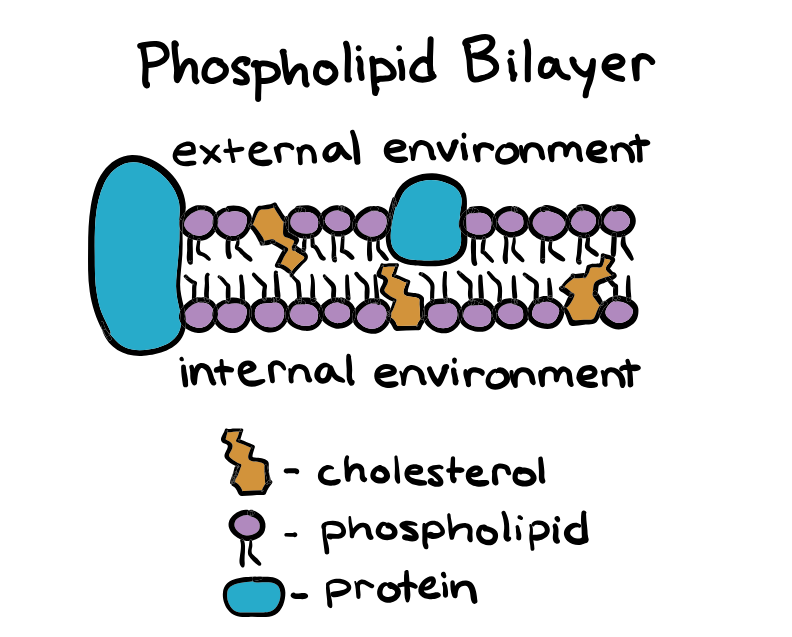
Define cholesterol
Component of membrane, steroid built from 4 linked hydrocarbon rings
Characteristics of cholesterol (w phospholipid bilayer)
Contains linked hydrocarbon tail at one end and an -OH group at the other end
Orientated parallel to FA chains of phospholipids in membranes (→ fits into membrane bc interaction near hydrophilic region, most of molecule sits in hydrophobic interior)
OH group interacts with phospholipid head group
Cholesterol fits between phospholipids and helps control membrane fluidity, stability, and permeability
Define amphipathic
One molecule contains both hydrophilic and hydrophobic region
→ so membrane lipids = AMPHIPATHIC MOLECULES
Define moiety
Part or portion
Which part of the membrane lipid is hydrophobic moiety, hydrophilic moiety?
Hydrophobic moiety: fatty acid tails
Hydrophilic moiety: phosphorycholine (phosphate-containing head)
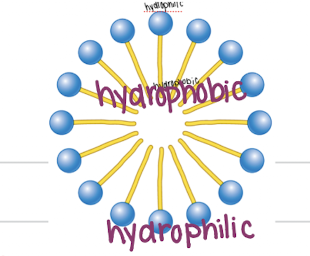
Define micelle
globular structure with the polar head groups on the outside surface and hydrocarbon tails sequestered inside
Membrane formation is a consequence of the amphipathic nature of the molecules
How are micelles formed?
Formed by many single taniled FA molecules
Describe the lipid bilayer
Hydrophobic tails of each sheet interact → forms permeability barrier
Hydrophilic head group interact with aqueous medium

Lipid bilayer formation is spontaneous (meaning the arrangement is energetically favorable), how is it stablized?
Hydrophobic interactions
VDW interactions b/w hydrocarbon tails
Electrostatic + H-bonding interactions b/w polar ends and water
What are consequences of hydrophobic interactions between lipid bilayers?
Tend to close on themselves so that there are no edges with exposed hydrocarbon chains
→ forms compartments where organelles are stored
Why are exposed hydrophobic tails bad?
Unfavorable → bilayer self-seals and repairs gaps
What type of molecules have high vs. low permeability?
LOW PERMEABILITY
Ions
Polar molecules (because they interact well with water)
But water is an exception → has low MW, high [], lack of charge so it crosses better than expected
Charged / strongly polar (unequal e- sharing) → lower permeability
HIGH PERMEABILITY
Hydrophobic
Non polar molecules (equal e- share)
Define membrane proteins
Allow transport of molecules and information across a membrane, can open and close channels
Vary in protein content (<20% - 75%)
What do membrane proteins in a cell reflect?
Reflection of biochem occurring inside cell
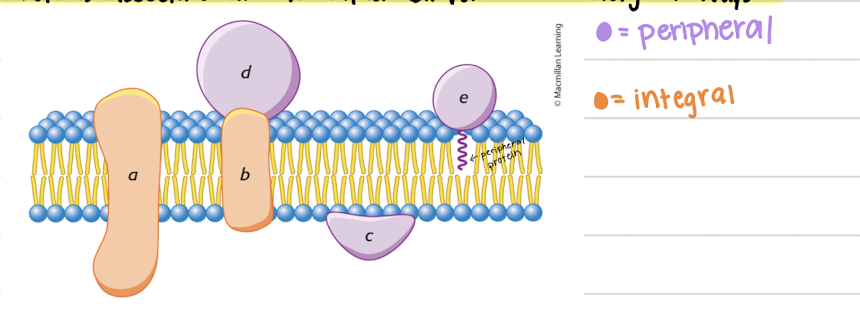
Define integral membrane proteins, where are they bound?
Interact with hydrophobic hydrocarbon region of membrane
Most completely span bilayer
What happens to integral membrane proteins when a chemical that interacts with the hydrophobic region competes?
Held in membrane partly bc their NP regions interact with NP fatty acid → when chemical that also interacts with hydrophobic region competes w/ tail for interaction w/ protein THEY GET RELEASED
Define peripheral membrane proteins, where are they bound?
Loosely bound to membranes primarily by electrostatic and H-bonding interactions with head groups of lipids
Often bound to surface of INTEGRAL proteins
What happens with tiny changes (pH, pKa, etc.) to peripheral membrane proteins?
Fall off membranes
What would these two proteins look like on the bilayer
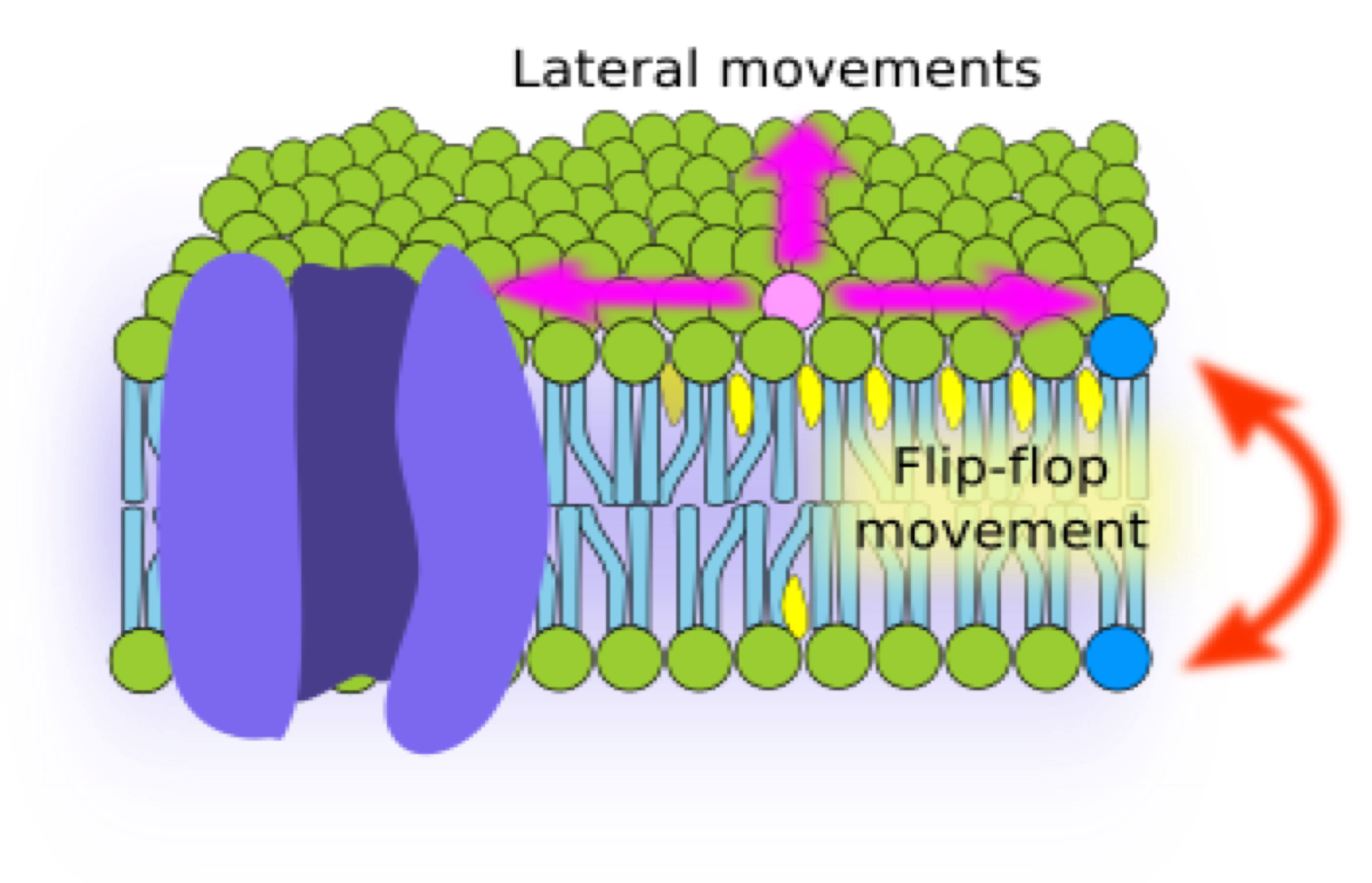
Define lateral diffusion
process by which lipids and many membrane proteins are constantly in lateral motion
Are membranes rigid? Define membranes
NO! They are organized, fluid structures
→ lipids + many membrane proteins diffuse rapidly in plane of the membrane
What is the purpose of FRAP and how is it done?
FRAP demonstrates that the membrane is fluid-like amd moves laterally
Membrane glowing everywhere → one area gets bleached → if membrane components move laterally, unbleached fluorescent molecules from surrounding area move into dark area
What does the rate of recovery for FRAP depend on?
Depends on lateral mobility and temp of labeled component
→ Process resulting in an increase in fluorescence intensity in the area previously bleached, recovery occurs if component is mobile
Define fluid mosaic model
Describes biological membrane organization as two dimensional solutions of oriented lipids and globular proteins
What are characteristics of the lipid bilayer (in terms of movement and permeability)
Solvent and permeability barrier
Lipids rapidly diffuse laterally in membranes
Transverse diffusion (flip-flopping) = very slow and unlikely to happen
What is the difference between lateral diffusion and transverse diffusion
Lateral diffusion: moves laterally, rapid
Transverse diffusion: flip flops, slow, preserves membrane asymmetry

What do many membrane processes depend on?
Fluidity of the membrane
What does fluidity of the membrane depend on?
Properties of fatty acid chains
Temperature
Below transition T = more rigid
Above transition T = more fluid
How does saturation impact the melting temperature of a fluid membrane?
Saturated fatty acid (no double bond) → interact favorably with one another
Favors rigid state, tighter packing → stronger interactions
→ HIGHER MELTING TEMP
Unsaturated fatty acid (double bond produces bend in hydrocarbon)
Interferes with highly ordered packing of fatty acid chains
→ LOWER MELTING TEMP