Chronic adaptations to aerobic training - cardiovascular
 Studied by 0 people
 Knowt Play
 Learn
Learn Practice Test
 Spaced Repetition
 Match
Match Flashcards
1/25

There's no tags or description
Looks like no tags are added yet.
Name | Mastery | Learn | Test | Matching | Spaced |
|---|
No study sessions yet.
26 Terms
Define cardiac hypertrophy
Enlargement of the heart muscle, increasing left ventricle size and volume
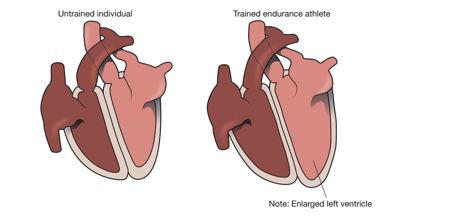
Effect of increased left ventricle size
Greater blood ejection from the heart, delivering more oxygen to working muscles
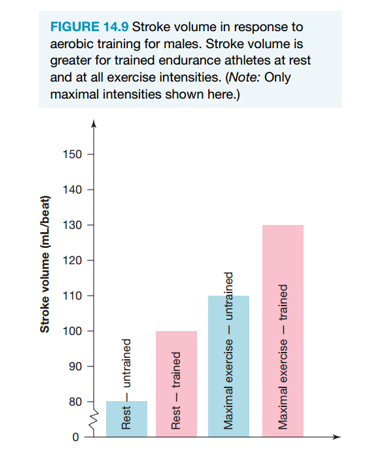
Increased stroke volume
Stroke volume is higher at rest, submaximal, and maximal exercise due to cardiac hypertrophy, delivering more oxygen to muscles for sustained aerobic ATP production at higher intensities for longer with fewer fatiguing factors
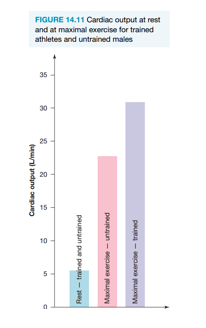
Increased cardiac output
Cardiac output rises at maximal exercise mainly from increased stroke volume, as heart rate changes little with aerobic training
Decreased resting and submaximal heart rate
With higher stroke volume from training, the heart pumps more blood per beat, so fewer beats are needed at rest and submaximal exercise
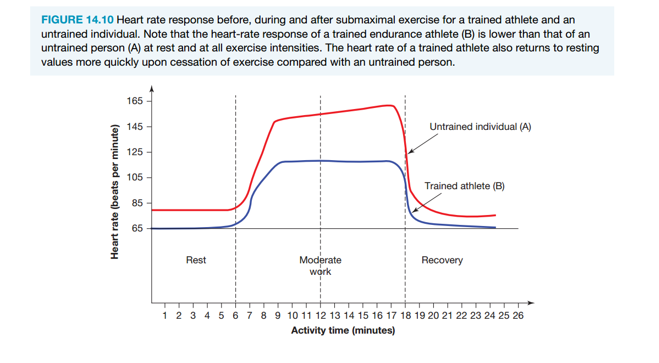
Faster heart rate recovery
Trained athletes’ hearts return to resting rate faster due to greater cardiovascular efficiency and aerobic energy production
Effect of aerobic training on blood pressure
May lower blood pressure (especially among people who suffer from hypertension (high blood pressure)), reducing resistance to blood flow and heart strain, decreasing the risk of heart attack and other cardiovascular conditions
Effect of aerobic training on blood volume and haemoglobin
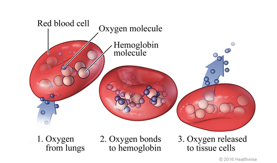
Total blood volume may rise by up to 25% for an average adult male, red blood cells and haemoglobin content increase, enhancing oxygen delivery to muscles (oxygen carrying capacity of the blood may also rise)
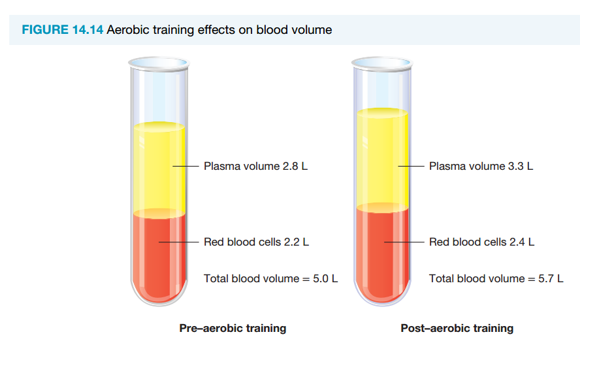
How does increased blood plasma volume help
Reduces blood viscosity, allowing smoother flow through vessels and better oxygen delivery to muscles
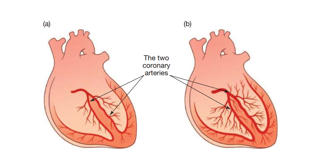
Effect of cardiac hypertrophy on heart muscle capillarisation
Increases capillarisation, providing more blood and oxygen, allowing the heart to beat more strongly and efficiently during exercise and rest
Effect of aerobic training on skeletal muscle capillarisation
Increases capillary supply to working muscles, improving blood flow, oxygen and nutrient delivery, removal of by-products, and contributes significantly to higher VO₂ max
Heart size and volume adaptation to aerobic training
Increase
Capillarisation of heart muscle adaptation
Increase
Capillarisation of skeletal muscle adaptation
Increase
Total blood volume adaptation
Increase
Red blood cells/haemoglobin: Increase
Plasma volume: Increase
Stroke volume adaptation
Rest: Increase
Submaximal exercise: Increase
Maximal exercise: Increase
Heart rate adaptation
Rest: Decrease
Submaximal exercise: Decrease
Maximal exercise: No change
Recovery heart rate adaptation
Faster
Cardiac output adaptation
Rest: No change
Submaximal exercise: Slight decrease
Maximal exercise: Increase
Blood pressure adaptation
Slight decrease
Increased left ventricle size and volume
Cardiac hypertrophy increases left ventricle size and volume, raising stroke volume and cardiac output. More blood is ejected, delivering more oxygen for performance.
Increased capillarisation of the heart muscle
Cardiac hypertrophy increases capillarisation, providing more blood and oxygen, allowing the heart to beat more strongly and efficiently at rest and during exercise.
Faster heart rate recovery
Trained athletes’ hearts return to resting rates faster due to greater cardiovascular efficiency and aerobic energy production.
Increased blood volume and haemoglobin levels
Red blood cells and haemoglobin increase oxygen-carrying capacity. Increased plasma volume reduces blood viscosity, improving smooth flow and oxygen delivery to muscles.
Increased capillarisation of skeletal muscle
More capillaries increase blood flow, oxygen and nutrient delivery, and by-product removal, supporting higher VO₂ max and performance.
Decreased heart rate at rest and submaximal workloads
Higher stroke volume means fewer heartbeats are needed to deliver required blood/oxygen. Heart rate rises more slowly during exercise and reaches steady state sooner.