GENCHEM QA IJNIP
 Call Kai
 Learn
Learn Practice Test
 Spaced Repetition
 Match
Match Flashcards
 Knowt Play
1/52

There's no tags or description
Looks like no tags are added yet.
Name | Mastery | Learn | Test | Matching | Spaced | Call with Kai | Chat |
|---|
No analytics yet
Send a link to your students to track their progress
53 Terms
E
Which of the following has indefinite shape?
A) Solid
B) Liquid
C) Gas
D) A and B
E) B and C
D
Which of the ff. is classified as a chemical change?
A) Production of ice cubes
B) Reduction of sauces that are too dilute
C) Formation of suppositories in their molds
D) Combustion of gasoline
E
The oxygen we breathe is classified as?
A) Compound
B) Element
C) Molecule
D) A and B
E) B and C
C
When hydrocarbons in fuel are burned, they can
produce either carbon dioxide or carbon monoxide. This
is a manifestation of the law of
A) Conservation of mass
B) Definite proportion
C) Multiple proportion
B
Proposed the planetary model of the atom
A) Rutherford
B) Bohr
C) Thomson
D) Schrodinger
E) Chadwick
E
The mass of the atom is highly dependent on
A) Proton
B) Electron
C) Neutron
D) A and B
E) A and C
C
18Ar40 and 20Ca40 are examples of
A) Isotopes
B) Isotones
C) Isobars
D) Isomers
E) Allotropes
B
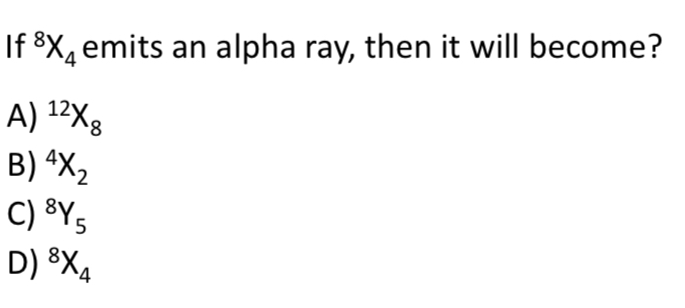
B
Dumbbell – shaped orbital
A) s
B) p
C) d
D) f
D
What is the azimuthal number of the s sublevel?
A) 1
B) 2
C) 3
D) 0
C
A d subshell has how many orbitals?
A) 1
B) 3
C) 5
D) 7
E) 9
D
It is impossible to determine simultaneously the
momentum and position of the electron according to
the
A) Hund’s Rule
B) Pauli’s Exclusion Principle
C) Aufbau’s Building Up Principle
D) Heisenberg Uncertainty Principle
D
Which among the choices gained popularity for
advancing the development of the periodic table?
A) Avogadro
B) Le Chatelier
C) Lavoisier
D) Mendeleev
A
Which among the following elements is likely to
have the lowest ionization energy?
A) Calcium
B) Carbon
C) Bromine
D) Helium
E
All noble gases have the following number of
valence electrons
A) 2
B) 5
C) 3
D) 7
E) 8
B
A certain bond in compound A has an
electronegativity difference of 0.8, the bond is
A) Nonpolar
B) Polar
C) Ionic
D) None of the above
C
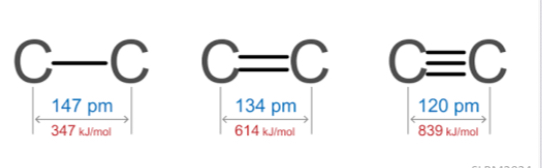
As the number of bonds between two carbons
increases, which of the following decreases?
A) Number of electrons
B) Bond energy/strength
C) Bond length
D) All of the above
D
Which of the following is the geometry is PF5?
A) Tetrahedral
B) Trigonal planar
C) Linear
D) Trigonal bipyramidal
E) Bent
A
What intermolecular force is involved with
compounds with purely C-C and C-H bonds?
(EN: C = 2.5, H = 2.1)
A) London dispersion
B) Hydrogen bond
C) Dipole-dipole
D) Ion-dipole
B
What intermolecular force is demonstrated by 2
molecules of water? (EN: O = 3.5, H = 2.1)
A) London dispersion
B) Hydrogen bond
C) Dipole-dipole
D) Ion-dipole
D
Which of the following compounds is not a
candidate for dipole-dipole formation?
A) CH3Cl
B) CH3OCH3
C) CH3SH
D) CH3CH2CH3
E) HC
D
Which of the following would a neutralization
reaction most appropriately classified as?
A) Combination
B) Decomposition
C) Single displacement
D) Double displacement
B
Which of the following is true to an oxidizing agent
like cupric sulfate?
A) Will be oxidized
B) Will gain electrons
C) Will have a higher oxidation state
D) Two of the above
E) All of the above
D
States that energy cannot be created nor destroyed,
but can only be converted from one form into another
A) Third law of thermodynamics
B) Second law of thermodynamics
C) Zeroth law of thermodynamics
D) First law of thermodynamics
B
What is the symbol of enthalpy?
A) G
B) H
C) E
D) S
D
Which of the following has the highest entropy?
A) Margarine
B) Brewed coffee
C) Mind
D) Aerosol propellants
A
If enthalpy is negative, then it means
A) There was release of heat
B) The change is endothermic
C) The environment will feel colder
D) The object will eventually become hotter
B
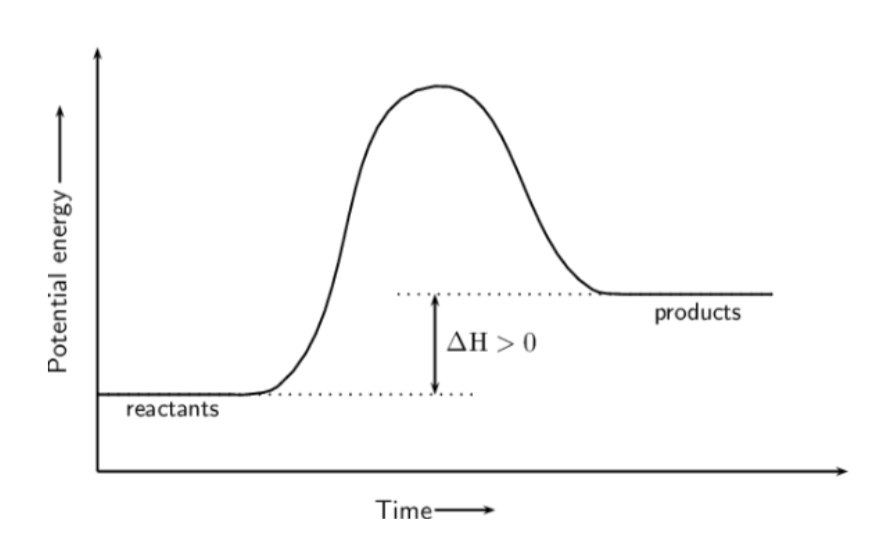
What statements apply for the energy diagram
presented?
A) exergonic
B) a positive ΔG
C) spontaneous
D) two of the above
C
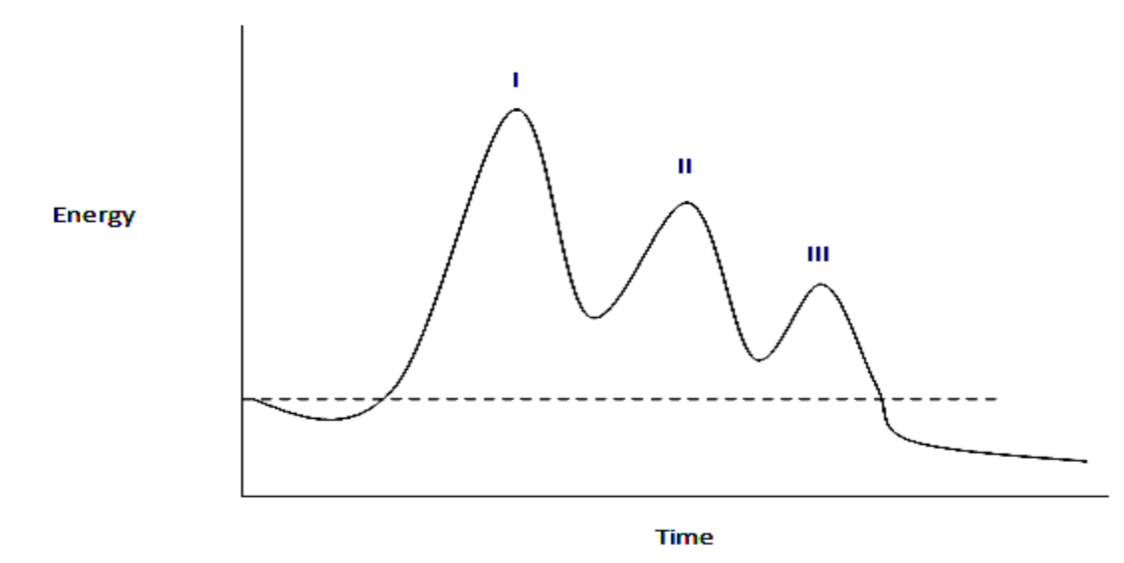
Refer to the diagram. How many steps are there in
the reaction?
A) 1
B) 2
C) 3
D) 4
A
catalyst performs the following EXCEPT
A) Raises activation energy
B) Lowers activation energy
C) Favors formation of product
D) Two of the above
A
A system in which two opposing reactions are
proceeding at unchanging rates, having no change in
proportions
A) Chemical equilibrium
B) Chemical reaction
C) Chemical kinetics
D) Chemical thermodynamics
A
In accordance to the law of mass action, what is the
appropriate interpretation for an equilibrium constant
that has a big value?
A) Rate of product formation is greater than reactant
B) Rate of reactant formation is greater than product
C) Both reactions occur equally
B
The following can cause a shift of equilibrium and
will be balanced back as per the Le Chatelier’s principle,
except
A) Concentration
B) Catalyst
C) Pressure
D) Temperature
B
What effect does an increase in pressure have in this system at equilibrium?
A (g) + 2B (g) <-→ 5AB (g) 𝚫H = +30kJ
A) Forward
B) Backward
C) No shift
A
What effect does heating have in this system at
equilibrium?
A (g) + 2B (g) ←→ 5AB (g)𝚫H = +30kJ
A) Forward
B) Backward
C) No shift
A
In the equilibrium system:
P4 (g) + 6Cl2 (g) ←→ 4PCl3 (g)
what will happen if the volume is changed from 12L to 15L?
A) Equilibrium will shift to the left
B) Equilibrium will shift to the right
C) No change in equilibrium
B
In the equilibrium system:
P4 (g) + 6Cl2 (g) ←→ 4PCl3 (g)
what will happen if the chlorine gas employed was doubled in quantity?
A) Equilibrium will shift to the left
B) Equilibrium will shift to the right
C) No change in equilibrium
B
If the ion product is less than Ksp, the solution is
A) Saturated
B) Unsaturated
C) Supersaturated
D) Diluted
C
The following are true about acids except
A) Generally requires electronegative groups
B) Contains hydrogens with dipoles
C) Generally tastes bitter
D) Does not change the color of red litmus paper
C
The following are TRUE about acids and bases?
I. According to Arrhenius, acids are hydroxide donors
II. According to Lewis concept, acids are electron acceptors
III. According to Bronsted-Lowry concept, bases are proton donors
IV. According to Lewis concept, bases are electron donors
A) I, II, IV
B) I, III
C) II, IV
D) II, III, IV
B
Can act as either acid or base
A) Amphipathic
B) Amphoteric
C) Amphibolic
D) Amphibian
B
What is the relationship between a value and its
negative logarithm?
A) Direct
B) Inverse
D
The pH value is calculated mathematically as the
A) Log of hydroxyl ion concentration
B) Negative log of the OH- concentration
C) Log of the hydrogen ion concentration
D) Negative log of the H+ concentration
D
Which of the following does not belong to the
group?
A) HI
B) HCl
C) HNO3
D) HCN
D
In accordance with the law of mass action, which
would be the proper formula for the Ka of carbonic acid
H2CO3?
A) [H2CO3] / [HCO3-][H+]
B) [H2CO3][HCO3-] / [H+]
C) [H+] / [H2CO3][HCO3-]
D) [H+][HCO3-] / [H2CO3]
E) None of the choices
C
C
Oxides of typically non-metallic elements are
A) Neutral
B) Basic
C) Acidic
D) Amphoteric
C
How does a buffer work?
A) Being a mixture of various salts, a buffer can shift the equilibrium of the solution in either the direction of H3O+ or OH- (depending on
whether an outside acid or base is added)
B) Being a mixture of strong acid and a strong base, a buffer stabilizes pH by neutralizing itself, its environment, and consequently, any
added outside acid or base
C) Being a mixture of either weak acid or base and its conjugate, a buffer stabilizes pH by both accepting and providing protons for
reaction with any added outside acid or base.
D) Being a mixture of water, acids and bases, a buffer adjusts Kw upon addition of an outside acid or base so that either Ka or Kb remains
relatively constant
C
C
How does a buffer work?
A) Being a mixture of various salts, a buffer can shift the equilibrium of the solution in either the direction of H3O+ or OH- (depending on
whether an outside acid or base is added)
B) Being a mixture of strong acid and a strong base, a buffer stabilizes pH by neutralizing itself, its environment, and consequently, any
added outside acid or base
C) Being a mixture of either weak acid or base and its conjugate, a buffer stabilizes pH by both accepting and providing protons for
reaction with any added outside acid or base.
D) Being a mixture of water, acids and bases, a buffer adjusts Kw upon addition of an outside acid or base so that either Ka or Kb remains
relatively constant
D
Which of the ff. would be the most basic?
A) Benzoic acid (pKa = 4.20)
B) Fluoroacetic acid (pKa = 2.59)
C) Trifluoroacetic acid (pKa = 0.23)
D) Acetic acid (pKa = 4.76)
C
What is the concentration of diluted acid?
A. 85
B. 2.4
C. 6
D. 98