ev/qv
 Call Kai
 Learn
Learn Practice Test
 Spaced Repetition
 Match
Match Flashcards
 Knowt Play
1/14

There's no tags or description
Looks like no tags are added yet.
Name | Mastery | Learn | Test | Matching | Spaced | Call with Kai | Chat |
|---|
No analytics yet
Send a link to your students to track their progress
15 Terms
what is a discount rate and how is it calculated?
discount rate represents the return investors require to invest in a company, based on the risk of its future cash flows (the higher the risk, the higher the return required/discount rate)! if u are valuing the entire company, you would usually use wacc as the discount rate.
Discount rates vary because not all companies have the same risk, even if they are in the same industry and similar in size. For example, two retailers with the same revenue and growth rate may still deserve different discount rates if one has more stable cash flows, stronger margins, lower CapEx needs, or operates in a healthier geography. A retailer that can grow while spending less on CapEx may be viewed as higher quality because more of its earnings convert into actual free cash flow. On the other hand, a retailer exposed to a declining sub-industry or geography may have a higher discount rate because investors see its future cash flows as riskier.
what is wacc and how is it calculated?
WACC stands for Weighted Average Cost of Capital, and it represents a company’s blended cost of financing from its main capital providers, usually debt and equity. In a DCF, WACC is used as the discount rate when valuing a company based on unlevered free cash flow, because unlevered free cash flow is available to all investors, including both debt holders and equity holders. In other words, WACC tells you the minimum return the company must generate to satisfy everyone who provides capital to the business.
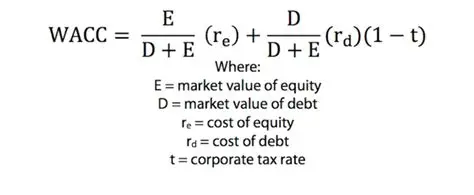
To calculate WACC, you weight the company’s cost of equity and after-tax cost of debt based on how much of the company’s capital structure comes from each source. The formula is WACC = (E / V × Cost of Equity) + (D / V × Cost of Debt × (1 - Tax Rate)), where E is the market value of equity, D is the market value of debt, and V is total capital, or debt plus equity. The cost of equity is usually calculated using CAPM, which equals the risk-free rate plus beta times the equity risk premium. The cost of debt is based on the interest rate lenders would require to lend to the company, and it is tax-adjusted because interest expense is tax-deductible.
Conceptually, WACC is higher for riskier companies because investors require a higher return to compensate for greater uncertainty. A higher WACC lowers valuation because future cash flows are discounted more heavily, while a lower WACC increases valuation because the company’s future cash flows are viewed as safer and more valuable today.
from the guides: Remember that WACC is equal to the “cost” of each part of a company’s capital structure times
the percentage of capital in that part:
WACC = Cost of Equity % Equity + Cost of Debt % Debt + Cost of Preferred * % Preferred
So, if a company has different amounts of Debt, Equity, or Preferred Stock, those percentages
will all change – and therefore WACC will change.
does buying back shares increase qv?
Not necessarily. Decreasing share count does not automatically increase total Equity Value. It can increase each remaining shareholder’s ownership percentage, but the company also used cash to buy back shares, so there is less total equity value left.
The key distinction is:
Equity Value = total value of all common equity
Share Price = Equity Value / Shares Outstanding
So when a company repurchases shares, two things happen at the same time:
Cash goes down, which lowers total Equity Value.
Share count goes down, which can keep share price the same or sometimes increase it.
what’s the formula to calculate company value?
company value = cash flow / (discount rate - cash flow growth rate)
why do debt investors have lower return expectations and why is debt cheaper?
Debt investors have lower returns expectations than Equity investors since they can only earn a
fixed, or relatively fixed, interest rate on the Debt; also, to the company, the Interest Expense is
tax-deductible.
For these reasons, we can say that Debt is “cheaper” than Equity.
ebit
core, recurring business profitability, before the impact of capital structure and taxes.
ebitda
proxy for core, recurring business cash flow from operations, before the impact of
capital structure and taxes.
net income
profit after taxes, the impact of capital structure (interest), AND non-core
business activities.
what is free cash flow (FCF)
the cash a company generates from its business after paying for the investments needed to keep growing or maintaining the business.
In plain English:
Free Cash Flow = cash left over after running the business and buying/maintaining long-term assets.
A common formula is:
Free Cash Flow = Cash Flow from Operations - CapEx
ebit
EBIT = Earnings Before Interest and Taxes
The definition says:
“Core, recurring business profitability, before the impact of capital structure and taxes.”
That means EBIT shows how profitable the company’s main business is before considering:
Interest expense, which depends on how much debt the company has
Taxes, which depend on tax rules and tax rates
So EBIT is useful because it focuses on the actual business operations.
ebitda
EBITDA = Earnings Before Interest, Taxes, Depreciation, and Amortization
The definition says:
“Proxy for core, recurring business cash flow from operations, before the impact of capital structure and taxes.”
The important word is proxy.
EBITDA is not actual cash flow, but it is closer to cash flow than EBIT because it adds back non-cash expenses like depreciation and amortization.
Unlevered Free Cash Flow
NOPAT + Non-Cash Adjustments and Changes in Working Capital from CFS – CapEx.
Levered Free Cash Flow
Net Income + Non-Cash Adjustments and Changes in Working Capital from CFS – CapEx – (Mandatory?) Debt Repayments.
discount rate and dcf
the discount rate translates current market perceptions of risk into the DCF.
What is Free Cash Flow, and what does it mean if it's positive and increasing?
There are different types of Free Cash Flow, but one simple definition is Cash Flow from
Operations minus CapEx. FCF represents a company’s “discretionary cash flow” – how much it
has left for other areas after spending what’s required for its business.
You define it this way because pretty much everything in a company’s “Cash Flow from
Operations” section is required for its business – earning Net Income, paying for Inventory,
collecting Receivables, etc.
But almost every line item within the Investing and Financing Activities sections is “optional,”
except for Capital Expenditures.
If FCF is positive and increasing, it means the company can spend its excess cash in different
ways: it could hire more employees, spend more on Working Capital or CapEx, invest in other
assets, repay debt, acquire other companies, or return money to shareholders with dividends
or stock repurchases.