(09) GAAS & Quality Control
 Call Kai
 Learn
Learn Practice Test
 Spaced Repetition
 Match
Match Flashcards
 Knowt Play
1/44

There's no tags or description
Looks like no tags are added yet.
Name | Mastery | Learn | Test | Matching | Spaced | Call with Kai | Chat |
|---|
No analytics yet
Send a link to your students to track their progress
45 Terms
c. A system of quality controls.
1. A basic objective of a CPA firm is to provide professional services that conform with professional standards. Reasonable assurance of achieving this basic objective is provided through
a. A system of peer review.
b. Continuing professional education.
c. A system of quality controls.
d. Compliance with generally accepted reporting standards.
c. Peer review
2. The examination by CPAs of a CPA firm’s auditing practices to ascertain compliance with its quality control system
a. Compliance audit
b. Examination
c. Peer review
d. Quality control audit


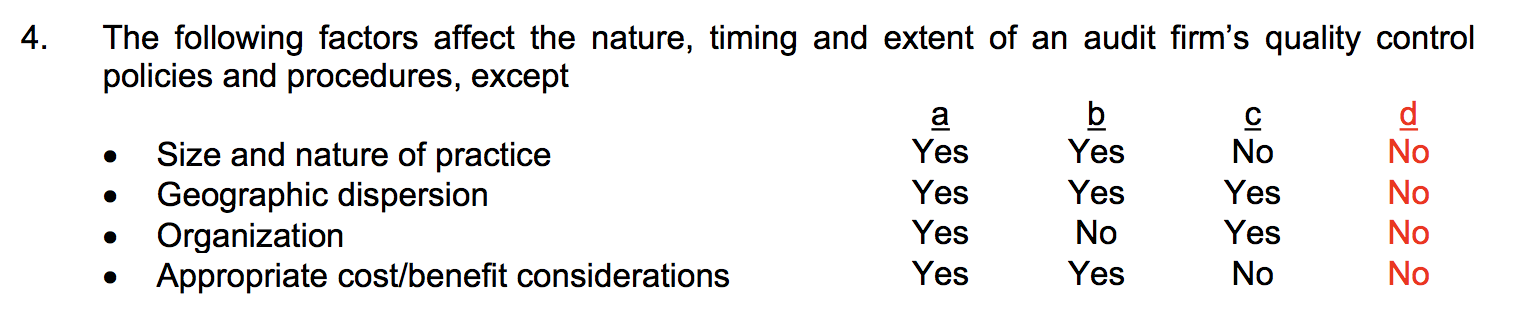
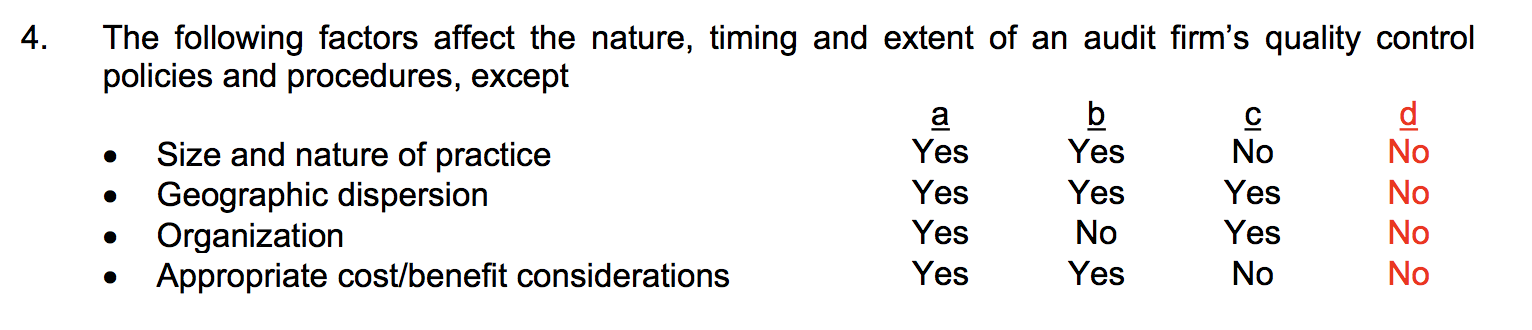
b. Skills and Competence
5. The firm is to be staffed by personnel who have attained and maintained the technical standards and professional competence required to enable them to fulfill their responsibilities with due care is the objective of what quality control policy?
a. Professional Requirements
b. Skills and Competence
c. Assignment
d. Delegation
a. Have the knowledge required to enable them to fulfill responsibilities assigned.
6. In connection with the element of professional development, a CPA firm’s system of quality control should ordinarily provide that all personnel
a. Have the knowledge required to enable them to fulfill responsibilities assigned.
b. Possess judgment, motivation, and adequate experience.
c. Seek assistance from persons having appropriate levels of knowledge, judgment, and authority.
d. Demonstrate compliance with peer review directives.
c. Knowledge required to fulfill assigned responsibilities and to progress within the firm.
7. Within the context of quality control, the primary purpose of continuing professional education and training activities, is to enable a CPA firm to provide personnel within the firm with:
a. Technical training that assures proficiency as an auditor.
b. Professional education that is required in order to perform with due professional care.
c. Knowledge required to fulfill assigned responsibilities and to progress within the firm.
d. Knowledge required in order to perform a peer review.
b. Requiring timely identification of the staffing requirements of specific engagements so that enough qualified personnel can be made available.
8. In pursuing its quality control objectives with respect to assigning personnel to engagements, a public accounting firm may use policies and procedures such as
a. Rotating employees from assignment to assignment on a random basis to aid in the staff training effort.
b. Requiring timely identification of the staffing requirements of specific engagements so that enough qualified personnel can be made available.
c. Allowing staff to select the assignments of their choice to promote better client relationships.
d. Assigning a number of employees to each engagement in excess of the number required so as not to overburden the staff and interfere with the quality of the audit work performed.
a. Quality control.
9. A CPA firm’s personnel partner periodically studies the CPA firm’s personnel advancement experience to ascertain whether individuals meeting stated criteria are assigned increased degrees of responsibility. This is evidence of the CPA firm’s adherence to prescribed standards of
a. Quality control.
b. Due professional care.
c. Supervision and review.
d. Fieldwork.
b. Advancement
10. The firm’s evaluation of the performance of its personnel and advising them of their progress is a quality control procedure that relates to
a. Promotion
b. Advancement
c. Monitoring
d. Directing
d. All of these
11. Which of the following relate to skills and competence as an objective of quality control policies?
a. Advancement
b. Hiring
c. Professional development
d. All of these
c. B D
12. Which of the following practices will promote the objectives of assignment of personnel?
A. Evaluates partners periodically by means of senior partner or fellow partner evaluation and counseling as to whether they continue to have the qualifications to fulfill their responsibilities.
B. Identifies on a timely basis the staffing requirements of specific audits
C. Periodically counsels personnel as to their progress and career opportunities
D. Prepares time budget for audit to determine manpower requirements and to schedule audit work.
a. A
b. A C
c. B D
d. All of them
c. Assigns an appropriate person or persons to be responsible for assigning personnel to audits.
13. Which of the following is not likely a quality control procedure on consultation?
a. Identifies areas and specialized situations where consultation is required and encourage personnel to consult with or in use authoritative sources on other complex matters.
b. Designates individuals as specialists to serve as authoritative sources and define their authority in consultative situations.
c. Assigns an appropriate person or persons to be responsible for assigning personnel to audits.
d. Specifies the extent of documentation to be provided for the result of consultation in those areas and specialized situations where consultation is required.
a. Providing reasonable assurance that the firm’s other quality control policies and procedures are effectively operating.
14. Monitoring, as an element of quality control policies of a firm, requires:
a. Providing reasonable assurance that the firm’s other quality control policies and procedures are effectively operating.
b. Designates individuals as specialists to serve as authoritative sources and define their authority in consultative situations.
c. Ensuring that personnel are sufficiently directed, supervised and their work being reviewed adequately.
d. Identify the right personnel to be assigned in an audit engagement.
b. Reviews and tests compliance with the firm’s general quality control policies and procedures.
15. Which of the following quality control procedures is a monitoring activity?
a. Evaluates the firm’s independence and its ability to serve the prospective client
b. Reviews and tests compliance with the firm’s general quality control policies and procedures.
c. Designates individuals as specialists to serve as authoritative sources
d. Monitors continuing professional education programs and maintain appropriate records
c. A, B, C, E, G, H
16. Which of the following objectives are generally a component of a firm’s quality control?
A. Professional requirements
B. Skills and competence
C. Assignment
D. Inspection
E. Consultation
F. Due professional care
G. Monitoring
H. Delegation
a. A, B, C, D, E, F
b. A, B, C, F, E, G
c. A, B, C, E, G, H
d. B, C, G, F, H
d. Prudence
17. Which of the following is not an element of professional requirements as prescribed by Quality Control Policies for an audit firm?
a. Independence
b. Integrity
c. Confidentiality
d. Prudence
b. Informing assistants of their responsibilities and the objectives of the procedures they are to perform.
18. Which of the following is an element of “directing an audit assistant” objective?
a. Identifying in advance the staffing requirements of a particular audit engagement.
b. Informing assistants of their responsibilities and the objectives of the procedures they are to perform.
c. Resolving any differences in professional judgment between audit personnel.
d. Resolution of differences in audit findings.
c. Directing
19. It involves informing assistants of their responsibilities and the objectives of the procedures they have to perform:
a. Supervision
b. Monitoring
c. Directing
d. Consultation
b. To have reasonable assurance that such work will be performed with due care by the audit assistant.
20. What is the overriding reason why the auditor considers the professional competence of assistants to whom the work will be delegated?
a. All the audit assistants assigned to an engagement must be independent in appearance.
b. To have reasonable assurance that such work will be performed with due care by the audit assistant.
c. To lessen the working paper preparation.
d. To eliminate audit risk.
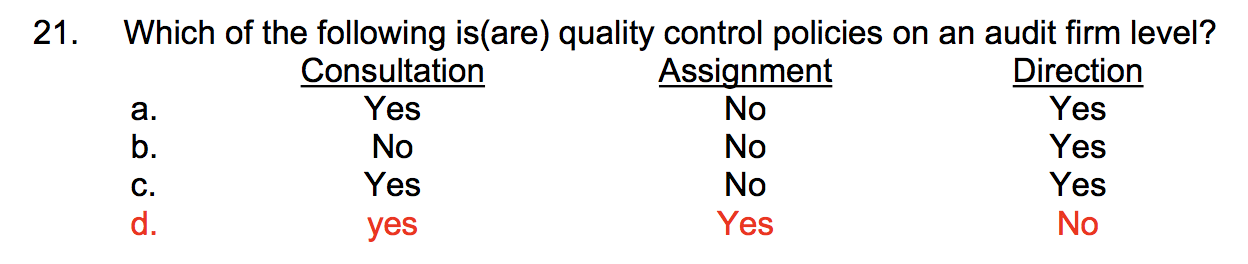
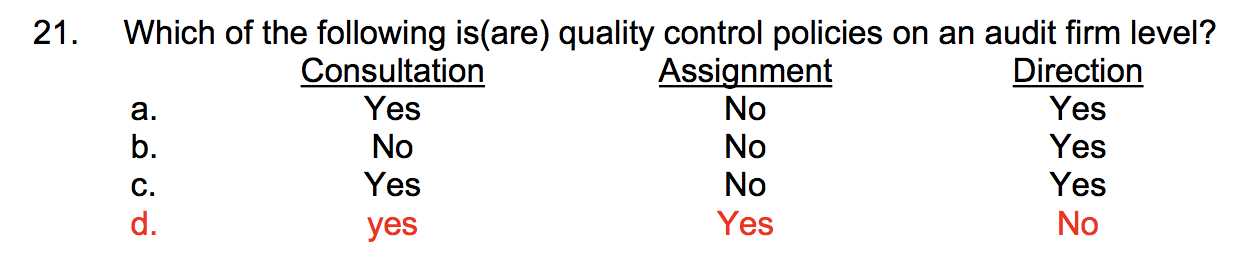
b. There is to be a sufficient direction, supervision, and review of work at all levels to provide reasonable assurance that the work performed meets appropriate standards of quality.
22. Which one of the following relates to delegation objective of quality control?
a. The firms creates a group that provides technical training to audit staff.
b. There is to be a sufficient direction, supervision, and review of work at all levels to provide reasonable assurance that the work performed meets appropriate standards of quality.
c. Assignment of work to the more qualified personnel.
d. Whenever necessary, consultation within or outside the firm is to occur with those who have appropriate expertise.


c. Minimum standards of performance which must be achieved on each audit engagement.
24. Generally Accepted Auditing Standards (GAAS) and Philippine Standards on Auditing (PSA) should be looked upon by practitioners as:
a. Ideals to work towards, but which are not achievable
b. Maximum standards which denote excellent work.
c. Minimum standards of performance which must be achieved on each audit engagement.
d. Benchmark to be used on all audits, reviews, and compilations.
d. Measures of the quality of the auditor’s performance
25. Which of the following best describes what is meant by Generally Accepted Auditing Standards?
a. Pronouncements issued by the Auditing Standards and Practices Council.
b. Procedure to be used to gather evidence to support financial statements.
c. Rules acknowledged by the accounting profession because of their universal compliance.
d. Measures of the quality of the auditor’s performance
d. Any of the three above is correct.
26. An auditor need not abide by an auditing standard if the auditor believes that
a. The amount is immaterial
b. The requirement of the standard is impractical to perform
c. The requirement of the standard is impossible to perform
d. Any of the three above is correct.
a. Without exception
27. A CPA should comply with applicable generally accepted auditing standards on every engagement
a. Without exception
b. Except in examinations that result in a qualified report
c. Except in engagements where the CPA is associated with unaudited financial statements.
d. Except in examinations of interim financial statements.
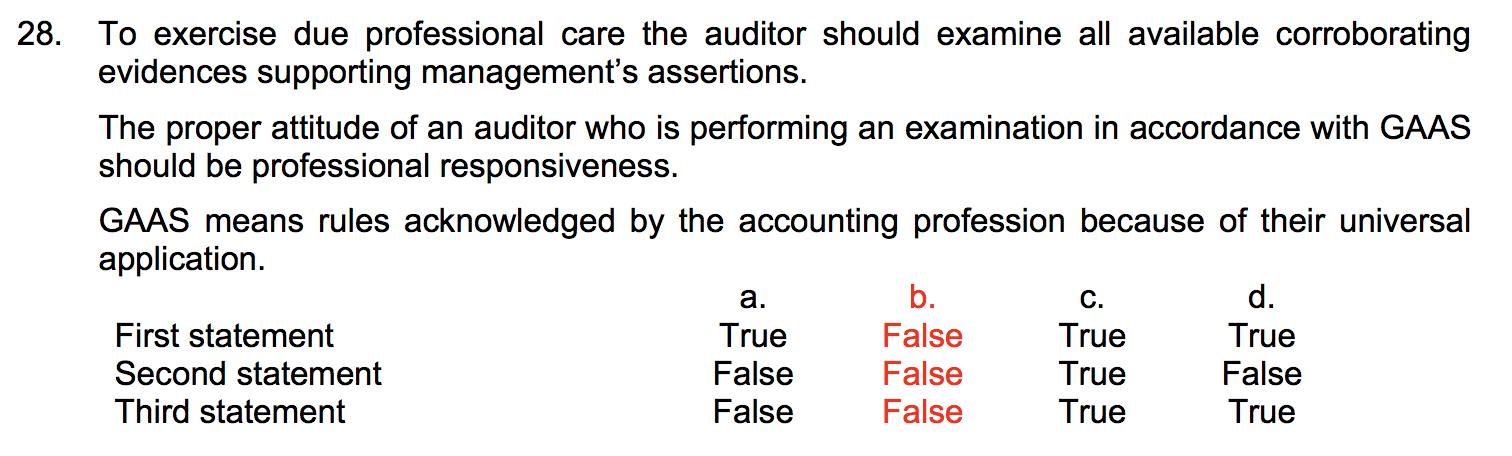
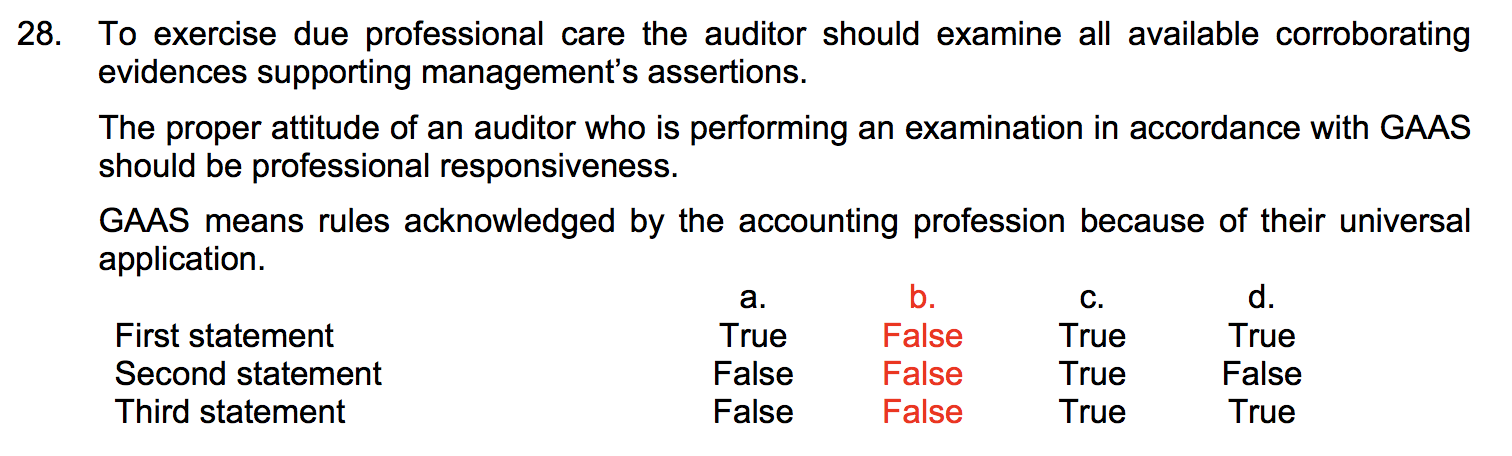
d. Whether the CPA should undertake an audit engagement.
29. A CPA is most likely to refer to one or more of the three general auditing standards in determining
a. The nature of the CPA’s auditing qualification.
b. The scope of the CPA’s auditing procedures.
c. Requirements for the review of internal control.
d. Whether the CPA should undertake an audit engagement.
a. The personal qualities which the auditor should have
30. The general standards stress the importance of
a. The personal qualities which the auditor should have
b. Evidence accumulation
c. Communicating the auditor’s finding to the reader
d. All of the above
d. All of the above
31. The Audit Standard which requires “adequate technical training and proficiency” is normally interpreted as requiring the auditor to have
a. Formal education in auditing and accounting
b. Adequate practical experience for the work being performed
c. Continuing professional education
d. All of the above
d. Responsibility for losses because of errors of judgment
32. Which of the following is not required by the Generally Accepted Auditing Standards that states that due professional care is to be exercised in the performance of the audit?
a. Observance of the standards of field work and reporting
b. Critical review of the audit work performed at every level of supervision
c. Degree of skill commonly possessed by others in the profession.
d. Responsibility for losses because of errors of judgment
c. Proficiency as an auditor, which likely has been acquired from previous experience.
33. The first general standard requires that the audit of financial statements be performed by a person or persons having adequate technical training and
a. Independence with respect to the financial statements and supplementary disclosures.
b. Exercising professional care as judged by peer reviewers.
c. Proficiency as an auditor, which likely has been acquired from previous experience.
d. Objectivity as an auditor, as verified by proper supervision.
a. Possession by the auditor of adequate technical training.
34. Which of the following is mandatory if the auditor is to comply with generally accepted auditing standards?
a. Possession by the auditor of adequate technical training.
b. Use of analytical review on audit engagements.
c. Use of statistical sampling whenever feasible on an audit engagement.
d. Confirmation by the auditor of material accounts receivable balances.
c. Warranting the infallibility of the work performed.
35. Competence as a certified public accountant includes all of the following except
a. Having the technical qualifications to perform an engagement.
b. Possessing the ability to supervise and evaluate the quality of staff work.
c. Warranting the infallibility of the work performed.
d. Consulting others if additional technical information is needed.
b. Obtain a knowledge of matters that relate to the nature of the entity's business.
36. An auditor who accepts an audit engagement and does not possess the industry expertise of the business entity, should
a. Engage financial experts familiar with the nature of the business entity.
b. Obtain a knowledge of matters that relate to the nature of the entity's business.
c. Refer a substantial portion of the audit to another CPA who will act as the principal auditor.
d. First inform management that an unqualified opinion cannot be issued.
d. Any of the above
37. In any case in which the CPA or the CPA’s assistants are not qualified to perform the work, a professional obligation exists to
a. Acquire the requisite knowledge and skills
b. Suggest someone else who is qualified to perform the work
c. Decline the engagement
d. Any of the above
d. Maintain public confidence in the profession.
38. A CPA, while performing an audit, strives to achieve independence in appearance in order to
a. Reduce risk and liability.
b. Comply with the generally accepted standards of field work
c. Become independent in fact.
d. Maintain public confidence in the profession.
a. Apply judgment in a conscientious manner, carefully weighing the relevant factors before reaching a decision.
39. The standard of due audit care requires the auditor to
a. Apply judgment in a conscientious manner, carefully weighing the relevant factors before reaching a decision.
b. Ensure that the financial statements are free from error.
c. Make perfect judgment decisions in all cases.
d. Possess skills clearly above the average for the profession.
d. As a professional possessing the degree of skill commonly possessed by others in the field.
40. The third general standards states that due care is to be exercised in the performance of the examination. This standard should be interpreted to mean that a CPA who undertakes an engagement assumes a duty to perform.
a. With reasonable diligence and without fault or error.
b. As a professional who will assume responsibility for losses consequent upon error of judgment.
c. To the satisfaction of the client and third parties who may rely upon it.
d. As a professional possessing the degree of skill commonly possessed by others in the field.
b. Critical review of work done at every level of supervision
41. The third general standard states due care is to be exercised in the performance of an audit. This standard is generally interpreted to require
a. Objective review of the adequacy of the technical training and proficiency of firm personnel
b. Critical review of work done at every level of supervision
c. Thorough review of the existing internal control structure
d. Periodic review of a CPA firm’s quality control procedures.
a. Early appointment of the auditor is advantageous both to the auditor and to the client.
42. The first standard of fieldwork, which states that the work is to be adequately planned, and assistants, if any, are to be properly supervised, recognizes that
a. Early appointment of the auditor is advantageous both to the auditor and to the client.
b. Acceptance of an audit engagement after the close of the client's fiscal year is generally not permissible.
c. Appointment of the auditor subsequent to the physical count of inventories requires a disclaimer of opinion.
d. Performance of substantial parts of the engagement is necessary at interim dates.
d. It is an acceptable practice to carry out part of the audit at interim dates.
43. With respect to the auditor’s planning of a year-end audit, which of the following statements is always true?
a. An engagement should not be accepted after the fiscal year-end.
b. An inventory count must be observed at the balance sheet date.
c. The client’s audit committee should not be told of the specific audit procedures that were performed.
d. It is an acceptable practice to carry out part of the audit at interim dates.
b. The auditor’s report must state whether GAAP was consistently followed from the prior period to the current period.
44. Which of the following statements is incorrect?
a. The auditor’s report must state whether the financial statements were prepared with GAAP.
b. The auditor’s report must state whether GAAP was consistently followed from the prior period to the current period.
c. The auditor’s report must imply whether the client has provided adequate disclosure on the financial statements and in the accompanying notes.
d. The auditor’s report must express an opinion on the financial statements taken as a whole, or explain why there is no opinion provided.
c. Misinterpretations regarding the degree of responsibility the auditor is assuming
45. The fourth standard of reporting requires the auditor’s report to contain either an expression of opinion regarding the financial statements taken as a whole or an assertion to the effect that an opinion cannot be expressed. The objective of the fourth standard is to prevent
a. An auditor from expressing different opinions on each of the basic financial statements.
b. Restrictions on the scope of the examination, whether imposed by the client or by the inability to obtain evidence.
c. Misinterpretations regarding the degree of responsibility the auditor is assuming
d. An auditor from reporting on one basic financial statement and not the others.