bios 3200 exam 1 dr. Moats
 Call Kai
 Learn
Learn Practice Test
 Spaced Repetition
 Match
Match Flashcards
 Knowt Play
1/75

There's no tags or description
Looks like no tags are added yet.
Name | Mastery | Learn | Test | Matching | Spaced | Call with Kai | Chat |
|---|
No analytics yet
Send a link to your students to track their progress
76 Terms
enzymes protein
catalyze (speed up) reactions
structural proteins
to support
transport proteins
allow passage of hydrophilic substances across the membrane
motor protein
A protein that interacts with cytoskeletal elements and other cell components, producing
When multiple alpha helices come together, they may form a structure often called a _________________.
coiled coil
How is the small protein ubiquitin used in protein modification?
Ubiquitin marks other proteins for destruction.
What is the function of SDS in polyacrylamide gel electrophoresis?
It coats the protein with uniform negative charge.
storage proteins
A source of nutrients or other compounds
In proteins, alpha helices and beta sheets are examples of ___________.
secondary structure
A _________ is a portion of a protein which folds independently into a specific unit and is used to add functionality to proteins.
domain
ligand
A molecule that binds specifically to another molecule, usually a larger one.
dimer
a compound whose molecules are composed of two identical monomers
primary structure
sequence of amino acids
secondary structure
The second level of protein structure; the regular local patterns of coils or folds of a polypeptide chain.
tertiary structure
The third level of protein structure; the overall, three-dimensional shape of a polypeptide due to interactions of the R groups of the amino acids making up the chain.
Beta sheets may be constructed in 2 ways: parallel and antiparallel. The term "antiparallel" indicates
The polypeptide chains making up the sheet are arranged in opposite directions.
If the folding of a polypeptide chain results in the placement of two cysteine side chains near each other, a ____________ may form.
disulfide bond
Binding sites for additional molecules on a particular protein are usually formed directly by the primary structure of the protein itself.
False
Enzymes which add high-energy phospates onto other proteins are known as __________.
kinases
phosphorylase
An enzyme that breaks down glycogen by catalyzing hydrolysis of the a-glycosidic linkages between the glucose residues.
phosphatases
remove phosphate groups
ATPases
hydrolyze ATP
the sanger reaction
The Sanger reaction breaks all the peptide bonds at once, and so is useful in identifying only 1 particular amino acid in the protein.
The Sanger reaction may be problematic, but its still useful. How?
It adds a fluorescent label to only the N-terminal amino acid in a protein.
Beta sheets may be constructed in 2 ways: parallel
The polypeptide chains making up the sheet are arranged in the same direction.
In gel electrophoresis, SDS is added to the protein samples to
add a negative charge
Mercaptoethanol
breaks disulfide bonds
dye
tracks the protein
Which method of studying proteins usually involves a protein called Cre?
conditional knock-out animals
Western blotting
procedure that uses labeled antibodies to detect specific antigens in a mixture of proteins separated according to their molecular weight
affinity chromatography
uses a bound receptor or ligand and an eluent with free ligand or a receptor for the protein of interest
2-hybrid systems
The purpose of cholesterol in mammalian cell membranes is to ______________________.
reduce membrane fluidity
A great example of the cell cortex and the use of the protein spectrin can be found in the ______________________.
red blood cell
The process in which regulated ion channels may spontaneously open & close is called ____________.
flicker
A lipid bilayer with a high percentage of phospholipids with double bonds in their fatty acid tails ("unsaturation") will display a high degree of __________.
fluidity
Membrane fluidity in animal cells is decreased by the presence of an increasing amount of
cholesterol.
On the extracellular surface of the plasma membrane, you'll find a greater amount of _____________________ when compared to the intracelluar surface.
carbohydrate
Which of these protein features is/are commonly found in proteins passing through the plasma membrane?
alpha helices
Which of these would be considered an "integral" membrane protein?
What might be present in secondary structures of a transmembrane protein that would allow for the creation of a small pore or channel?
hydrophilic amino acids
Respiratory gases, such as O2 and CO2, can pass directly through cell membranes because they are polar.
False (n0n polar)
Identify the driving force for the movement of solutes through the plasma membrane by passive transport.
the concentration gradient of the solute
Why might the passive movement of a charged molecule through the cell membrane be limited even if the concentration gradient for the molecule is high?
The membrane electrical gradient restricts the flow of like charges.
Which of the following is/are TRUE about the action of the Na+/K+ ATPase?
ALL of these answers are TRUE.
3 multiple choice options
What feature of the Na+/K+ ATPase allows it to be categorized as a primary active transporter?
It breaks down ATP directly for energy.
It is very common for a transport protein to use the sodium electrochemical gradient to pump other molecules into or out of the cell.
Because of their dependence on the sodium gradient set up by the Na+/K+ ATPase, these proteins are called ___________________.
secondary active transporters
secondary active transporters
couple the potential energy of ion gradients to transport substances
it need susbatances from the primary to the secpundary
primary active transporters
needs an engery source
atp
light
Which of these are the most rare of the ion channels, occurring in the ear and bone?
mechanically-gated ion channels
ligand-gated ion channel
A protein pore in the plasma membrane that opens or closes in response to a chemical signal, allowing or blocking the flow of specific ions.
mechanically-gated ion channels
respond to mechanical vibration or pressure
voltage-gated ion channels
Channels that open or close in response to a change in the membrane potential.
signal protein
carries signals from cell to cell
receptor protien
receive and transmit messages into a cell
gene regulation protein
process of controlling which genes in a cell's DNA are expressed
petide bond
(-) carbolyic acid
(+) amine
hydrophlic side chain
polar
hydrophic
non polar
noncovalent interactions
allows for folding of the bonds
chaperones
Proteins that assist in protein folding during posttranslational processing
alpha helices
form of a secondary structure of peptides
rod like structure
peptide chain coils clockwise around the central axis
is stabilized by the carbonyl oxygen atom and an amide hydrogen atom four residues down -- hydrogen bonding
side chains of the amino acids point away from the helical core
ex. keratin
beta sheets
can be parallel or antiparallel peptide chains forming rows or strands held together by intramolecular H bonds between carbonyl oxygen atoms and amide H atoms in an adjacent chain;
ex. fibroin - primary protein component of silk fibers
domain type
can be all aplha
can be all beta
can be combined
quaternary structre
involves association of multiple polypeptides to form a monomeric protein
binding proteins
bind a specific substrate, either to sequester it in the body or hold its concentration at steady state
tethering domains within a protein
can be threadted together 2 and 3 to make something new
tethering interacting proteins
allows for scaffolifng so the bits can fold nicelly
disulifde bonds
alllows for 3 and 4 to keep protein shape
proteins work through interactions
basicallt folding mkaes it stable so it can have a cylic amp
enzyme work in phases
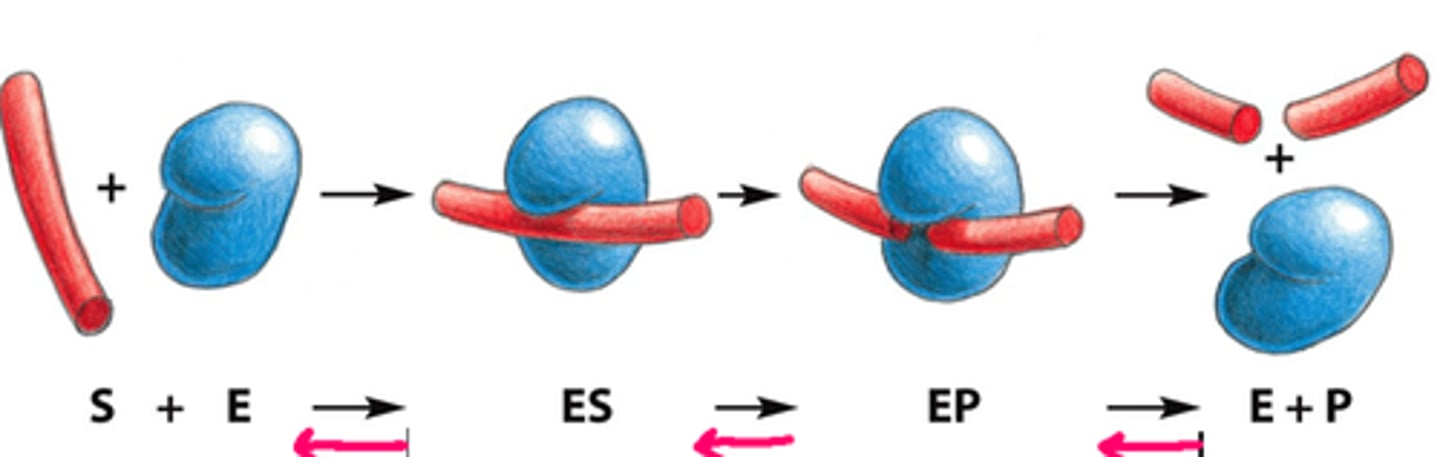
reasons for cofactors
they allow for the build of proteins
feedback
basicallt one one cup is filled it will stop to allow the others to bcome filled
conformation change
shape changes
allosteric regulation
The binding of a molecule to a protein that affects the function of the protein at a different site.
nucleotide hydrolysis
allows motor proteins to produce large movements in cells