bio4
 Note
Note Call Kai
 Learn
Learn Practice Test
 Spaced Repetition
 Match
Match Flashcards
 Knowt Play
1/63

There's no tags or description
Looks like no tags are added yet.
Name | Mastery | Learn | Test | Matching | Spaced | Call with Kai | Chat |
|---|
No analytics yet
Send a link to your students to track their progress
64 Terms
Where do the light-dependent reactions of photosynthesis take place?
in the thylakoid
The photosystems can be found in:
The thylakoid membrane
The light reactions of photosynthesis serve to:
Split water and release oxygen AND reduce the electron acceptor NADP+ to NADPH and generate ATP from ADP by photophosphorylation.
NADPH is produced in the light reactions of photosynthesis by:
The reduction of NADP+ by NADP+ reductase
The Electron Transport Chain from PSII to PSI in the light reactions:
Provides the energy that moves H+ ions from the stroma to the thylakoid space
From where does the oxygen come that is produced as a byproduct of photosynthesis?
from the breakdown of water
Where do the light-independent reactions of photosynthesis take place?
in the stroma
Fill in the sentence: The enzyme _________ attaches CO2 to the five- carbon molecule ________.
RuBisCo; RuBP
In plants, the ultimate electron donor in photosynthesis is:
H2O
The passing of a pair of high energy electrons to NADP+, resulting in NADPH, is associated with which photosystem(s)?
photosystem I
Antennae work with reaction centers by providing:
energy transfer
What happens to the NADPH molecules that are generated in the photosynthetic electron transport chain?
They provide energy to the Calvin cycle.
The terminal electron acceptor of a photosynthetic electron transport chain is:
NADP+
Which of these correctly lists the three phases of the Calvin cycle?
carboxylation, reduction, and regeneration
The products of the Calvin cycle are 3-carbon sugars.
True
Carbon enters the Calvin cycle in the form of:
CO2.
During periods of illumination, the pH in the stroma of the chloroplast should be _____ compared with the thylakoid lumen due to the _____ concentration of protons in the stroma.
higher; lower
Which compound is required for the reduction phase of the Calvin cycle?
NADPH
Why is the regeneration phase of the Calvin cycle essential?
because a 5-carbon molecule RuBP is necessary for the carboxylation phase
Which of the sequences accurately represents the flow of electrons through living organisms?
H2O → photosynthesis → carbohydrate → cellular respiration → H2O
Which of the following is NOT a reason for cell division?
Sexual reproduction
Which phase of the cell cycle involves DNA replication?
S
What is the diploid number of chromosomes in humans?
46
Which of the following is true about homologous chromosomes?
They have the same genes in the same order
Which organelles divide by binary fission?
Mitochondria and chloroplasts
What are chromosomes made of?
DNA and proteins
Which of the following is true about homologous chromosomes?
They have the same genes in the same order
The division of the cell's cytoplasm in a eukaryotic cell is known as:
cytokinesis
A skin cell in G1 of interphase has _____ as much DNA as it is in prophase.
half
A cell that is not actively dividing is in what phase of the cell cycle?
G0
The two large phases of the cell cycle, which include all others, are:
Interphase and the M Phase
Which of the following accurately describes when sister chromatids are present:
S, G2, Prophase, Metaphase
At the end of mitosis:
There is one cell with 2 nuclei
What would happen to the daughter cells if the G2 phase of the parent cell is shortened?
The cells would be smaller than normal.
At which stage does cell growth, duplication of organelles, and expression of regulatory proteins for replication occur?
G1
How many DNA molecules are present in a replicated chromosome?
Two identical molecules
Which of the following accurately describes when sister chromatids are NOT present:
G1, Anaphase, Telophase
What molecule is necessary to move the chromosomes from metaphase through anaphase?
microtubules
If the function of actin were disrupted, what would be the most likely outcome?
Cells would become multinucleate
Which of the following is NOT a reason for cell division?
Sexual reproduction
Which organelles divide by binary fission?
Mitochondria and Chloroplasts
A cell that is not actively dividing is in what phase of the cell cycle?
G0
Which of the following is a purine base?
Guanine
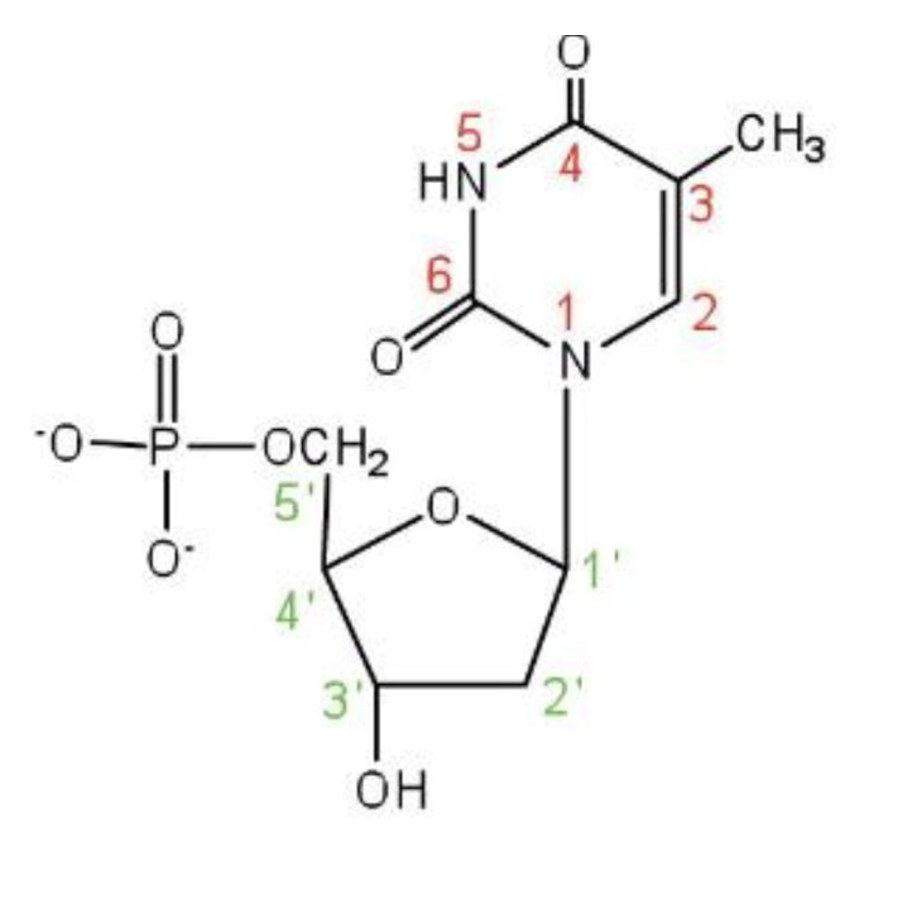
What is this?
DNA pyrimidine nucleotide
The 5’ carbon in DNA is located where?
just off the deoxyribose sugar ring
What allows the DNA to be opened up during replication but then come back together after?
The hydrogen bonds between the complimentary pairs
What bonds hold together the sugar-phosphate backbone of DNA?
Covalent
Which base pairs with guanine in DNA?
Cytosine
Which of the nucleotides in only present in DNA
Thymine
Which of these nucleotides in only present in RNA
Uracil
An organism's genome is analyzed and found to contain 11% guanine. What percentage of that organism's DNA is adenine?
49%
the DNA polymerase reads the template DNA from the:
3’ to 5’ direction
The DNA polymerase synthesizes the daughter DNA from the
5’ to 3’ direction
Primase
Adds RNA primer to initiate replication
Helicase
Unwinds the template DNA strand
DNA polymerase
Proofreads DNA
Ligase
Seals DNA
Exonuclease
Removes RNA from DNA
A daughter strand of DNA produced during chromosome replication can be composed of leading and lagging strands from different replication fork. (true or false)
true
In semiconservative replication:
Two new DNA helices are created where individual strand in the helix is a equal mixture of both parental DNA and newly synthesized DNA