Methods of Infection Transfer
 Call Kai
 Learn
Learn Practice Test
 Spaced Repetition
 Match
Match Flashcards
 Knowt Play
1/17

There's no tags or description
Looks like no tags are added yet.
Name | Mastery | Learn | Test | Matching | Spaced | Call with Kai | Chat |
|---|
No analytics yet
Send a link to your students to track their progress
18 Terms
Recall the Koch’s postulates in 1884
Same pathogen has to be present in every case of the disease
The pathogen is isolated from the host and grown in culture
The pathogen from the culture must cause the same disease when injected in a healthy lab animal
Pathogen isolated from the infected lab animal must be the same as the one from the host
What are some limitations of Koch’s postulates?
The pathogen can sometimes be found in healthy individuals
The pathogen can cause different diseases
A disease with the same symptoms can be caused by different pathogens (cystitis)
What are reservoirs?
Reservoirs are places where pathogens can live to keep causing infections and spread to new hosts
What are the 3 reservoirs?
Human reservoirs
Animal reservoirs
Non-living reservoirs: pathogens in an environment (soil, contaminated water)
What are the 3 ways virus can spread through infection?
Contact transmission
Vehicle transmission
Vector transmission
What are the 3 methods of contact transmission?
Direct contact
Indirect contact
Droplet transmission
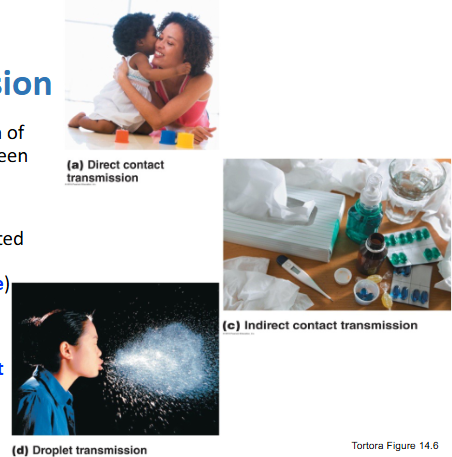
Describe Direct contact (contact transmission)
Direct contact: direct transmission of a pathogen by physical contact
Describe Indirect contact (contact transmission)
Indirect contact: pathogen is spread from its reservoir to a host through a non-living object (fomite)
Describe Droplet transmission (contact transmission)
Droplet transmission: pathogen is spread in droplets that travel short distances (less than 1 meter) through coughing, sneezing, etc.
What are the 3 methods of vehicle transmission?
The three ‘bornes’
Waterborne
Foodborne
Airborne
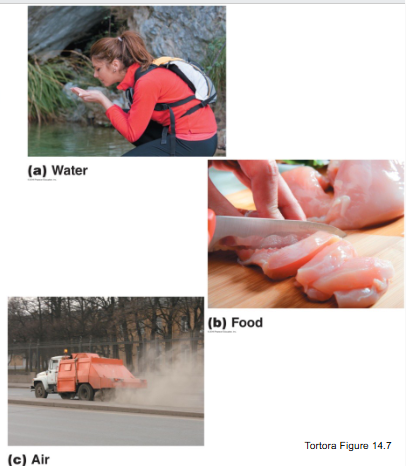
Describe Waterborne (vehicle transmission)
Waterborne: pathogens are spread through contaminated water (ex: cholera)
Describe Foodborne (vehicle transmission)
Foodborne: pathogens are spread through food that is not cooked or stored properly (ex: S. aureus, tapeworms)
Describe Airborne (vehicle transmission)
Airborne: pathogens are spread through small droplets or dust that can travel long distances (ex: fine spray from mouth containing influenza virus, coronavirus, and fungal spores)
What is a vector?
Vectors are animals or insects that carry pathogens from one host to another
What are the two methods of vector transmission?
Mechanical transmission
Biological transmission
What is mechanical transmission? (vector transmission)
Mechanical transmission is the carrying of pathogens by an insect without the pathogen growing or reproducing inside the insect
What is Biological transmission? (vector transmission)
Biological transmission is when a pathogen enters an animal or insect, reproduces inside it, then is passed to another host
What are some examples of biological transmission?
Examples of biological transmission:
Plasmodium in mosquito
Rabies virus in bats