Chemistry Ch6 Homework & Quizzes
 Call Kai
 Learn
Learn Practice Test
 Spaced Repetition
 Match
Match Flashcards
 Knowt Play
1/23

There's no tags or description
Looks like no tags are added yet.
Name | Mastery | Learn | Test | Matching | Spaced | Call with Kai | Chat |
|---|
No analytics yet
Send a link to your students to track their progress
24 Terms
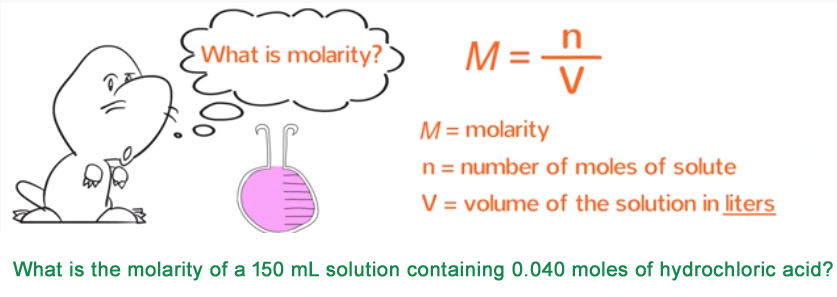
nearest 100th
0.27 mol/L
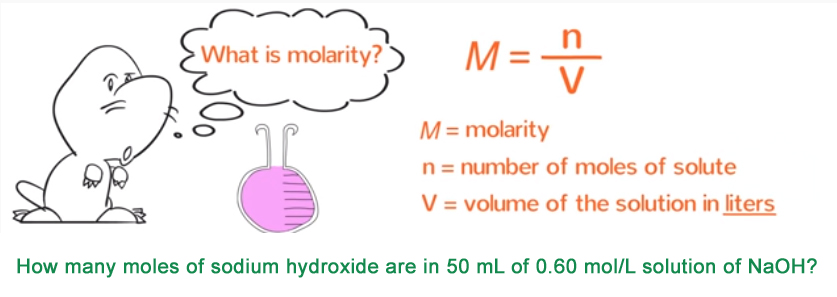
0.03 mol
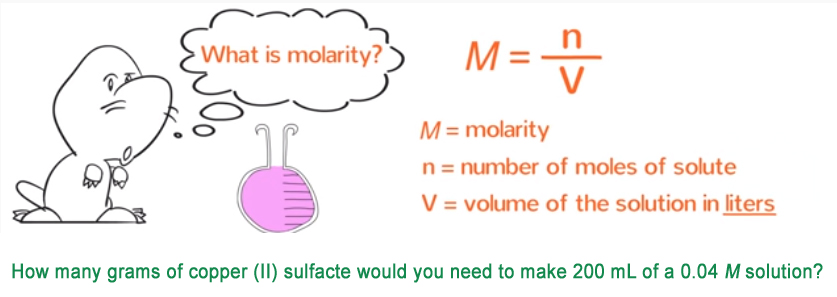
1.998 g
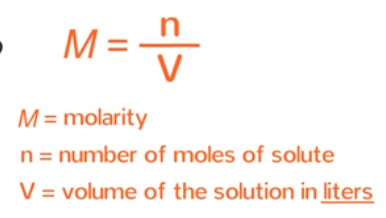
True or False
Molarity is equivalent to moles/Liter?
True
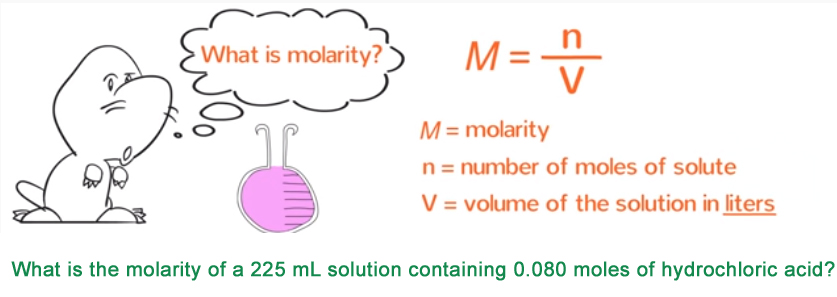
nearest 1000th mol/L
0.356 mol/L
How is the molecular mass of chloroform (CHCl₃) calculated?
A. By averaging the masses of carbon, hydrogen, and chlorine
B. By adding the masses of one carbon atom, one hydrogen atom, and three chlorine atoms
C. By multiplying the atomic masses of the elements
D. By using only the mass of the heaviest atom
B
Given the Molecule: Calcium carbonate (CaCO₃)
What is the molecular mass? (in amu and nearest 100th)
100.09 amu
Molecule: Magnesium chloride (MgCl2)
Magnesium chloride is an ionic compound composed of magnesium cations (Mg2+) and chloride anions (Cl-) in a 1:2 ratio. What is the formula mass of magnesium chloride? (nearest 100th in amu)
95.21 amu
Which statement about ionic compounds and their formula mass is correct?
A. The formula mass of an ionic compound is calculated by summing the average atomic masses of all atoms in its formula, similar to covalent compounds, even though it does not represent a discrete molecule.
B. Ionic compounds are composed of discrete molecules, so their molecular mass is always the same as their formula mass.
C. Ionic compounds cannot have a formula mass because they are not made of molecules.
D. The formula mass of an ionic compound must use the exact masses of the ions rather than the neutral atoms.
A
When a compound’s chemical formula is unknown, which experimental step is usually performed first to determine its formula?
A. Calculating the molecular mass from the crystal structure.
B. Counting the number of molecules using a microscope.
C. Measuring the volume of the compound at room temperature.
D. Measuring the mass of each element in the compound to calculate its percent composition.
D
Molecule: Ammonia (NH3)
What is the percent composition of nitrogen in ammonia?
nearest 100th decimal
82.24%
A gaseous compound contains 12.0 g of carbon and 32.0 g of oxygen. What is the empirical formula of the compound?
A. C₂O₄
B. C₂O
C. CO
D. CO₂
D
A compound contains 2.0 g of hydrogen and 16.0 g of oxygen. What is the empirical formula of this compound?
A. H₄O
B. H₂O
C. H₂O₂
D. HO
B
A hospital IV bag contains 0.150 mol of glucose (C₆H₁₂O₆) in 250. mL of solution. What is the molar concentration of glucose?
0.6 M
A laboratory solution contains 0.300 mol of CaCl₂ in 600. mL of solution. What is the molar concentration of CaCl₂?
0.5 M
How many grams of glucose, C₆H₁₂O₆ (molar mass = 180.2 g/mol), are present in 0.375 L of a 0.850 M glucose solution?
nearest 10th
57.4 g
What volume of a 2.50 M MgSO₄ solution contains 246 g of MgSO₄ (molar mass = 120.4 g/mol)?
0.82 L
What is the concentration of the solution that results from diluting 15.0 mL of a 3.50 M HCl solution to 100.0 mL?
0.525 M
According to EPA standards, the maximum contaminant level (MCL) for arsenic in drinking water is 10 ppb. What is this concentration in ppm?
0.010 ppm
solution for which water is the solvent
aqueous solution
process of adding solvent to a solution in order to lower the concentration of solutes
dilution
mass in grams of 1 mole of a substance
molar mass
sum of the average masses for all atoms represented in a chemical formula; for covalent compounds, this is also the molecular mass
formula mass
solution component present in a concentration that is higher relative to other components
solvent