Book 13E - Theory of CA
 Call Kai
 Learn
Learn Practice Test
 Spaced Repetition
 Match
Match Flashcards
 Knowt Play
1/9

There's no tags or description
Looks like no tags are added yet.
Name | Mastery | Learn | Test | Matching | Spaced | Call with Kai | Chat |
|---|
No analytics yet
Send a link to your students to track their progress
10 Terms
Describe TOT
Rises in TOT = TOT more favourable/improved
Fall in TOT = TOT more unfavourable/deteriorated

Explain how rise in price of exports affect TOT
Rise in price of exports -> TOT improve:
If PEDx > 1, higher price -> Qd falls more than proportionally -> X falls -> BOT worsen
If PEDx < 1, higher price -> Qd falls less than proportionally -> X increases -> BOT improves
Describe CSQ theory of CA
Based on the theory of comparative advantage, through specialisation, production and the exchange of goods (exports) that the country have the lower opportunity cost in, both the domestic economy and trade partners can consume a higher amount of goods
Different economies have different factor endowments (quantity and quality of FOP) -> different CA in different goods
For example, developed economies with greater quantity and quality of capital like the US is able to produce high-value added goods at a lower opportunity cost, while developing economies with abundant low skilled labour like Mexico can produce low value added goods at a lower opportunity cost
Specialisation in which the economy possesses CA in will lead to higher efficiency and world output
If trade occurs under mutually beneficial TOT, both countries are able to consume beyond their initial PPCs + increase m-SOL
Draw theory of CA using PPC
Describe theory of CA (before)
Assume that both countries have the same quantity of resources.
Opportunity costs are unchanged as more and more units of each good are produced
Before
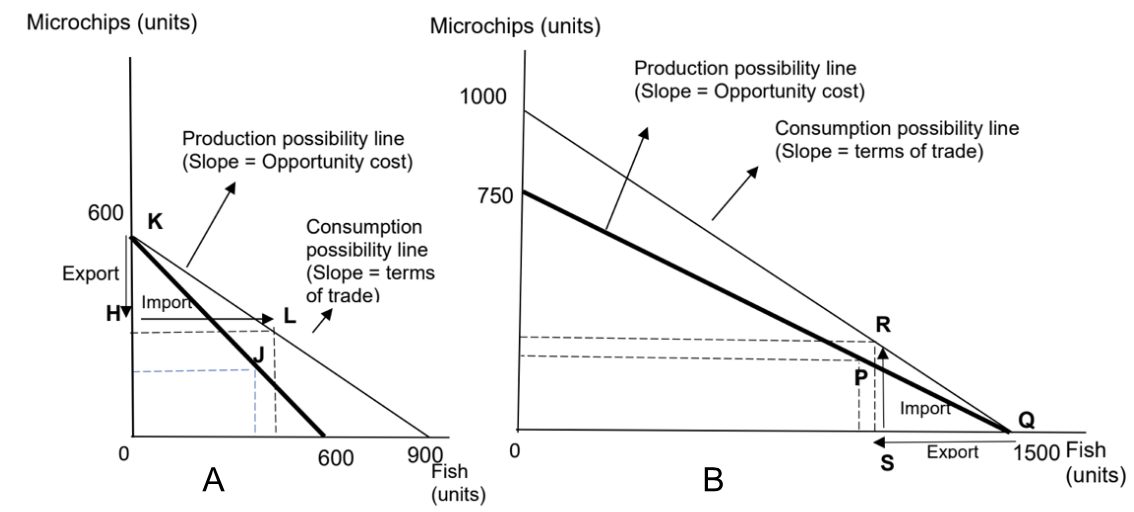
B has absolute advantage in the production of both microchips and fish (B PPC higher than A)
B has comparative advantage in the production of fish (B PPC gentler slope than A) as opportunity cost of fish is lower because (Eg. It has advanced technology in raising healthy fish)
Assume that countries A and B were initially consuming at points J and P respectively, which are points on their respective PPCs
Describe theory of CA (complete specialisation)
Each country engages in complete specialisation in producing the goods in which they have CA in
Country A will now produce at point K and Country B will now produce at point Q
Describe theory of CA (after specialisation)
After specialisation, for each country to consume both types of goods, they will need to trade with each other
They will be willing to do so if the terms of trade has a value that is between the 2 countries’ opportunity costs (Eg. 0.5H < 1C < 2H)
Importer will import 1 more as long as cost of import is cheaper than OC of producing the good itself AND exporter will export 2 more as long as money earned is more than OC of producing it
Country A exports KH units of microchips in exchange for HL units of fish while country B imports RS units of microchips in exchange for SQ units of fish
KH = RS and SQ=HL because A’s exports equal B’s imports
Describe theory of CA (outcome)
With specialisation and trade, both countries now consume beyond their PPC.
When countries specialise and trade according to their comparative advantage, they will both gain in terms of higher levels of consumption
There is mutual benefit for countries involved in the exchange
SOL improves as same amount of exports produced can be exchanged for more imports -> country consumes on a point further away from PPC
Explain how aging population causes fall in domestic CA
Aging population -> quantity of labour falls
Since more resources would be needed to produce the same amount of (textiles), there are less resources available for the production of (semiconductors)
Opportunity cost of production for the (textiles) in the domestic country increases as more of (semiconductors) are foregone
The decrease in the quantity of labour suitable for the production of (textiles) will decrease PC for these goods
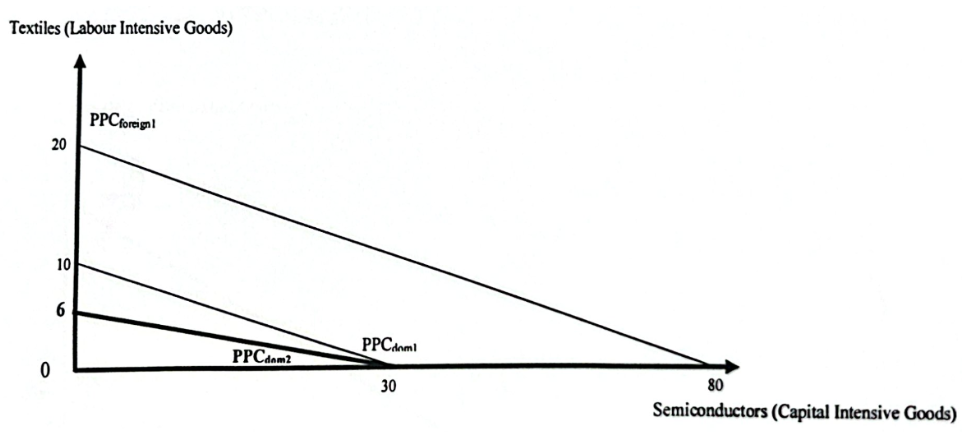
Assuming PC of the (semiconductors) remain constant, there will be a non-parallel shift of domestic PPC inwards from PPCdom to PPCdom2
Domestic country initially has CA in the production of (textiles)
To produce 1 unit of (textiles), the foreign country has to sacrifice 4 units of (semiconductors) while the opportunity cost of producing 1 unit of (textiles) in the domestic country is only 3 units of (semiconductors)
Now, opportunity cost of producing (textiles) in the domestic country is now 5 units of (semiconductors) -> higher -> loss of CA
Explain how aging population causes fall in domestic CA GRAPH