Learn: GERIA (WEEK1) | Quizlet
 Call Kai
 Learn
Learn Practice Test
 Spaced Repetition
 Match
Match Flashcards
 Knowt Play
1/49

There's no tags or description
Looks like no tags are added yet.
Name | Mastery | Learn | Test | Matching | Spaced | Call with Kai | Chat |
|---|
No analytics yet
Send a link to your students to track their progress
50 Terms
GERONTOLOGY
defined as the study of aging process
GERIATRIC NURSING
defined as caring of older adults.
AGEISM
A negative stereotype or discrimination against older adults' individuals.
HOW TO AVOID AGEISM
Treat them as unique individuals
GREATEST barrier OF AGEISM
Preconceived assumptions or misconceptions
BIOLOGICAL THEORIES OF AGING
The rate of aging among different body systems within one individual may vary, with one system showing marked decline while another demonstrates no significant change
BIOLOGICAL THEORIES OF AGING DIVIDED INTO 2 CATEGORIES
stochastic and nonstochastic
STOCHASTIC THEORIES
Resulting from random assaults from both the internal and external environment
CROSS-LINKING THEORY
Proposes that cellular division is threatened as a result of radiation or a chemical reaction in which an agent attaches itself to a DNA strand and prevents normal parting of the strands during mitosis.
Over time, they form dense aggregates that impede intracellular transport; ultimately, the body's organs and systems fail.
FREE RADICALS AND LIPOFUSCIN THEORIES
aging results from oxidative metabolism, the process by which cells use oxygen to produce energy
During this process, (unstable molecules with unpaired electrons) are generated.
can damage DNA, proteins, and cell membranes, leading to cumulative cellular injury over time.
WEAR AND TEAR THEORIES
attribute aging to the repeated use and injury of the body over time as it performs its highly specialized functions
Stresses to the body can have adverse effects:
gastric ulcers, heart attacks, thyroiditis, and inflammatory dermatoses
EVOLUTIONARY THEORIES
1. mutation accumulation theory
2. antagonistic pleiotropy theory
3. Disposable Soma Theory
mutation accumulation theory
suggests that aging occurs due to a declining force of natural selection with age.
antagonistic pleiotropy theory
Suggests that accumulated mutant genes that have negative effects in late life may have had beneficial effects in early life
Disposable Soma Theory
this theory differs from other evolutionary theories because it emphasizes energy use rather than genetics
The body has a finite supply of energy from food, which must be divided among:
1. Metabolism
2. Reproduction
3. Maintenance of functions
4. Repair of cellular damage
Disposable Soma Theory
energy is prioritized for reproduction, leaving less available for long-term repair and upkeep. This leads to gradual decline and eventual death.
BIOGERONTOLOGY
study of the connection between aging and disease processes
BIOGERONTOLOGY
Bacteria, fungi, viruses, and other organisms are thought to be responsible for certain physiologic changes during the aging process.
NONSTOCHASTIC THEORIES
See aging changes resulting from a complex, predetermined process.
APOPTOSIS
the process of programmed cell death that continuously occurs throughout life due to biochemical events
According to this theory, this programmed cell death is part of the normal developmental process that continues throughout life.
GENETIC THEORIES
1. programmed theory of aging
2. error theory
programmed theory of aging
proposes that animals and humans are born with a genetic program or biological clock that predetermines the life span
error theory
also proposes a genetic determination for aging
This theory holds that genetic mutations are responsible for aging by causing organ decline as a result of self-perpetuating cellular mutations
error theory
(1) Mutation of DNA
(2) Perpetuation of mutation during cell division
(3) Increasing number of mutant cells in body
(4) Malfunction of tissues, organs, and systems
(5) Decline in body functions
AUTOIMMUNE REACTIONS THEORY
The primary organs of the immune system, the thymus and bone marrow, are believed to be affected by the aging process
NEUROENDOCRINE AND NEUROCHEMICAL THEORIES
suggest that aging is the result of changes in the brain and endocrine glands
Some theorists claim that specific anterior pituitary hormones promote aging
Others believe that an imbalance of chemicals in the brain impairs healthy cell division throughout the body.
RADIATION THEORIES
repeated exposure to ultraviolet light
Ultraviolet light is also a factor in the development of skin cancer
may induce cellular mutations that promote aging
solar elastosis
the "old age" type of skin wrinkling that results from the replacement of collagen by elastin
NUTRITION THEORIES
The importance of good nutrition throughout life is a theme hard to escape in our nutrition-conscious society. It is no mystery that diet impacts health and aging.
Obesity
is shown to increase the risk of many diseases and shorten life
ENVIRONMENTAL THEORIES
Several environmental factors are known to threaten health and are thought to be associated with the aging process.
environmental factors to threaten health:
ingestion of mercury, lead, arsenic, radioactive isotopes, certain pesticides, and other substances can produce pathologic changes in human beings.
Smoking and breathing tobacco smoke and other air pollutants
crowded living conditions, high noise levels, and other factors are thought to influence how we age.
SOCIOLOGIC THEORIES OF AGING
1. DISENGAGEMENT THEORY
2. ACTIVITY THEORY
3. CONTINUITY THEORY
4. SUBCULTURE THEORY
5. AGE STRATIFICATION THEORY
DISENGAGEMENT THEORY
Developed by Elaine Cumming and William Henry
DISENGAGEMENT THEORY
It views aging as a process in which society and the individual gradually withdraw, or disengage, from each other, to the mutual satisfaction and benefit of both.
ACTIVITY THEORY
asserts that an older person should continue a middle-aged lifestyle, denying the existence of old age as long as possible, and that society should apply the same norms to old age as it does to middle age and not advocate diminishing activity, interest, and involvement as its members grow old
CONTINUITY THEORY
also referred to as the developmental theory
Personality and basic patterns of behavior are said to remain unchanged as the individual ages. For instance, activists at 20 years of age will most likely be activists at 70 years of age
SUBCULTURE THEORY
views older adults as a group with distinct norms, beliefs, expectations, habits, and issues that separate them from the rest of society
AGE STRATIFICATION THEORY
Persons within a similar age group generally have similar experiences, beliefs, attitudes, and life transitions that offer them a unique shared history.
New age groups are continually being formed with the birth of new individuals; thus, the interaction between society and the aging population is dynamic.
As each group ages, they have their own unique experience with and influence on society, and there is an interdependence between society and the group.
PSYCHOLOGICAL THEORIES OF AGING
1. PSYCHOSOCIAL THEORY
2. GEROTRANSCENDENCE
3. FUNCTIONAL CONSEQUENCES THEORY
4. THEORY OF THRIVING
5. THEORY OF SUCCESSFUL AGING
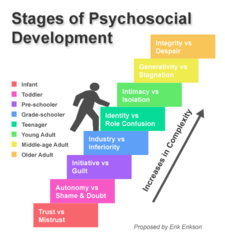
PSYCHOSOCIAL THEORY
Developed by ERIK ERIKSON.
PSYCHOSOCIAL THEORY
explore the mental processes, behavior, and feelings of persons throughout the life span, along with some of the mechanisms people use to meet the challenges they face in old age.
PSYCHOSOCIAL THEORY
Integrity vs. Despair
Generativity vs. Stagnation
Intimacy vs. Isolation (adulthood)
Identity vs. Role-Confusion (adolescence)
Industry vs. Inferiority (elementary years)
Initiative vs. Guilt (preschool years)
Autonomy vs. Shame / Doubt (toddlerhood)
Trust vs. Mistrust (infancy)
GEROTRANSCENDENCE
A recent theory that suggests aging entails a transition from a rational, materialistic metaperspective to a cosmic and transcendent vision (Tornstam, 2005).
As people age, they are less concerned with their physical bodies, material possessions, meaningless relationships, and self-interests and instead desire a life of more significance and a greater connection with others.
FUNCTIONAL CONSEQUENCES THEORY
It holds that nurses can promote wellness by addressing individuals holistically, recognizing the interconnection of body, mind, and spirit.
THEORY OF THRIVING
is continuous and enables aging individuals to find meaning in life and adapt to changes.
This theory reinforces the importance of nurses considering the many factors that can impact health and quality of life for older adults.
THEORY OF SUCCESSFUL AGING
THEORY OF SUCCESSFUL AGING
By integrating Roy's adaptation model with the theory of gerotranscendence and other aging literature, Flood (2005) attempt to develop a nursing theory to guide the care of older adults.
The Adaptation Model of Nursing, developed by Sister Callista Roy, saw the individual as a biopsychosocial being that continuously interacts with and adapts to the changing internal and external environment (Roy & Andrews, 2008)
Roy viewed health on a continuum and involves the person becoming an integrated, whole individual.