3: Guide to Writing A Descriptive Research Proposal
 Studied by 0 people
 Call Kai
 Learn
Learn Practice Test
 Spaced Repetition
 Match
Match Flashcards
 Knowt Play
1/11

Earn XP
Description and Tags
Prelim
Name | Mastery | Learn | Test | Matching | Spaced |
|---|
No study sessions yet.
12 Terms
STEP 1: Identify a Practical Topic
“The Influence of Binge-Watching Across Streaming Platforms on Individual Productivity and Lifestyle”
This is a good example of a descriptive research topic—it seeks to describe behavior patterns (binge-watching) and perceived impact on productivity and lifestyle.
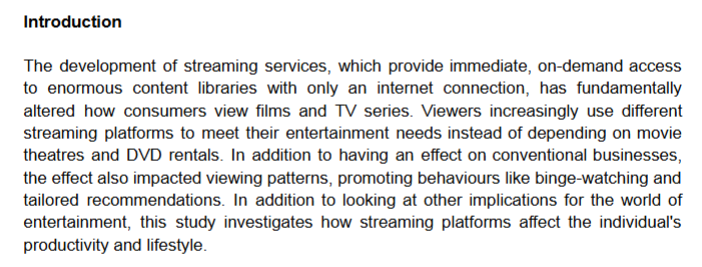
STEP 2: Write the Introduction
This section clearly introduces:
The popularity and accessibility of streaming services
The phenomenon of binge-watching as a common behavior
Its relevance to student routines and lifestyle choices
Tip: Your introduction should answer:
What is the behavior or trend being described?
Why is it worth exploring in the current digital context?
STEP 3: Establish the Need for the Study
“This study was conducted to identify the factors that contribute to binge-watching and how it affects their daily routines...”
This statement reflects the practical need for the study and highlights a common concern about time management and lifestyle.
STEP 4: Review of Related Literature
This section:
Covers foreign studies on psychological and behavioral effects of binge-watching
Cites local studies that support the context among Filipino students
Defines constructs like binge-watching behavior, time management, and digital platforms
Tip: Aim for 5–8 sources total, mixing global and local perspectives.
STEP 5: Set Objectives and Scope
This section gives:
A general objective (to determine the influence of binge-watching on productivity and lifestyle)
Specific objectives, such as identifying platforms used and measuring behavior across demographic groups
Tip: Each specific objective must match a section of your survey.
STEP 6: Describe Research Questions (Descriptive Only)
Example questions:
“What are the streaming platforms mostly used by students?”
“How many hours do students spend on binge-watching per week?”
These are quantitative descriptive questions, with no hypothesis or causality.
STEP 7: Define Constructs and Variables
The study examines the following:
Independent variables: Platform used, time spent, access level
Dependent variables: Productivity, perceived health impact, lifestyle routines
A Likert scale was used to measure perceptions and habits.
STEP 8: Design the Survey Tool
Use of Likert-type questions
Sections for demographics, platform use, time, and behavioral impacts
Tip: Your survey should have at least 5 items per construct (e.g., 5 items to measure productivity, 5 for lifestyle).
STEP 9: Methodology Section (Descriptive Focus)
Breakdown:
Participants: Students aged 18–24; sample size: 100+
Sampling method: Convenience sampling
Data Gathering: Google Forms; voluntary participation
Analysis: Descriptive statistics only — frequency, mean, standard deviation
This sample correctly avoids inferential tests (e.g., no t-tests or regression).
STEP 10: Results Using Descriptive Statistics
The results are clearly presented in:
Tables with Mean and Frequency (e.g., Platform usage frequency, hours spent watching)
Narrative descriptions of trends (e.g., "Netflix was the most frequently used platform...")
Tip: Every table must be followed by 1–2 paragraphs explaining what the numbers mean.
STEP 11: Draw Insights and Recommendations
This section discusses:
Summary of binge-watching patterns
Productivity and lifestyle impact
Recommended self-regulation strategies for students
The study successfully translates descriptive data into practical suggestions.
STEP 12: Format Properly and Use APA Citations
All cited works are listed in APA 7th format, including:
Journal articles
Online sources
Books
Tip: Use hanging indent and alphabetical order.