Chapter 6.3: Signal Transduction Allows a Cell to Respond Appropriately to a Signal
 Call Kai
 Learn
Learn Practice Test
 Spaced Repetition
 Match
Match Flashcards
 Knowt Play
1/4

Name | Mastery | Learn | Test | Matching | Spaced | Call with Kai | Chat |
|---|
No analytics yet
Send a link to your students to track their progress
5 Terms
Signal transduction pathway
A cascade of events that occur after a signal is received to ultimately change cellular function
Results in the amplification and distribution of a signal, which can result in different responses throughout an organism
Cellular response
What ultimately occurs at the end of a signal transduction pathway; includes:
Ion channel openings, modifying concentrations (seen in nerves and muscles)
Enzyme activity changes, altering metabolic rates
Gene expression changes, which in turn alter protein abundance and later cell function
These may be different across different cell types

Signal transduction cascade
The set of steps where enzymes are activated or inhibited by other enzymes in a pathway
Can involve a kinase phosphorylating a protein, resulting in activation or inhibition
Seen with mitogen-activated protein kinases requiring several steps of phosphorylation and binding

Second messengers
Small non-protein molecules that can be hydrophilic, hydrophobic, or even gases
Lack enzymatic activity and act through allosteric regulation
Help distribute cell signals via several internal responses
Examples include cAMP, IP3, DAG, PIP3, and NO
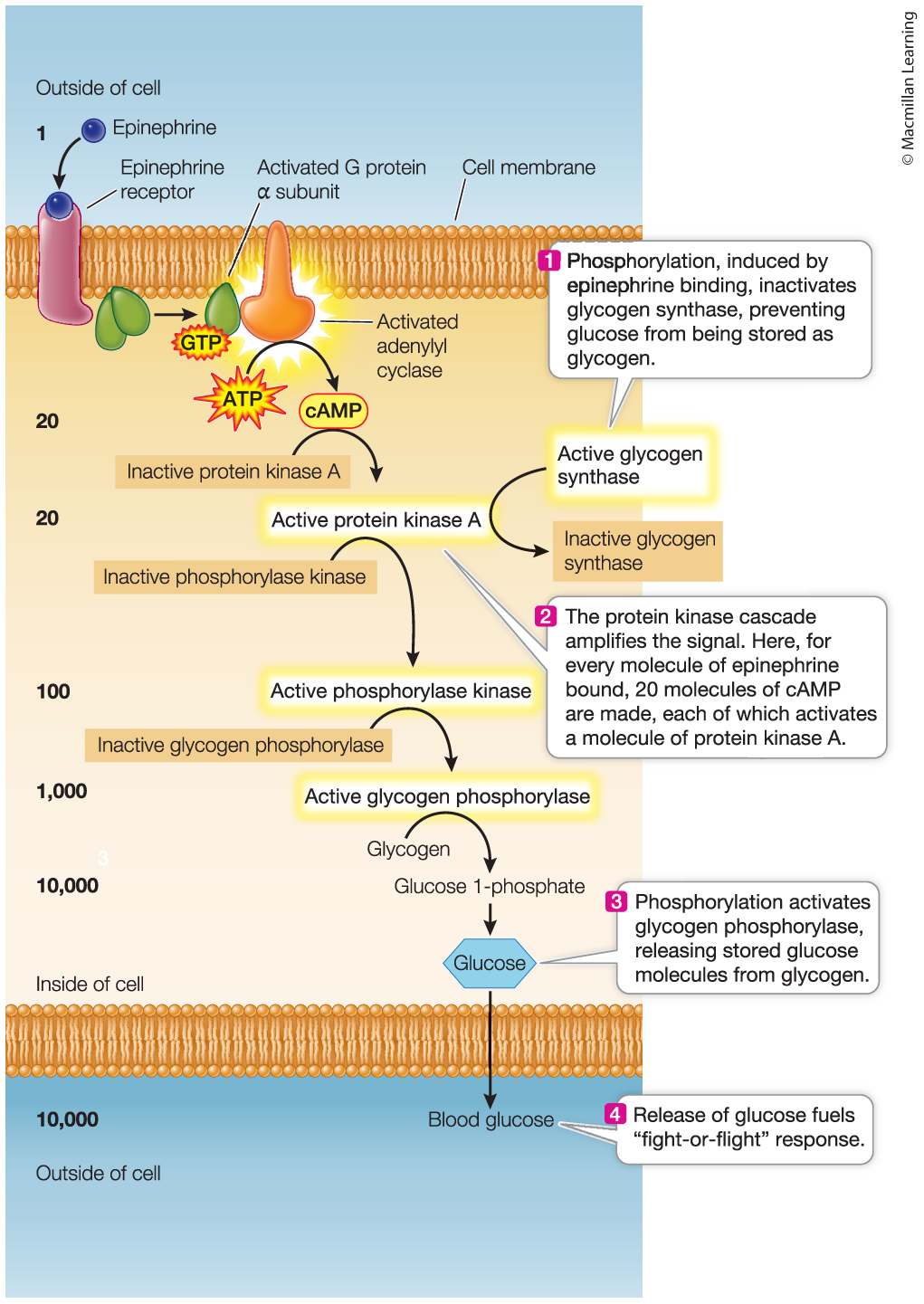
Epinephrine
A molecule that acts as a ligand for the activation of a G protein, enabling second messenger and amplifying enzyme interactions for the production of glucose from glycogen in the liver for emergencies