Chapter 13: Oscillations About Equilibrium
 Studied by 0 people
 Call Kai
 Learn
Learn Practice Test
 Spaced Repetition
 Match
Match Flashcards
 Knowt Play
1/28

There's no tags or description
Looks like no tags are added yet.
Name | Mastery | Learn | Test | Matching | Spaced |
|---|
No study sessions yet.
29 Terms
Periodic Motion
motion that repeats at regular intervals over time
swinging pendulums, vibrating strings, and oscillating springs
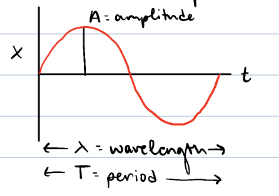
Periodic Motion Graph
displacement over time
A: amplitude/max displacement from equilibrium position (m)
lambda: wavelength, size of wave for full cycle (m)
T: time period of a complete cycle of period motion (s)
f = # of complete cycles/oscillations per second (Hz)
What is the period and frequency of a second hand on a clock?
T = 60 s
f = 1/60 = 0.017s^-1 = 0.017 Hz
A leaky faucet drips 40 times in 30 seconds. What is the frequency?
f = 1/T = 40 times/30 s = 1.3 Hz
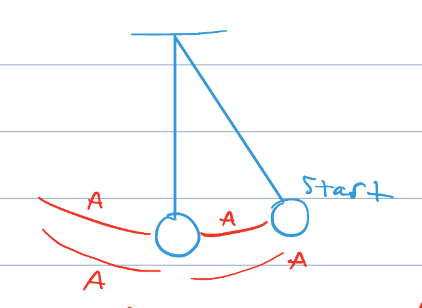
A mass on a spring in oscillation has amplitude A and period T. What is the total distance traveled by the mass after a time interval T?
mass moves from its maximum displacement at A to the equilibrium position and back to A
pendulum is easier to visualize
4A
Simple Harmonic Motion
motion back and forth around an equilibrium
obeys Hooke’s Law
Fs = -kx
F is proportional but opposite to x (SHM)
If a force (on object) is proportional to displacement but opposite in direction, then the object’s motion is SHM
applies to small angles
Applying a force Fx stretches the spring a distance of x. 2Fx stretches 2x.
In the absence of friction, mass will continue to oscillate
Which is not an example of approximate
simple harmonic motion?
a. A ball bouncing on the floor.
b. A child swinging on a swing.
c. A piano string that has been struck.
d. A car's radio antenna as it waves back and forth.
a. A ball bouncing on the floor
bounce is nonlinear: hits floor, stops, jumps
Force is NOT proportional to displacement
Uniform Circular Motion (UCM)
speed is constant but velocity is not (direction keeps changing)
centripetal acceleration ac always pulls toward center
constant speed → no work done by centripetal force
but torques can change rotational KE: W = torque * theta
SHM vs. UCM
SHM = edge view
UCM = top view
Position of an object in SHM
x(t) = Acos(ωt)
ω: angular frequency of oscillation = 2pi(f)
A block is hung vertically at the end of a spring. When the block is displaced and released, it moves in SHM. Which one of the following statements is true concerning the block?
a) The maximum acceleration of the block occurs when its velocity is zero.
b) The velocity of the block is never zero m/s.
c) If the velocity of the block is zero m/s, its acceleration is zero m/s2.
d) The maximum velocity occurs when the maximum acceleration occurs.
velocity = 0 at top of swing when it is changing directions
a. Maximum acceleration occurs at maximum displacement, when velocity is zero
maximum acceleration occurring when it is changing direction (0→100)
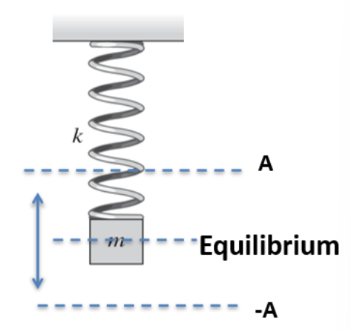
Mass-Spring System - SHM
the force on a mass on a spring is proportional to the displacement and acceleration
Angular Frequency of a mass-spring system in SHM
ω² = k/m → ω = sqrt(k/m)
describes how quickly the system oscillates around its equilibrium position
In a supermarket, you place a 22.3-N (around 5 lb) bag of oranges on a scale,
and the scale starts to oscillate at 2.7 Hz. What is the force constant (spring constant) of the spring of the scale?
A) 650 N/m
B) 600 N/m
C) 330 N/m
D) 820 N/m
E) 410 N/m
F = 22.3 N
w = 5 lb
f = 2.7 Hz
k = ?
ω = 2pi(f) = 2pi(2.7) = 17 rad/s
ω = sqrt(k / m)
find mass:
w = mg
22.3 N = mg → m = 2.28 kg
17 rad/s = sqrt(k / 2.28 kg)
k = 656.17 N/m
Conservation of Mechanical Energy in SHM
In a mass-spring system undergoing simple harmonic motion, the total mechanical energy is conserved, with potential energy being converted to kinetic energy and vice versa, remaining constant throughout the oscillation.
ME at all A values is equal
As KE increases, PE decreases and vice versa
Suppose that the block has mass m = 2.72 x 10⁵ kg and is designed to oscillate at frequency f = 10.0 Hz and with amplitude xm = 20.0 cm. What is the total mechanical energy E of the spring-block system?
A) 2.147 x 10⁷ J
B) 1.073 x 10⁹ J
C) 3.103 x 10⁷ J
D) 2.720 x 10⁵ J
E = U + K
E = ½ kA²
ω = 2pi(f) = 2pi(10 Hz) = 63 rad/s
ω = sqrt(k/m)
63 = sqrt(k / 2.72×10^5)
k = 1.07×10^9
E = ½ (1.07×10^9)(0.2m)²
E = 2.147×10^7 J
Simple Pendulum
a point mass hung by a massless string
apply Newton’s 2nd Law F = ma = -mgsin(theta)
If you have 2 different pendula, one with 5g mass, one with 10g mass, and the same L, what are their periods?
T = 2π√(L/g) for both
mass does not impact the period of the pendulum
Physical Pendulum
solid mass of any shape oscillating around its com in a circular arc
cannot be modeled as a point mass suspended by a massless string
At the surface of Mars, the acceleration due to gravity is 3.71 m/s2. On Earth, a pendulum that has a period of one second has a length of 0.248 m. What is the length of a pendulum on Mars that oscillates with a period of one second?
a) 0.0940 m
b) 0.143 m
c) 0.248 m
d) 0.296 m
e) 0.655 m
Earth
g = 9.8 m/s²
T = 1 s
L = 0.248 m
Mars
g = 3.71 m/s²
T = 1 s
L = ?
T = 2pi√(L/g)
1 = 2pi√(L / 3.71m/s²)
L = 0.094 m
Damped Oscillation
oscillation through fluid (water, oil)
amplitude decreases exponentially as energy is lost over time, leading to a gradual stop in motion
underdamping
position as a function of time
b in equation is dampening constant
depends on shape of object and density of medium
examples: car suspension spring, bungee jumping
compared to SHM: no friction, keeps oscillating
Damped Oscillation depends on…
fluid’s viscosity
thickness, resistance to flow
low viscosity fluid (ie water): vibrating motion = preserved
underdamped/light damping: amplitude of vibration decreases in time until motion ceases
high viscosity fluid (ie syrup/oil): faster amplitude decrease
critically damped: object returns rapidly to equilibrium after it is released and does not oscillate
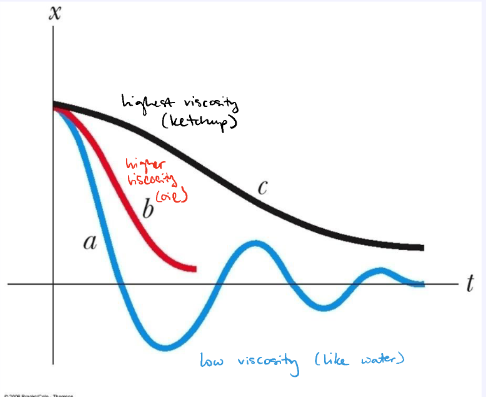
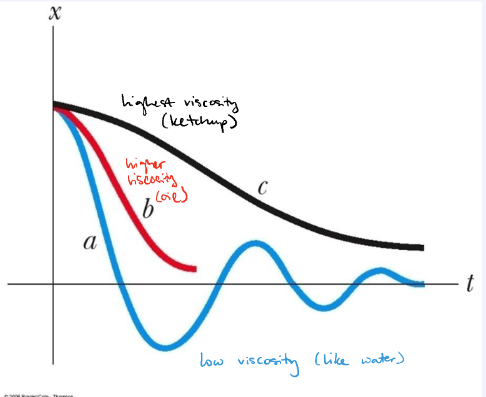
What would a car suspension spring be?
A
underdamped
B is critically damped
C is overdamped
A particle undergoes damped harmonic motion. The spring constant is 100 N/m; the damping constant is 8.0 x 10⁻³ kg∙m/s, and the mass is 0.050 kg. If the particle starts at its maximum displacement, x = 1.5 m, at time t = 0, what is
the amplitude of the motion at t = 5.0 s?
A) 1.5 m
B) 1.3 m
C) 1.0 m
D) 0.67 m
E) 0.24 m
k = 100 N/m
b = 8.0×10^-3 kg*m/s
m = 0.050 kg
xmax = 1.5 m = A when t = 0
t = 0 → 5 s
A = ? when t = 5s
x = Ae^(-bt/2m) cosωdt
A(t) = Ae^(-bt/2m)
A(5) = 1.5e^((8.0×10^-3×5)/2×0.05kg)
A = 1 m
When the oscillator is subjected to an external force that is periodic, the oscillator will…
exhibit forced/driven oscillations
example: a swing in motion is pushed with a periodic force of angular frequency, ωd
What 2 frequences are involved in a forced driven oscillator?
ω: natural angular frequency of the oscillator without presence of external force
ωd: angular frequency of the applied external force
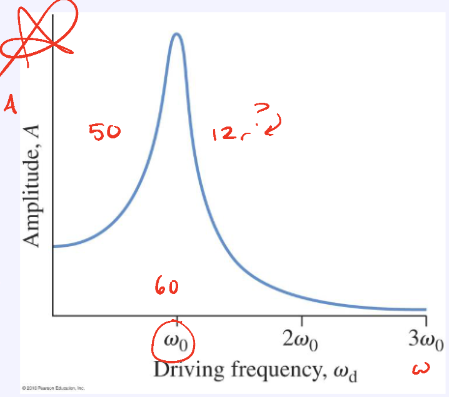
The velocity amplitude of the oscillations is greatest when…
ω = ωd
this is resonance
when displacement amplitude is largest as well
Significance of resonance
when the frequency of an object matches with the external frequency, it starts to oscillate violently
this results in a very high amplitude and collapse
ω = ωexternal
f = fexternal
For many centuries, soldiers have been trained to march side by side with their steps matching all of the other soldiers. At time t = 0 s, the soldiers all step with their left feet and continue marching with the same period. When they come upon a bridge, how should they change their marching, if at all?
a) They should continue marching with the same period.
b) Every other row of soldiers should take two steps for every one taken by the rows of soldiers ahead and behind them.
c) Every other row of soldiers should take a step with their right foot when the rows of soldiers ahead and behind them are stepping with their left feet, but keep marching with the same period.
d) They should all walk at their own pace so that they do not cause resonance on the bridge.
d) They should all walk at their own pace so that they do not cause resonance on the bridge.
if marching frequency matches bridges natural frequency → resonance