L05 Metals and Ceramics
 Call Kai
 Learn
Learn Practice Test
 Spaced Repetition
 Match
Match Flashcards
 Knowt Play
1/15

There's no tags or description
Looks like no tags are added yet.
Name | Mastery | Learn | Test | Matching | Spaced | Call with Kai | Chat |
|---|
No analytics yet
Send a link to your students to track their progress
16 Terms
What are single crystals?
Single crystals have a perfect periodic atomic arrangement throughout the entire specimen, with all unit cells aligned in the same orientation.
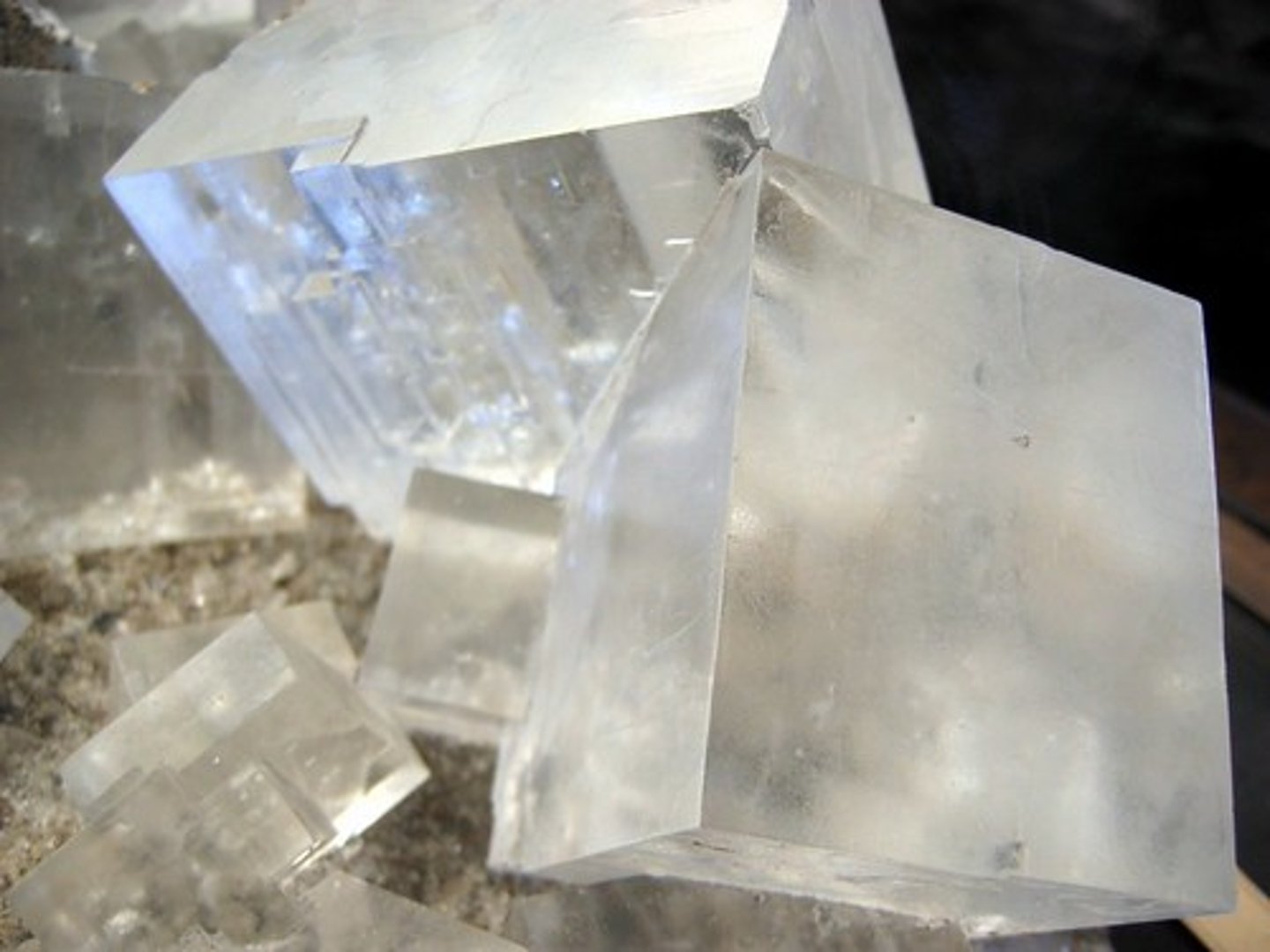
What are polycrystalline materials?
Polycrystalline materials consist of many small crystals (grains) with different orientations, separated by grain boundaries.
What are the influencing parameters of diffusion processes?
Main influencing parameters include material combination (diffusion couple) and temperature. Higher temperatures increase atomic mobility and diffusion rate.
What are phase diagrams used for?
Phase diagrams show the stable phases and microstructural changes of materials depending on temperature and composition.
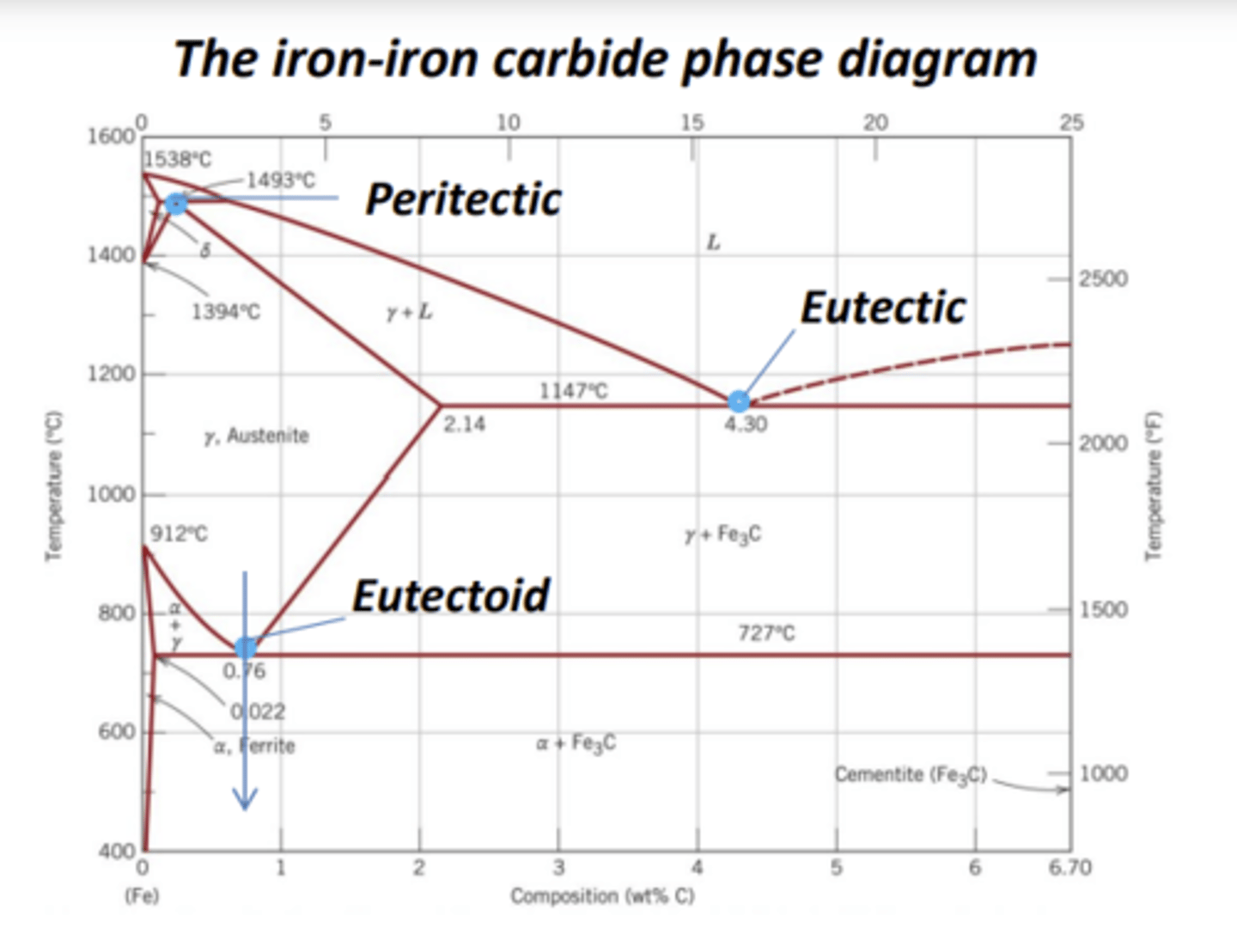
Where is the peritectic, eutectic and eutectoid point in the iron carbide diagram?
Peritectic, eutectic, and eutectoid points are critical transformation points on the iron-carbon phase diagram, located at specific carbon contents and temperatures.
Which carbon contents define iron, steel and cast iron?
Iron: C < 0.008 wt%, Steel: 0.008 wt% < C < 2.14 wt%, Cast iron: 2.14 wt% < C < 6.7 wt%.
How can the phase fractions and total structure be calculated?
Phase fractions are calculated using the lever rule based on the positions of the compositions in the phase diagram.
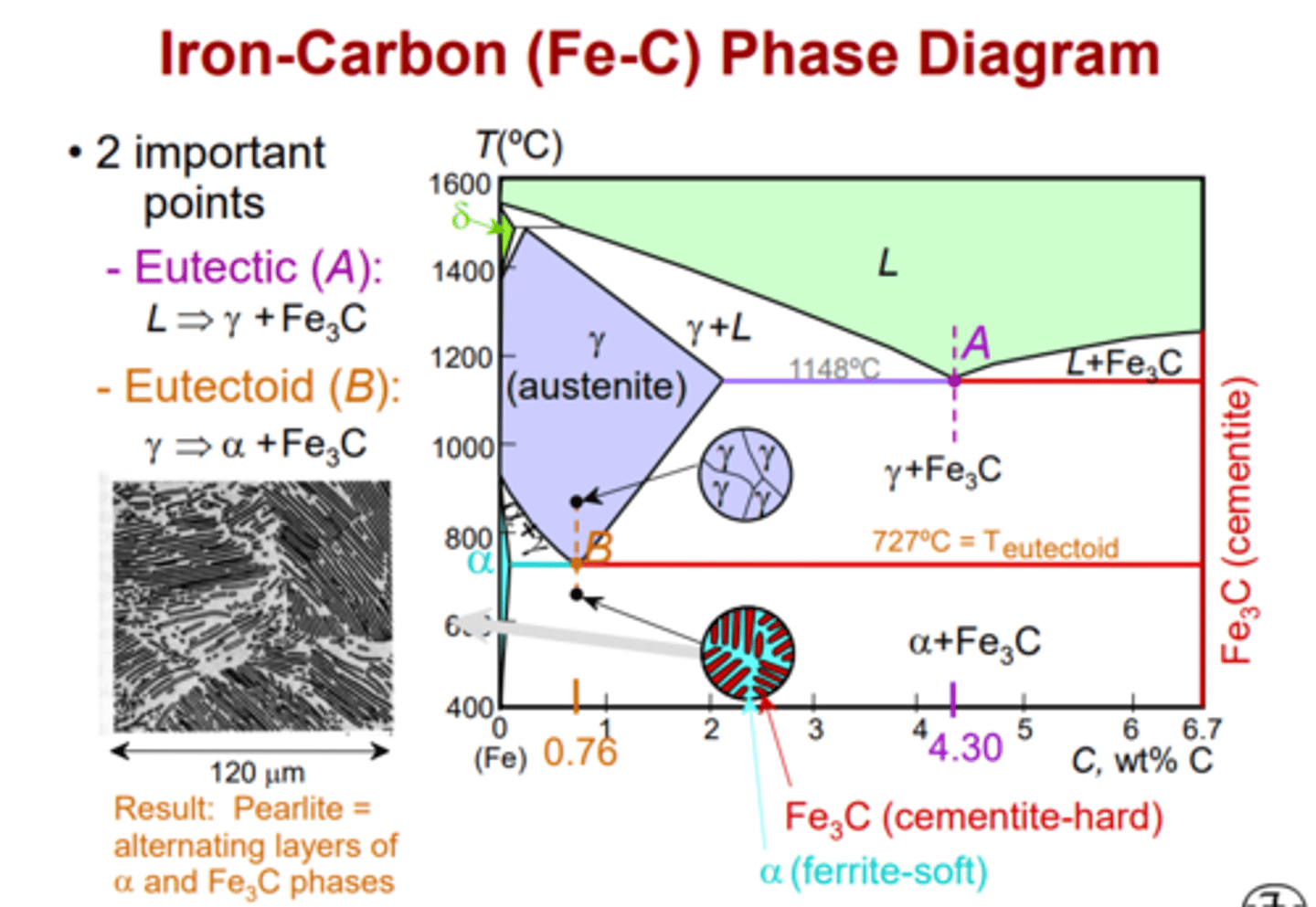
Draw and name the microstructures of steel into the iron carbide diagram!
Microstructures such as pearlite, ferrite, cementite, and austenite are plotted within the iron-carbon diagram depending on carbon content and cooling rate.
Why is heat treatment performed on steels?
Heat treatment alters the microstructure to achieve desired mechanical properties like strength, toughness, hardness, or ductility.
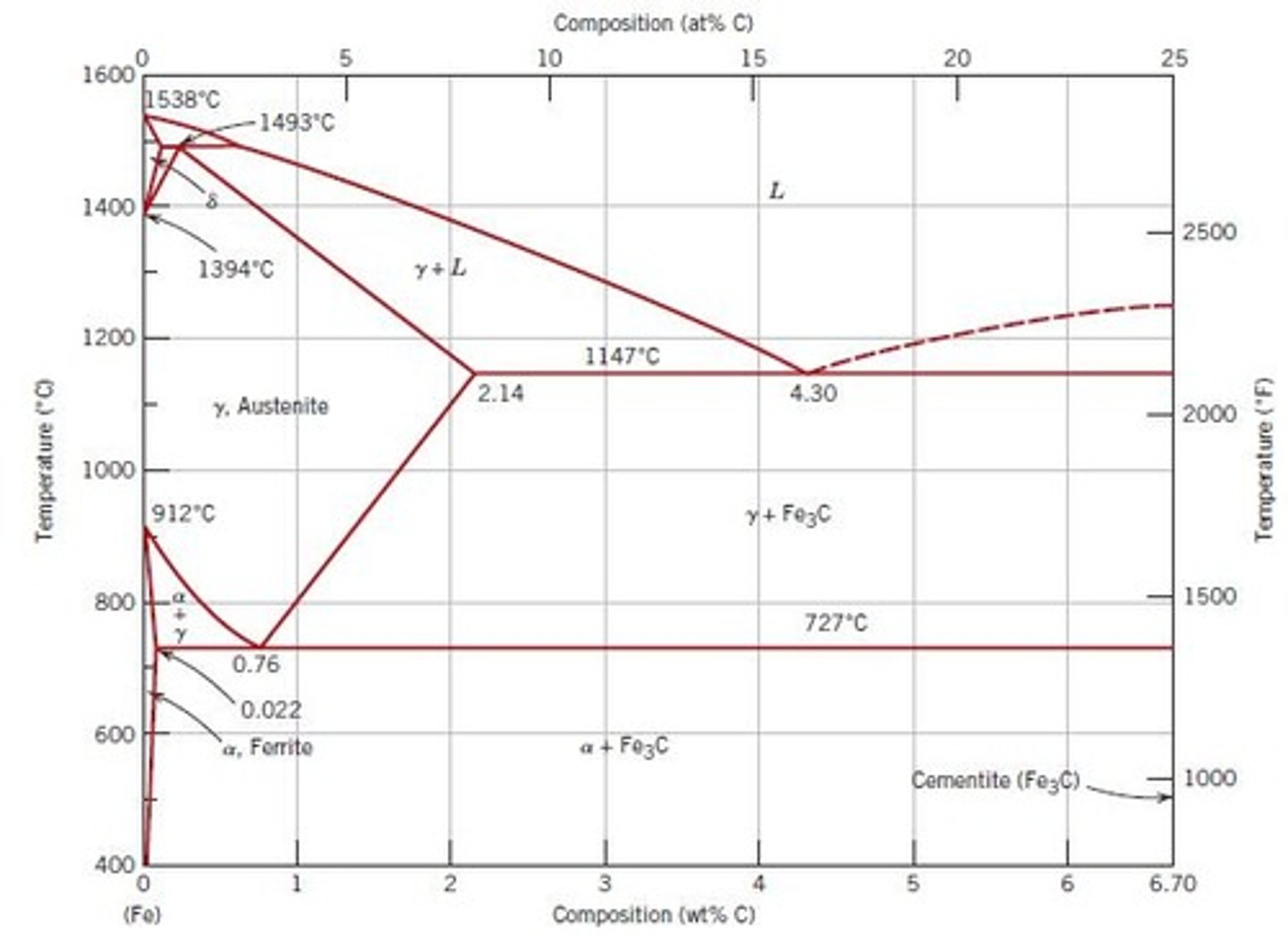
Fill out the annealing areas in the iron carbide diagram!
Annealing areas are specific temperature regions in the iron-carbon diagram where processes like normalizing, spheroidizing, and stress relief occur.
What is the difference between annealing and hardening?
Annealing involves slow cooling to create equilibrium microstructures, while hardening involves rapid cooling (quenching) to form martensite.
Name 5 typical alloy elements of steel!
Common alloying elements include: chromium, nickel, molybdenum, manganese, and vanadium.
What C contents have low, mid and high carbon steels?
Low carbon: < 0.25 wt%, Medium carbon: 0.25-0.6 wt%, High carbon: 0.6-1.4 wt%.
Why is not always high-carbon steel used?
High-carbon steels are very hard but brittle and less ductile, making them unsuitable for applications requiring high toughness or machinability.
What is the main advantage of stainless steel?
Stainless steel's main advantage is its corrosion resistance in various environments.
Why is stainless steel corrosion resistant?
Stainless steel resists corrosion due to the formation of a passive chromium-oxide layer that protects the surface from oxidation.