Lecture 10: Common Disorders of the Equine Hind Limb
 Call Kai
 Learn
Learn Practice Test
 Spaced Repetition
 Match
Match Flashcards
 Knowt Play
1/43

There's no tags or description
Looks like no tags are added yet.
Name | Mastery | Learn | Test | Matching | Spaced | Call with Kai | Chat |
|---|
No analytics yet
Send a link to your students to track their progress
44 Terms
What are the common etiologies of cervical spine OA and how is it diagnosed?
etiology: trauma, unnatural head carriage, OC
diagnosed: stiff neck, ± lame or neurologic, rads
How is cervical spine OA treated and what is the prognosis?
tx: inject facets with corticosteroid, acupuncture, mesotherapy
prognosis: fair, will require life long maintenance, may progress and cause neurologic signs
What is kissing spines?
impinging dorsal spinous process caused by trauma or poor fitting saddle
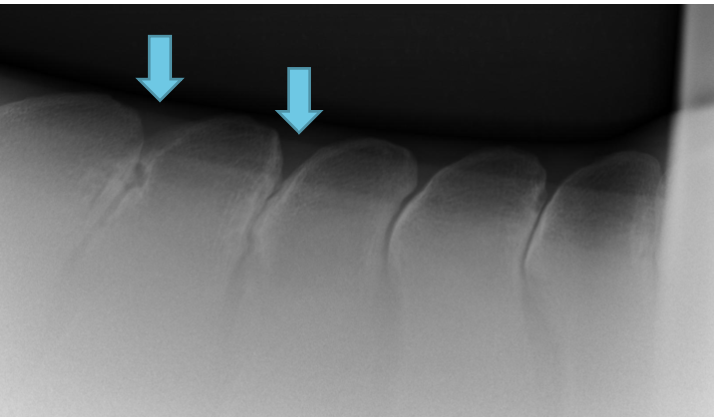
What is this and how is it diagnosed?
impinging dorsal spinous processes aka kissing spines
diagnosis:
pain on palpation
reduced performance (behavior change)
rads
How is kissing spines treated and what is the prognosis?
tx: check saddle fit, inject area with corticosteroids, surgical resection
prognosis: depends on severity
What are the possible etiologies of general back muscle pain and how is it diagnosed?
etiology: underlying hind limb lameness, poor saddle fit, poor riding, trauma
diagnosis: pain on palpation and reduced performance
How is general back muscle pain treated and what is the prognosis?
tx: check saddle fit, inject area with corticosteroids (mesotherapy), acupuncture, rest
prognosis: good once address underlying cause
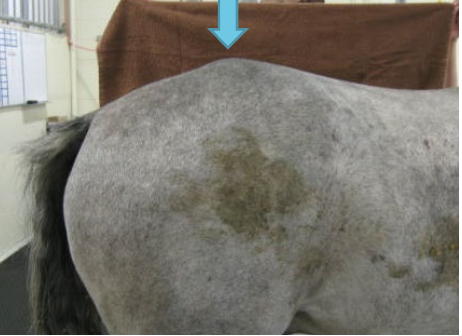
What is this and what is it caused by ?
SI disease (arthritis or subluxation of SI joint = hunters bump) caused by trauma or inappropriate use
How is SI disease diagnosed?
clinical signs
acute: lame, can feel crepitus by rectal palpation
How is SI disease treated and what is the prognosis?
tx: rest, inject SI joint with corticosteroids
prognosis: good, may require ongoing maintenance
What structures commonly cause hind limb lameness in the horse from most to least common?
hock
below hock
stifle
above stifle
What commonly causes metatarsal 2 & 4 fractures (splint bones) and how are they diagnosed?
etiology: kick injury - if wound, sequestration likely
diagnosis: rads, observe wound - often non-healing
How are metatarsal 2 & 4 fractures treated and what is the prognosis?
tx: ostectomy
prognosis: excellent
What are the gait characteristics of hock lameness?
drag toes
fails to “track up” on lame leg
lame leg adducts most
rider feels difference in their connection
How is hock lameness diagnosed?
joint palpation: often none, bone spavin = hard swelling, bog spavin = effusion
flexion tests
blocks
rads, nuclear scintigraphy, CT
What is the most common cause of hind end lameness diagnosed in performance horses?
hock OA (distal intertarsal and tarsometatarsal joint)
What are the common etiologies of hock OA and how is it diagnosed?
etiology: athletic use, genetic - juvenile spavin
diagnosis: + upper limb flexion, BLOCKS to distal hock joints, rads (do NOT correlate well with clinical lameness)
How is hock OA treated and what is the prognosis?
tx: intra-articular corticosteroids, shoeing (squared toe), facilitated ankyloses or arthrodesis
prognosis: good, will require ongoing maintenance during career
What are the common etiologies of tibiotarsal effusion (bog spavin)?
OCD
synovitis - poor conformation, hard work
OA - rare
blood = hemarthrosis (associated with collateral ligament injury)
infection = septic arthritis
How is tibiotarsal effusion (bog spavin) diagnosed?
effusion in TT joint
radiographs
ultrasound?
diagnostic arthroscopy
What are the most to least common locations of hock OC?
distal intermediate ridge of tibia (DIRT)
trochlear ridge (lateral > medial)
medial malleolus
What is the treatment and prognosis of tibiotarsal effusion (bog spavin)?
tx: drain joint and inject corticosteroids, arthroscopy
prognosis: good, usually cosmetic problem if underlying issue addressed
What is the etiology of plantar ligament desmitis (curb) and how is it diagnosed?
etiology: strain on plantar aspect of hock, sickle hocked horse, standardbreds
diagnosis: characteristic swelling, mild to moderate lameness, blocks, ultrasound
What is the treatment for plantar ligament desmitis (curb) and what is the prognosis?
tx: as for other ligament injuries, usually just need rest
prognosis: good, will always have a “curb” swelling
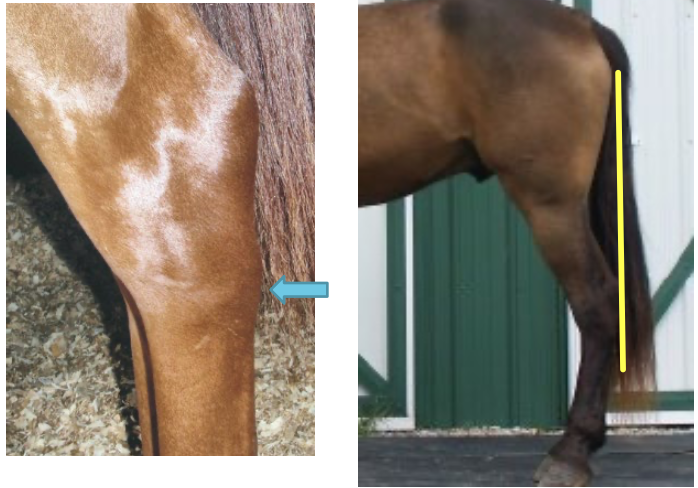
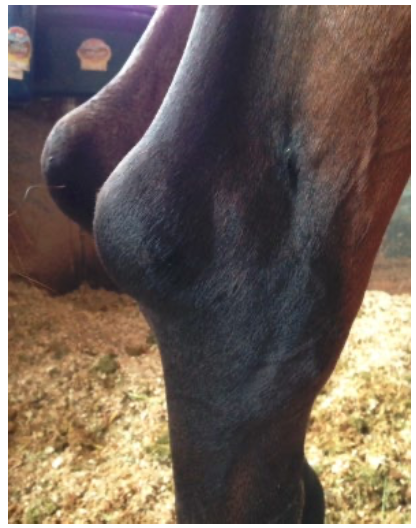
What is this and how is it diagnosed?
calcaneal bursitis (capped hock) caused by repeated trauma (stall kicker) and diagnosed by characteristic swelling and not being lame (usually)
What is the treatment and prognosis for calcaneal bursitis?
tx: drain and inject corticosteroids - cosmetic fix
prognosis: excellent for function, poor for cosmesis
How is septic calcaneal bursitis diagnosed?
VERY lame
pressurize bursa
contrast radiographs
ultrasound
How is septic calcaneal bursitis treated and what is the prognosis?
tx: flush bursa (tenoscopy best), regional limb perfusion, may require opening bursa and resecting part of calcaneus
prognosis: guarded
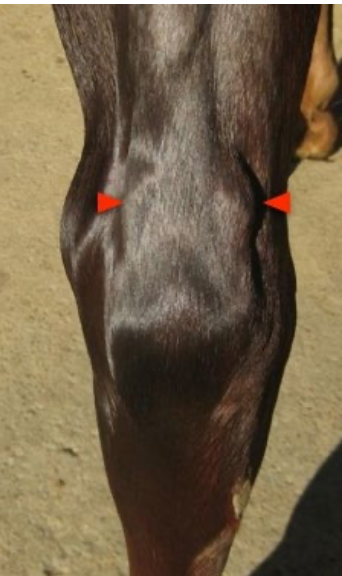
What is this and how is it diagnosed?
tarsal sheath tenosynovitis (thoroughpin) caused by wear and tear or conformation (straight hocks) and diagnosed by characteristic swelling and not being lame (usually)
What is the treatment and prognosis for tarsal sheath tenosynovitis?
tx: inject corticosteroids?, none, bandaging not effective
prognosis: excellent for athletic use, guarded for cosmesis
What are the common etiologies of a ruptured peroneus tertius and how is it diagnosed?
etiology: trauma (usually foals), full limb hind limb casts
diagnosis: ability to extend the hock with a flexed stifle, lameness and swelling initially, tarsus extends more than usual at the trot
What is the treatment and prognosis for ruptured peroneus tertius?
tx: avulsions near stifle → arthroscopy, stall rest
prognosis: good, but poor if involving stifle joint
What is the treatment and prognosis for SDF or gastrocnemius muscle/tendon rupture?
tx: long term splinting and rest - challenging
prognosis: fair to poor, good if heals
How is fibrotic myopathy due to trauma diagnosed?
characteristic movement - most evident at walk
palpable hardening in semitendinosus mm. (possible ossification)
What is the treatment and prognosis of fibrotic myopathy?
tx: semitendinosus ± semimembranosus tenotomy - may not result in complete resolution of clinical signs
prognosis: fair for success of tx, horse will likely have altered gait
What are the gait characteristics and clinical signs of stifle lameness?
gait characteristics:
jumps off lame leg in weight bearing phase - quicker, short step
drags toe because leaves leg out behind
increased lameness when lib is on outside of circle?
clinical sings:
joint effusion - femoropatellar pouch easily palpable
hind end muscle atrophy with chronic problem
How is stifle lameness diagnosed?
flexion test: upper limb and caudal extension
blocks
rads, ultrasound
arthroscopy
nuclear scintigraphy
What are the most common lesions of stifle OC?
medial femoral cysts and trochlear ridge OCD
What is the treatment and prognosis of stifle OC?
tx: sx (wait until 1 yr) - debride and treat cysts
prognosis: depends on severity and success of surgery, leads to OA
What are the common etiologies of stifle OA and how is it diagnosed?
etiology: underlying OC, trauma, athletic use
diagnosis: blocks to stifle
What is the treatment and prognosis for stifle OA?
tx: intra-articular corticosteroids
prognosis: fair - high motion, complicated joint
What causes upward fixation of the patella?
weak quadriceps or conformation (straight legs) causes the inability to release the stay apparatus - patella does not disengage from the medial trochlea of the femur
How is upward fixation of the patella diagnosed?
presentation
severe → stifle is locked in extension
mild → horse catches their stifle
How is upward fixation of the patella treated?
immediate: back the horse up
exercise strengthen quadriceps (works for most cases): hills, Cavaletti
surgery: medial patellar ligament splitting or blistering, medial patella ligament desmotomy (last resort)