Chemcial Reactions (C6)
 Call Kai
 Learn
Learn Practice Test
 Spaced Repetition
 Match
Match Flashcards
 Knowt Play
1/21

Earn XP
Description and Tags
IGCSE Chemistry: C6.1 Physical and Chemcial changes C6.2 Rate of reaction C6.3: Redox
Name | Mastery | Learn | Test | Matching | Spaced | Call with Kai | Chat |
|---|
No analytics yet
Send a link to your students to track their progress
22 Terms
What do you need in order for a chemical reaction to occur?
For the activation energy (Ea) to be overcome, and molecules of the reactants to undergo a collision in the correct orientation
What are successful collisions?
When reactants collide and overcome the activation energy of a chemical reaction and undergo the collision in the correct orientation, forming new products in the reaction
What is collision theory?
States that for a reaction to take place, reactant molecules must collide with each other, and that these colliding molecules must posses sufficient energy and be properly orientated for a collision to be effective
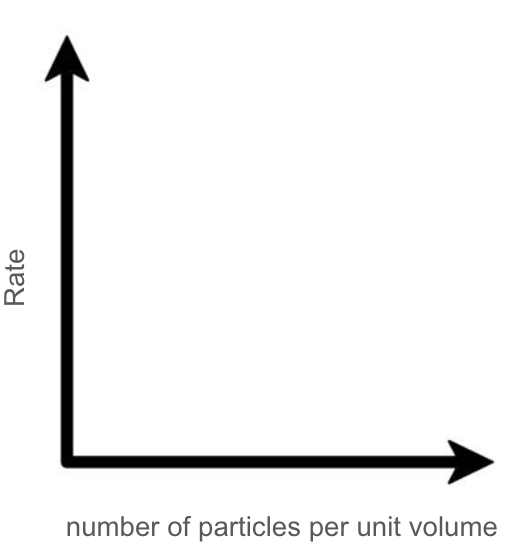
How does this affect rate of reaction?
Increasing concentration will increase the rate of reaction because more particles in the same space will lead to more frequent collisions between reactant molecules, so there’s a higher chance of successful collisions resultig in a reaction
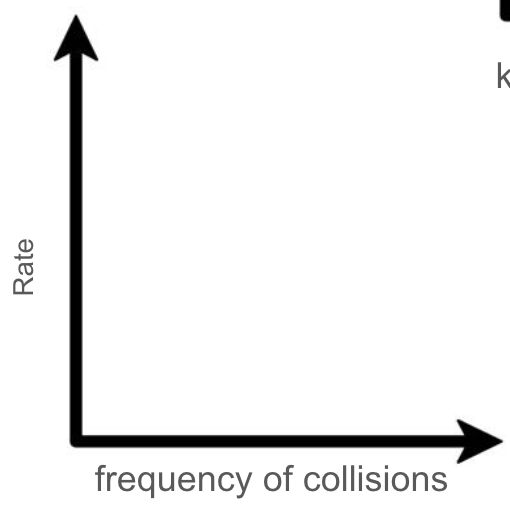
How does this affect rate of reaction?
Increasing frequency of collisions between particles increases the rate of reaction, given that the increase in temperature or pressure leads to more frequent collisions
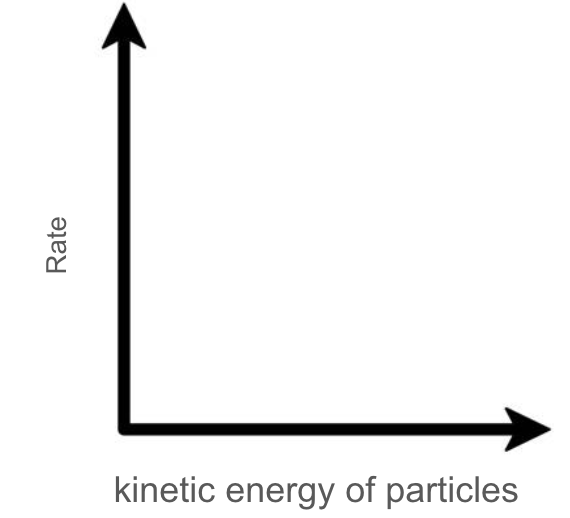
How does this affect rate of reaction?
Increasing the temperature increases the kinetic energy (KE) of particles, leading to more frequent collisions, which in turn increases the rate of reaction
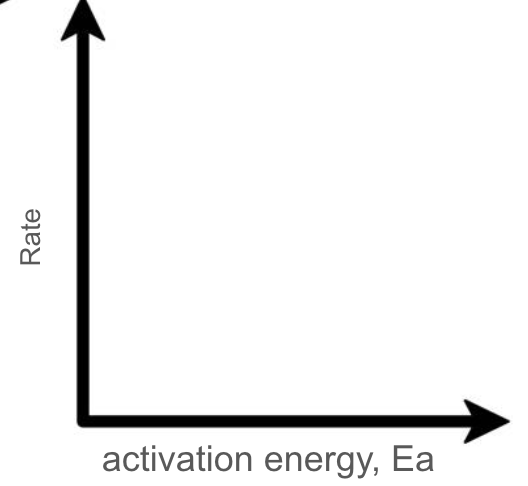
How does this affect rate of reaction?
A higher activation energy (Ea) will slow down the reaction (slower rate of reaction), while a lower Ea will accelerate it (higher rate of reaction)
What are some physical changes present in a reaction? Give examples
Change of state, easily reversible without the need for a chemical reaction
Ex: Separating mixtures
What are some chemical changes present in a reaction? Give examples
Change in color, bubbling, production of gas
Ex: Iron rusting, burning wood
Define oxidation and give an example
The gain of oxygen
Ex: Magnesium burns in oxygen: 2Mg+O2—>2MgO (Mg is being oxidised)
Define reduction and give an example
The loss of oxygen
Ex: Copper (II) oxide heated with carbon: 2CuO+C—>2Cu+Co2 (copper (II) oxide is being reducted)
Define oxidation in terms of electrons and give an example
Loss of electrons
Ex: Na—>Na+ +e- (sodium is oxidised because it loses electrons)
Define reduction in terms of electrons and give an example
Gain of electrons
Ex: Cl2 +2e- —> 2Cl- (chlorine is reduced because it gains electrons)
State the 3 oxidation numbers provided in class
Fe2+=Iron(II)
Fe3+=Iron(III)
Cu2+=Copper(II)
What are redox reactions? Give an example
Redox reactions have both oxidation and reduction happening at the same time
Ex: Zn+CuSO4—>ZnSO4—>Cu (Zn is oxidised because it loses electrons and Cu2+ is reduced because it gains electrons)
What is a rate of reaction?
The speed at which a chemical reaction occurs
What is a catalyst?
A substance that increases the rate of a chemical reaction without being used up or changed by the reaction.
How does changing the pressure of a gas affect the rate of reaction?
Increasing pressure of gas means the gas particles are forced into a smaller space, meaning more frequent collisions occur which increases chances of successful collisions occurring
How does changing the surface area of solids affect the rate of reaction?
If surface area is increased, the rate of reaction increases because larger surface areas create more space for the particles to collide more frequently, leading to increased chances in successful collisions
How does using a catalyst affect the rate of reaction?
By using a catalyst, the rate of reaction increases since catalysts lower activation energy required which means its easier to overcome it and have a successful reaction occur
What are physical changes?
Changes of state, shape, and size that are easily reversible without the need for a chemical reaction. No new substances are formed and no bonds are broken or formed
What are chemical changes?
Impossible to reverse without another chemical reaction happening, where a new substance is formed with new properties and bonds ARE broken and formed