Chapter 6 Biology: Lipids, Membranes, and the First Cells
5.0(2)
 Studied by 10 people
5.0(2)
 Call Kai
 Learn
Learn Practice Test
 Spaced Repetition
 Match
Match Flashcards
 Knowt Play
Card Sorting
1/23

There's no tags or description
Looks like no tags are added yet.
Study Analytics
Name | Mastery | Learn | Test | Matching | Spaced |
|---|
No study sessions yet.
24 Terms
1
New cards
What are the attributes of a lipid?
1. Primarily carbon and hydrogen based compounds (hydrocarbons)
2. Largely nonpolar and hydrophobic (insoluble in water)
2. Largely nonpolar and hydrophobic (insoluble in water)
2
New cards
What are the two building blocks found in many lipids?
1. Fatty acid
2. Isoprene
2. Isoprene
3
New cards
What are the three most important types of lipids found in cells?
1. Fats (triglycerides)
2. Steroids
3. Phospholipids
2. Steroids
3. Phospholipids
4
New cards
What are the structures of fats?
A glycerol linked to 3 fatty acids (triglyceride) by an ester linkage
5
New cards
Compare saturated and unsaturated fatty acids.
Saturated fatty acid chains: single bonds (LINEAR)
Unsaturated fatty acids chains: 1 or more double bonds (KINKS)
*Saturation affects the physical characteristics of lipids*
Unsaturated fatty acids chains: 1 or more double bonds (KINKS)
*Saturation affects the physical characteristics of lipids*
6
New cards
What are some examples of highly saturated fats?
butter, lard, animal fat
7
New cards
What are some examples of highly unsaturated fats?
sesame seed oil, olive oil
8
New cards
What is a steroid?
A four-ring structure, differ by functional groups
9
New cards
What are three examples of steroids? Explain each.
1. cholesterol: a hydrophilic hydroxyl group attached to the top ring and an isoprenoid "tail" attached at the bottom
2. testosterone: male hormone
3. estradiol: female hormone used to regulate reproductive cycles
2. testosterone: male hormone
3. estradiol: female hormone used to regulate reproductive cycles
10
New cards
List and describe the 3 components of a phospholipid.
1. glycerol attached
2. 2 hydrophobic fatty acid "tails" (or isoprene tails)
3. Phosphate, and charged group "head"
2. 2 hydrophobic fatty acid "tails" (or isoprene tails)
3. Phosphate, and charged group "head"
11
New cards
Which component of a phospholipid interact with water?
The phospholipid head
12
New cards
What are the 2 structures that phospholipids can form upon contact with water?
1. Micelles: heads face the water and tails face each other
2. Phospholipid bilayer (lipid bilayer): two layers of phospholipid molecules align (hydrophilic heads face surrounding solution / the hydrophobic tails face one another
2. Phospholipid bilayer (lipid bilayer): two layers of phospholipid molecules align (hydrophilic heads face surrounding solution / the hydrophobic tails face one another
13
New cards
What are the 3 functions of a plasma/cell membrane?
1. Keep damaging materials out of the cell
2. Allow entry of materials needed by the cell
3. Facilitate the chemical reactions necessary for life
2. Allow entry of materials needed by the cell
3. Facilitate the chemical reactions necessary for life
14
New cards
What is selective permeability in regards to
molecules?
molecules?
The tendency to allow a given substance to pass across it
15
New cards
List and explain the 4 factors that influence the permeability of the cell membrane.
1. number of double bonds between the carbines in the phospholipid's hydrophobic tail
2. length of the tail
3. number of cholesterol molecules in the membrane
4. temperature
2. length of the tail
3. number of cholesterol molecules in the membrane
4. temperature
16
New cards
Do individual phospholipids move throughout the lipid bilayer more, or flip between layers?
Individual phospholipids can:
-move laterally throughout the lipid bilayer
-rarely flip between layers
-move laterally throughout the lipid bilayer
-rarely flip between layers
17
New cards
List the 3 transport mechanisms.
1. passive transport
2. facilitated transport
3. active transport
2. facilitated transport
3. active transport
18
New cards
Does passive transport require energy?
No
19
New cards
What is diffusion?
The random movement of molecules from a high concentration to a low concentration
20
New cards
Explain osmosis?
-the movement of water through a selectively permeable membrane leaving molecules on the other side
-water tends to equalize the concentration of solutes across a membrane
-water moved toward the higher concentration gradient
-water tends to equalize the concentration of solutes across a membrane
-water moved toward the higher concentration gradient
21
New cards
Define and explain isotonic, hypotonic, and hypertonic in reference to water movement
in/out of a cell.
in/out of a cell.
1. isotonic: equal solute concentration inside cell as outside (No net movement of water)
2. Hypotonic: solution with a lower concentration of solutes, than inside of a cell (Water moves from solution, into cell by osmosis)
3. Hypertonic: solution with a higher concentration of solutes, than inside of a cell (Water moves from cell, into solution by osmosis)
2. Hypotonic: solution with a lower concentration of solutes, than inside of a cell (Water moves from solution, into cell by osmosis)
3. Hypertonic: solution with a higher concentration of solutes, than inside of a cell (Water moves from cell, into solution by osmosis)
22
New cards
Compare: integral, transmembrane, and peripheral proteins.
-transmembrane (integral) proteins are amphipathic and span the membrane facing the interior & exterior of a cell (involved in the transport of selected ions and molecules across the membrane / able to affect permeability)
-Peripheral proteins are found only on the side of the membrane (often attached to integral proteins)
-Peripheral proteins are found only on the side of the membrane (often attached to integral proteins)
23
New cards
Identify the location of the charged amino acids.
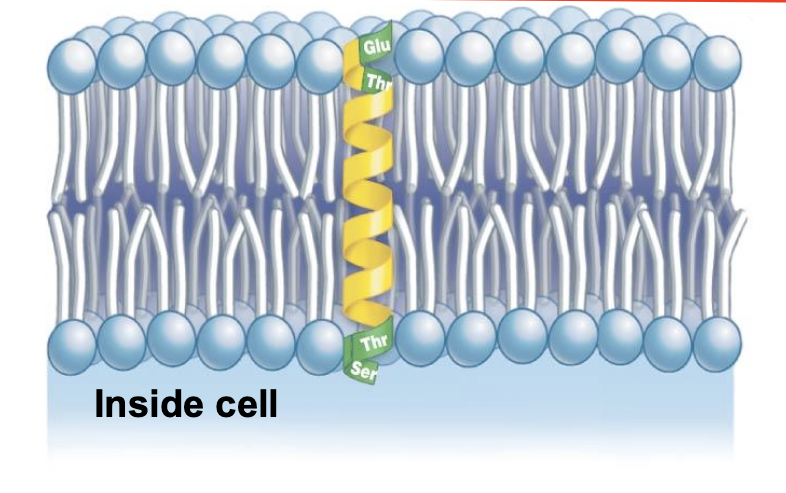
24
New cards
List and define the three types of transport proteins.
1. Channels: proteins selective in which molecules pass along a membrane
2. Carrier proteins or transporters: change shape during the transport process moving molecules down a concentration gradient
3. Pumps: membrane proteins that provide active transport molecules across the membrane against a concentration gradient and requires energy, ATP
2. Carrier proteins or transporters: change shape during the transport process moving molecules down a concentration gradient
3. Pumps: membrane proteins that provide active transport molecules across the membrane against a concentration gradient and requires energy, ATP