CHAPTER 6 - communication, integration, homeostasis
 Studied by 1 person
 Call Kai
 Learn
Learn Practice Test
 Spaced Repetition
 Match
Match Flashcards
 Knowt Play
1/40

There's no tags or description
Looks like no tags are added yet.
Name | Mastery | Learn | Test | Matching | Spaced | Call with Kai |
|---|
No study sessions yet.
41 Terms
name the 7 kinds of proteins of the body
membrane transporters
enzymes
receptors
regulatory proteins
binding proteins
signal molecules
immunoglobulins
what are the 2 physiological signals in cell to cell communication
electrical signals - change cell membrane potential
chemical signals - molecules secreted by cells and received by target cells (most common)
3 local communications in cell to cell communication
gap junctions
contact-dependent
autocrine/paracrine
3 long distance communications in cell to cell communication
endocrine (hormones from glands)
neurotransmitters (electrical, action potentials)
neurohormones (released into bloodstream in response to nerve signals)
what are gap junctions
form direct cytoplasmis connections between adjacent cells
eg. heart muscle, smooth muscle
what are desmosomes in the cardiac muscle
type of cell junction
strong proteins that surround sarcomeres and bind neighbouring sarcomeres
allow force to be transferred
what are gap junctions in the cardiac muscle
provide electrical connection
electrical signals are rapidly transmitted via these protein pores providing the basis for synchronous contraction
what are autocrine/ paracrine cells
autocrine - act on same cells that secreted them
paracrine - secreted by one cell and diffuse to adjacent cells
eg. histamine, cytokines, eicosanoids
what are contact dependent signals
require interaction between membrane molecules on two cells, occurs in system during growth and development
what 2 systems look after long distance signalling
endocrine and nervous
where are hormones released from
endocrine glands/ endocrine cells
where are neurocrines released from
neurons; neurotransmitter, neuromodulator, neurohormone
what are cytokines
peptides, both local and long distance,
short proteins that help in signalling
3 neurocrine molecules
neurotransmitters
neuromodulators
neurohormones
define hormones
chemical messengers produced by endocrine glands that are released into the bloodstream and travel to target organs or tissues
what are neurotransmitters
chemical messengers that transmit signals across a synapse from one neuron to another target neuron, muscle cell, or gland cell
released from synaptic vesicles in the presynaptic neuron into the synaptic cleft, where they bind to specific receptors on the postsynaptic membrane.
what are neurohormones
chemicals released by neurons into the blood for action at distant targets
what are lipophobic signal molecules
dont want to diffuse through cell membrane
bind receptors on the cell membrane
what are lipophilic signal molecules
diffuse through cell membrane
usually bind cytosolic receptors or nuclear receptors
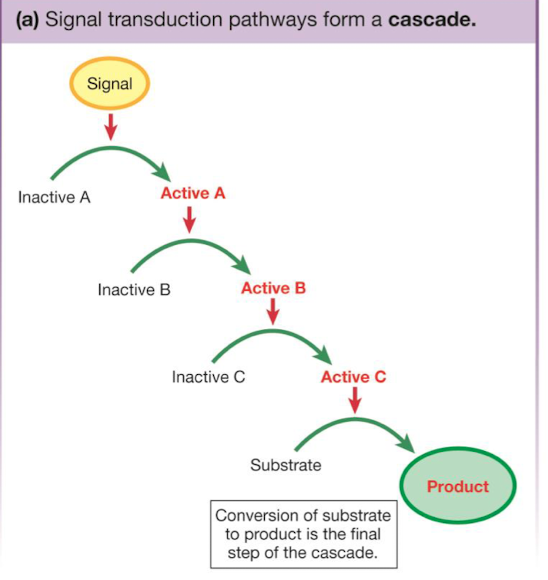
what is a cascade signal transduction
conversion of substrate to product
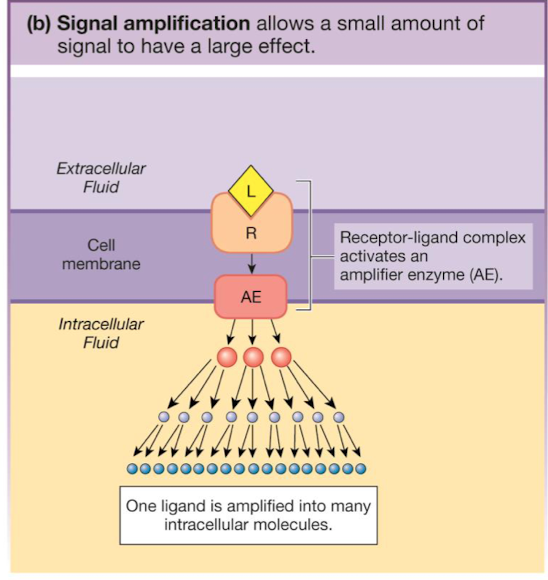
what is signal amplification
allows a small amount of signal to have a large effect
what are the 4 categories of membrane transporters
receptor - channel: ligand binding opens and closes channel
g protein receptor: opens an ion channel or alters enzyme activity
receptor - enzyme: activates an intracellular enzyme
integrin receptor: alters enzymes or cytoskeleton
what membrane receptor is most commonly used for signal transduction
G protein coupled receptors
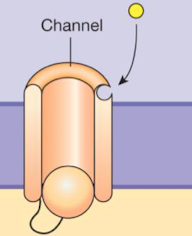
what is a receptor-channel
ligand binding opens or closes the channel
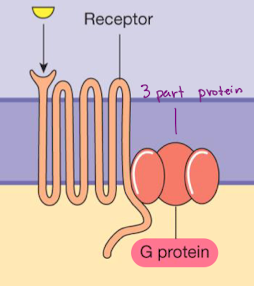
what is a G protein-coupled receptor
ligand binding to a G protein-coupled receptor opens an ion channel or alters enzyme activity
which is a faster reaction: gated signal transduction or cascade
gated
what is a second messenger
a substance whose release within a cell is promoted by a hormone and which brings about a response by the cell.
name the 5 steps of lipophobic hormones during signal transduction (cAMP system)
signal molecule binds to G protein coupled receptor, activating G protein
G protein activates adenylyl cyclase
adenylyl cyclase converts ATP to cAMP ( secondary signal)
cAMP activated protein kinase A
protein kinase A amplifies leading to a cellular response
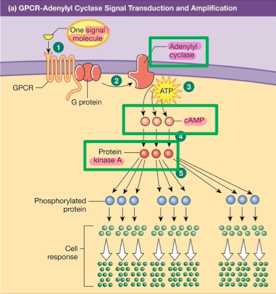
name the 5 steps of lipid- derived second messengers during signal transduction
signal molecule activates receptor, activating G protein
G protein acivates phospholipase
phospholipase converts membrane phospholipids into diacylglycerol (DAG) - remains in membrane and IP3 - diffuses into the cytoplasm
DAG activates protein kinase C which phosphorylates proteins
IP3 causes release of Ca2+ from organelles creatign a Ca2+ signal
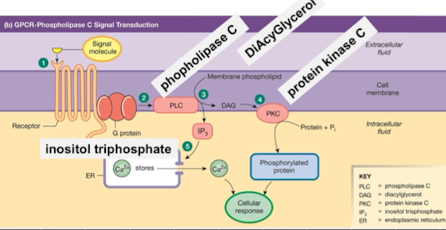
name 6 secondary messenger molecules
cAMP
calcium
DAG
IP3
Kinase A
cGMP
what is paracrine signalling
acts on cells nearby
what is autocrine signalling
acts on the same cell that produced the hormone
what is an agonist ligand
a ligand that still has some affinity and can activate the receptor but not as much as the primary ligand
what is an antagonist ligand
a ligand that blocks the receptor activity
eg. CO2 block O2 receptors in cells
alpha receptors have a high affinity to norepinephrine or epinephrine
norepinephrine
beta receptors have a high affinity to norepinephrine or epinephrine
epinephrine
what is tonic control
continuous regulation of a physiological function by a single control mechanism or signal, which can be increased or decreased as needed.
signal always present, changes in intensity
what is antagonistic control
Antagonistic control involves the regulation of a physiological function by opposing signals or mechanisms.
define up regulation
Upregulation refers to the process by which a cell increases the number or sensitivity of its receptors or signaling molecules in response to a particular stimulus.
define down regulation
Downregulation is the process by which a cell decreases the number or sensitivity of its receptors or signaling molecules in response to prolonged exposure to a stimulus.
define pathway termination
Pathway termination refers to the processes that deactivate or stop a signaling pathway once the appropriate cellular response has been achieved or the stimulus is no longer present