4 - Fruit Fly
 Call Kai
 Learn
Learn Practice Test
 Spaced Repetition
 Match
Match Flashcards
 Knowt Play
1/130

There's no tags or description
Looks like no tags are added yet.
Name | Mastery | Learn | Test | Matching | Spaced | Call with Kai | Chat |
|---|
No analytics yet
Send a link to your students to track their progress
131 Terms
What class do fruit flies belong to?
Insecta
What order do fruit flies belong to?
Diptera
What family do fruit flies belong to?
Drosophilidae
What does the genus name 'Drosophila' mean?
Dark gut
What is the species name of the common fruit fly?
melanogaster
Who began experiments with fruit flies in 1908?
Thomas Hunt Morgan
What significant theory did Thomas Hunt Morgan link to sex chromosomes?
Mechanism of Mendelian Heredity
What major award did Thomas Hunt Morgan receive in 1933?
Nobel Prize in Physiology or Medicine
What did Hermann Joseph Muller prove using fruit flies?
The chromosomal theory of inheritance
What did Seymour Benzer study using fruit flies?
The influence of genes on behavior
What is the typical lifespan of a fruit fly?
2-3 months
How long does the fruit fly life cycle take at 25°C?
~10 days
What is the first stage of the fruit fly life cycle?
Egg stage

What is the final stage before adulthood in the fruit fly life cycle?
Pupa stage

Where has the fruit fly been introduced?
Every continent except Antarctica
What is a key characteristic of the fruit fly's habitat?
Requires moist environments
What is the average size of a fruit fly?
Around 2-3 cm in length
How many pairs of chromosomes do fruit flies have?
Four pairs
What percentage of human disease-causing genes have counterparts in fruit flies?
Approximately 70%
What are the main segments of a fruit fly's body?
Head, thorax, and abdomen
What anatomical feature aids in locomotion in fruit fly larvae?
Chitinous denticle belts
What is sexual dimorphism in fruit flies?
Differences in size and body shape between males and females
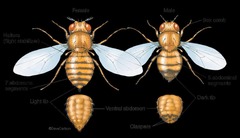
What is the primary function of the mushroom bodies in the fruit fly brain?
Olfactory learning and memory
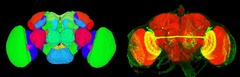
What is the role of the Ventral Nerve Cord (VNC) in fruit flies?
Controls locomotor actions and behaviors
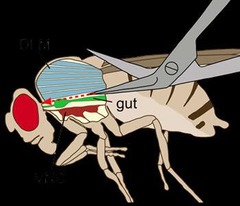
What anatomical structure in fruit flies is useful for studying human diseases?
Eyes

What type of genetic studies can be conducted using fruit flies?
Modeling neurological conditions such as Alzheimer's disease
What type of genetic manipulation is commonly performed on Kenyon cells?
Physiological studies related to brain function
What are the optic lobes in Drosophila?
Two large neuropils in the central brain that contain around 70,000 neurons, facilitating sensory input integration and transmission.
What is the primary function of the foregut in Drosophila?
To produce the peritrophic matrix and regulate the entry of ingested food into the midgut.
What is the main digestive and absorptive portion of the Drosophila digestive tract?
The midgut, which is approximately 6 mm in length.
What is the role of the hindgut in Drosophila?
Responsible for water and ion exchange.
How do Drosophila intestinal stem cells contribute to research?
They enable studies on gut regeneration, stem cell niche interactions, and mechanisms of tissue repair.
What similarities exist between the Drosophila gut and the mammalian gastrointestinal system?
Both share functions in nutritional signaling, hormonal regulation, and metabolic networks.
What is the significance of Drosophila salivary glands in research?
They serve as a model for energy metabolism and gene activation triggered by the steroid hormone ecdysone.
What is the generation time for Drosophila at room temperature?
10-12 days.
What is the optimal rearing condition for Drosophila?
25°C with 60% humidity.
What is the mean lifespan of Drosophila under optimal conditions?
45-60 days.
What is the heart rate of Drosophila?
~235 beats per minute.
How many eggs can Drosophila lay in one day?
100 eggs per day, totaling 750-1500 eggs in one lifetime.
What is the recommended housing for Drosophila studies?
Bottles and vials plugged with cotton wool or foam to prevent escape and entry of unwanted organisms.
What is the housing ratio for Drosophila breeding?
1 male to 3 virgin females.
What factors affect the life cycle speed of Drosophila?
High temperatures speed up the life cycle, while low temperatures slow it down.
What is the composition of the standard Drosophila diet?
Yeast, maize, sucrose, and agar, with possible additions like glucose, barley, soya, peptone, and banana.
What is the purpose of the nutrient-rich agar-based medium for Drosophila?
To provide a source of carbohydrates, proteins, and hydration for optimal growth.
How often should Drosophila food be replaced?
Regularly, every few days, depending on experimental needs.
What should be monitored in Drosophila housing to ensure health?
Presence of molds and potential contamination.
What is the role of supplemental feeding in Drosophila management?
To meet additional nutritional needs during research studies.
How do Drosophila obtain their hydration?
From moist and jelly-like foods, as they are not directly supplied with water.
What happens after Drosophila mating?
Larvae hatch and feed on the media, and adult flies are transferred to an enclosure once present.
How often should new cultures be set up?
Every 2-4 weeks.
What should be done with adults when transferring to a new container?
Transfer adults to a new container with new media.
What is the purpose of quarantine procedures in Drosophila management?
To prevent the introduction of foreign pathogens or pests.
What types of contaminants can affect Drosophila cultures?
Mites, fungi, and bacteria.
What can full-blown mite infections delay?
Experiments, publications, grant submissions, and other scientific endeavors.
What should be written on the fly vial upon arrival?
The arrival date.
What are G0 flies?
The first flies that hatch after transferring adults to a fresh vial.
How long should the original vial be kept for inspection?
At least 3 weeks.
What should be done if mites are detected in the original vial?
Select a few mite-free flies and perform rapid transfers.
What is the recommended action if fungal contamination is widespread?
Add a fungal inhibitor and check for infection sources.
How can bacterial contamination be treated?
By adding penicillin-streptomycin solution to the medium.
What is the most common problem caused by bacteria in Drosophila cultures?
Mucus-producing bacteria.
What should be done to bottles and vials to prevent contamination?
Wash with 10% chlorine bleach solution and sterilize by autoclaving.
What type of surfaces are recommended for laboratory spaces?
Smooth, non-porous surfaces like stainless steel.
What should be done daily for cleaning in the lab?
Wipe down surfaces with 70% ethanol or isopropyl alcohol.
What is the purpose of using sticky traps or UV light fly zappers?
To capture flies near entry points.
What is fly pushing?
A routine procedure of sorting flies based on visible markers using stereo microscopy.
What is fluorescent screening used for?
To identify successfully transfected flies or those expressing specific genes.
What is the purpose of dissection in Drosophila studies?
To study internal organs and tissues of adult flies and larvae.
What technique allows for long-term storage of Drosophila embryos?
Cryopreservation.
What are behavioral assays used to assess?
The locomotion abilities of larvae.
What should be done if no mites are found in subsequent vials?
Transfer some F2 flies into a new vial and bring them into the main lab.
What is the recommended action for cleaning contaminated areas?
Use disinfectant to clean any contaminated areas.
What should be done to prevent mold growth in cultures?
Use fresh media for culturing and discard used media immediately.
What should be done to manage fly density?
Properly manage fly density to avoid buildup of waste.
What is the role of live baker's yeast in Drosophila cultures?
To inhibit fungi.
What should be done with adult flies before progeny hatch?
Discard adults before progeny hatch and subculture progeny on untreated medium.
What is the purpose of drug screening assays?
To evaluate the physiological, survival, and behavioral effects of pharmacological compounds on living organisms.
How long before an experiment should specimens be obtained for acclimation?
Two weeks.
What is the recommended food medium depth for fruit fly colonies?
1.5-3 cm.
What is the first step in the larvae injection protocol?
Wash third instar larvae with Ringer's solution.
What is the purpose of daily health monitoring in research animals?
To record protocol number, principal investigator, emergency contact, experimental procedures, treatments, and health signs.
What are common contaminants in fruit fly cultures?
Bacteria, molds, and mites.
What method is used for sterilization of food media and vials before disposal?
Autoclaving or chemical disinfection.
What is one research area where fruit flies have contributed significantly?
Genetics and developmental studies.
What evidence did fruit flies provide regarding the chromosomal theory of inheritance?
They helped establish that genes are arranged linearly in chromosomes.
What is one application of fruit flies in studying neurodegenerative diseases?
Modeling Alzheimer's, Parkinson's, and Huntington's disease.
What is a key benefit of zebrafish in drug discovery?
They provide a cost-effective platform for high-throughput screening of potential therapeutic compounds.
How do zebrafish contribute to behavioral studies?
They exhibit behaviors such as sleep, learning, memory, and courtship.
What evolutionary processes can zebrafish help study?
Natural selection, genetic drift, and speciation.
What impact does spaceflight have on fruit flies according to research?
It alters the functioning of the Toll signaling pathway, weakening the immune system.
What role do fruit flies play in Alzheimer's disease research?
They help investigate the role of amyloid-beta plaques and test potential treatments.
What internal mechanism do fruit flies share with humans?
An internal time-keeping mechanism that regulates sleep-wake cycles.
What is the Bloomington Drosophila Stock Center known for?
It is the world's largest collection of fruit flies, established in 1987.
What is the significance of the Hox gene cluster discovered in fruit flies?
It is crucial for understanding body patterning and organ development.
What is the main focus of research using zebrafish in environmental biology?
Examining the effects of environmental stressors and adaptations.
What is the recommended temperature for incubating injected larvae?
25°C.
What should be done with flies and culture materials after experiments?
They should be securely sealed in airtight containers or plastic bags for disposal.
What are the minimum requirements for health monitoring of research animals?
Protocol number, principal investigator, emergency contact, experimental procedures, treatments, and health signs.
What is a common method for decontaminating materials unsuitable for autoclaving?
Chemical disinfection.
What is the role of zebrafish in studying genetic pathways related to behavior?
They allow identification of genes and pathways influencing behavior.