Public Administration
 Call Kai
 Learn
Learn Practice Test
 Spaced Repetition
 Match
Match Flashcards
 Knowt Play
1/96

There's no tags or description
Looks like no tags are added yet.
Name | Mastery | Learn | Test | Matching | Spaced | Call with Kai | Chat |
|---|
No analytics yet
Send a link to your students to track their progress
97 Terms
LECTURE 1 - What is public adminsitration?
Public administration (PA)
Both an empirical phenomenon and a field of research.
Organizations (public agencies), public servants, formal and informal structures and procedures
The machinery of government that turns political decisions into concrete actions
Close to parties, parliaments and governments BUT separate from them
PA as a field of research
Practice-oriented field: goal is to improve PA efficiency, not just understand how it works.
Defined by its object of study and practical goals, not by a particular method or theoretical approach
Key policy questions: Who will implement it? How will it be carried out? What role will PA play in determining its success or failure?
PA as a multi-disciplinary field
Borrows theoretical approaches and methods from political science, economics, management, law, sociology, psychology.
Close link to public policy analysis
Differences between US and European approaches
Bureaucracy
The rules and hierarchical structure through which administration is conducted
Often carries a negative connotation
Authority is exercised through administration: a law only has impact if the administration implements it
Often used interchangeably with PA, term from Weber.
Public Management
The management aspects of PA.
How government agencies should be organized
How public employees can be motivated to achieve goals (effectiveness, efficiency, equity, responsiveness)
PA in the US - historical development
Late 19th century: originated with focus on efficiency, professionalism and corruption (Wilson, 1887)
After WW2: challenged by Simon and Dahl who criticized focus on mechanic efficiency and lack of scientific rigor
More recent: highly specialized, focuses on human behavior, limits of rationality, role of context
PA is profoundly political
PA in Europe
After WW2: largely dominated by US perspective
1975 onwards: EU also relies on PA to implement policies -> not only US-based anymore
Variation of disciplines, discourses and research approaches between countries
Increasing internationalization and specialization
Distinct European research interests (welfare state, multi-level governance)
Dahl's 3 conditions for a science of PA (1947)
Science of PA is only possible if:
The place of normative values is made clear
The nature of man in PA is better understood and his conduct is more predictable
A body of comparative studies exists from which principles transcending national boundaries can be discovered
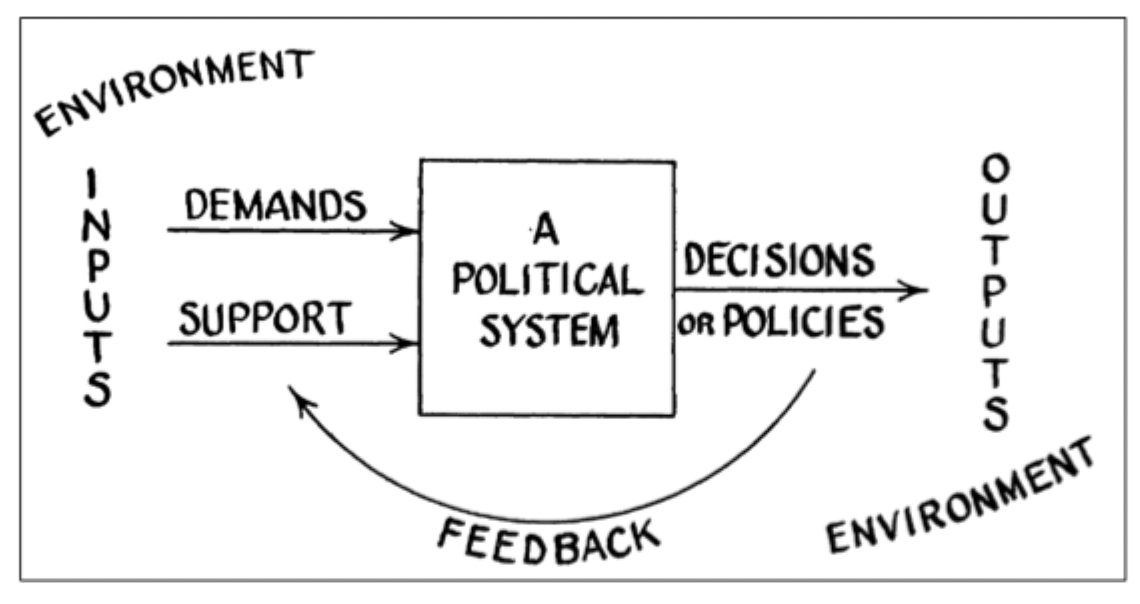
Easton's model of a political system
Inputs: demands and support from citizens/environment
Political system processes inputs
Outputs: decisions and policies
Outputs affect the environment -> feedback loop
PA is embedded in this system, tasked mainly with implementing policies
Chain of democratic delegation
Citizens -> Politicians -> Public Administration -> back to Society
Citizens elect politicians (representation)
Politicians delegate execution to PA (delegation & control)
Accountability goes back to citizens

Parliamentary vs Presidential democracy
Parliamentary (e.g. Italy): one line of delegation: Voters -> Parliament -> Government -> Bureaucracy. Government accountable to parliament.
Presidential (e.g. US): two lines of delegation: Voters -> Legislature AND President -> Bureaucracy. Both check the bureaucracy.

Policy cycle
Stages: Problem Recognition -> Agenda Setting -> Policy Formulation -> Policy Implementation -> Policy Evaluation -> Policy Termination
PA contributes at ALL stages, not only implementation
Bureaucrats provide expertise influencing agenda-setting and policy proposals

Implementation - room for discretion
Effective implementation requires room for discretion
Trade-off between democratic control and room for discretion
Simplistic view sees PA as an apolitical, neutral tool -> reality is more complex
Bureaucratic drift
When PA uses its discretion and de facto modifies policy in the implementation phase.
Principal-agent problem: politicians (principals) delegate to bureaucrats (agents) who may pursue their own preferences
The more veto players involved, the greater the potential drift

Street-level bureaucrats
Public servants in direct contact with citizens who use discretion to interpret and apply policies to local circumstances.
PA in non-democracies
PA is a political resource in the hands of authoritarian regimes (exercise power, support regime stability, oppress opponents)
J-shaped relationship between democracy and administrative capacity:
Authoritarian regimes: medium capacity
Initial democratization may decrease capacity
High democracy -> high capacity (due to accountability mechanisms)

Bounded rationality (Herbert Simon)
The limits of human rationality in decision-making.
Humans cannot process all information to make fully rational decisions
Crucial for understanding decision-making in PA
SESSION 3 - Organizing principles: Structures, procedures and personel.
3 main characteristics of PA organizations
Structure: Principles according to which administration is formally organized. 2. Procedures: Ways in which constitutive parts of PA are managed (formal/informal, hierarchical/cooperative). 3. Personnel: Members of PA specialized in a specific field.
Gulick's 4 principles of organization (1937)
By purpose (e.g. education, crime control) 2. By place (e.g. districts, regions) 3. By process (e.g. engineering, accounting) 4. By clientele or object (e.g. farmers, immigrants, the poor)
4 ways to achieve coordination
Hierarchical structure (a higher body decides in case of disagreement)
Procedures (detailed administrative rules or bonuses tied to common goals)
Recruitment/joint background (shared education between units)
Shared ideas/goals (overarching goal that motivates work beyond unit boundaries)
Public employees vs. civil servants (legal status)
Public employees: employed under civil/common law, similar to the private sector.
Civil servants: employed under a specific service law, more protective, meant to maintain institutions and resist short-term political pressure.
Generalists vs. specialists in PA
Generalists: selected by general intellectual ability (Ex: UK).
Specialists: selected for a particular educational background (Ex: US, France with l'ENA).
Merit vs. patronage
Merit: selection based on capabilities and neutral competence.
Patronage: selection based on political connections.
SESSION 4 - The hierarchist way
Degree to which PA is governed by specific rules. Measure of structure.
Low grid = lot of room for individuals.
High grid = most choices are limited by rules.
Degree to which PA involves coherent collectivities that are institutionally distinct from other spheres of society.
Low group = individual freedom.
High group = group cohesiveness.
Hierarchist (high grid, high group)
Fatalist (high grid, low group)
Individualist (low grid, low group)
Egalitarian (low grid, high group).
Evolve as a pendulum swinging back and forth. In practice they overlap.
High grid + high group.
Typical way of organizing the state.
Group centrality
Common interest has priority over individual interests.
Strong feeling of belonging.
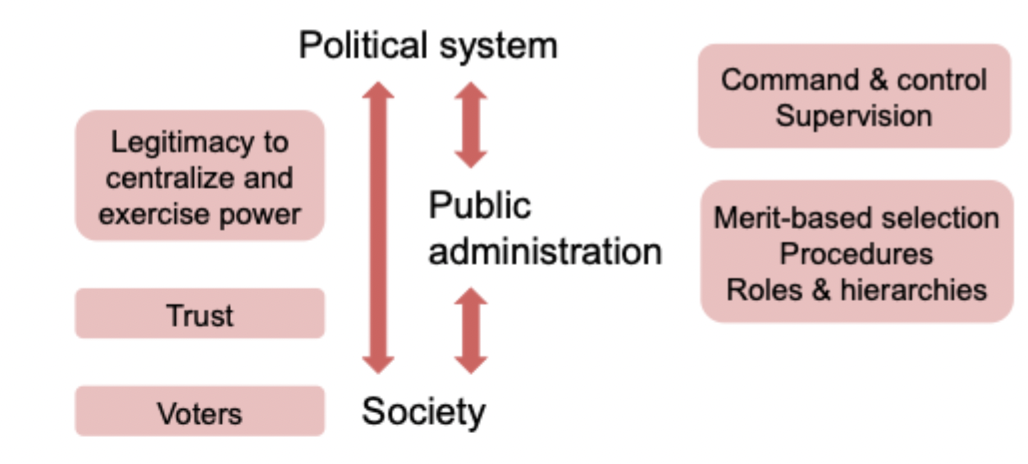
Rules, norms and procedures
Relationships within the group are translated into formal procedures
Roles fixed into a hierarchy with clearly defined centers of authority.
Control through supervision and monitoring of compliance with rules.
Chain of democratic delegation in the hierarchist model

1. Chinese modern state
2. Cameralism
3. Progressive and Fabian movements.
Common aspects: professional PA with clear rules, merit-based recruitment tested by competitive exams, trust in the ability of the state to govern effectively.
Written exams and days-long public competitions to test ethical standards and skills. Centralized selection procedures. Clear rules/homogenous procedures = key characteristic of the hierarchist model.
Term still used today for public servants selection.
1. Selection of public servants reflects the natural hierarchy of merits.
2. Merits = capacity to meet ethical standards based on Confucianism.
3. Relation between state officials and population compared to parents and children. Criteria enforced through control and punishment as hierarchical tools.
cience and practice of administration in German/Baltic states whereby monarchs or princes create a professional administrative apparatus for effective governing. (18th-19th century way of administering the state, now a scholar discipline.)
Cameralism - recruitment criteria
Public servants must have:
Specific university education in administration
Selected based on merit and technical competences
Permanent salary
Cameralism - 2 key skills
Understanding of administration as a process and skill
Understanding of economic development
Progressive & Fabian movements
Progressive movement in the US (1890s-1920s) and Fabian society in the UK (19th-20th century)
Wanted SOCIALISM in the interest of the masses:
Reduce corruption and inequalities
Support the poor
Eliminate monopoly capitalism
Reduce the power of elites
Goal: achieve this through a hierarchical approach
Progressive & Fabian movements - key aspects
Merit
Professionalism
Belief in science
Bureaucrats should serve citizens directly, not corrupt politicians
Weber, Taylor, Wilson.
Common points: only competent people recruited can lead to efficiency + specialization within organizations OR between politics and administration.
Weber - bureaucracy definition
Internal structures and procedures of an organization.
Empirical observation
Formalization of the hierarchist approach
Weber - 4 features of bureaucracy
Specialization: roles formalized, rights and responsibilities clearly described
Hierarchical organization: clear supervision and subordination, one unit of command
Professionalism and merit: recruitment and career progression based on competence and experience
Rule- and record-based procedures: homogenous, consistent, standardized rules ensure impersonality
Weber - bureaucracy as an ideal-type
Theoretically pure type. Does NOT mean it is normatively desirable.
→ Technical superiority of bureaucracies over other forms of organization
Taylor - Scientific Management
Theory analyzing workflows to improve efficiency and labor productivity through scientifically based management rules.
GOAL: improving economic efficiency and labor productivity
Belief in science to make administrations efficient
Efficiency is the only goal that should be pursued
-> Clearly hierarchical
Taylor - key argument
System must be first, not individuals. Structures and procedures are the base. Only rule-based recruitment can lead to efficiency.
Wilson - Politics-Administration Dichotomy (1887)
Politics and administration should be separated for the common good.
Politics sets the tasks
Technical administration decides how to execute them
Each sphere has its specific tasks
Wilson - role of PA
PA is subordinated to political guidelines (legitimated by citizens' vote)
PA expected to serve politicians BUT ALSO society more broadly
PA is a tool that SERVES the politician
In favour of merit-based and competitive recruitment
SESSION 5 - The individualist way
Low grid + low group.
Leaves a lot of space for individuals
Individual is the heart, most central node of society

Group = sum of individuals
Society and state must protect the individual
Work for the realization of each individual's well-being, happiness and potential
Freedom is a necessary condition for the realization of individual self-interest
Goal of the state should be “the greatest happiness of the greatest number”
As few rules as possible
Rules = constraints to individual freedom
Only necessary rules are legitimate:
Preventing from harm
Guaranteeing liberties (= limiting state intervention)
Negative definition: freedom = absence of constraints.
Preserving freedom FROM something
Individualists prefer markets over state intervention
Efficient bureaucracy can also be used for despotic purposes
The better democracy functions in a hierarchist society, the more it becomes a threat to society
Leads to enslavement of individuals -> Liberal scepticism = anti-state position = neo-liberal vision
Theories of government and public choice (Buchanan, Olson, Tullock): use economic tools to study bureaucrats and politicians as individuals
Economic theory of the bureaucracy (Niskanen, Dunleavy, Downs): uses economic concepts to study bureaucracy
Market vs hierarchy (Coase, Williamson): transaction costs
General distrust of collectivism, statism and centralization -> preference for a "small" state.
Where state intervention is necessary, market-based coordination mechanisms are preferred over bureaucratic hierarchies:
Incentives (e.g. performance-related pay)
Competition (e.g. between jurisdictions or agencies)
Actors are rational and calculating individuals who act to maximize their utility
Interests of rulers and ruled do not necessarily coincide
Rulers do not feel an obligation to align with the common interest
To maximize their utility, bureaucrats:
Progressively increase size and budget of their unit
Monopolize useful information to gain influence over policy-makers
Monopolize the implementation of policies to gain power vis-à-vis policy-makers
Public bureaucracy generates inefficiency:
Oversupply of public goods (too high budgets)
Production of public goods inefficiently -> Individualists want lean government: "Only by reducing the growth of government can we increase the growth of the economy."
Movement that aims at reforming the state and public administration.
1990s onwards, spread worldwide
Contains the essence of the individualist approach
Seen as a solution to bureaucrat inefficiency and too-high budgets

Aims to cut down the state on both grid and group dimensions:
State should be more organized like the private sector
Reduction of rules governing PA
Disaggregate the public sector into manageable units
Use contracts inside and outside the public sector
Emphasis on performance measurement and output controls
Enable more competition in the public sector
Give freedom and discretion to public managers
Incentives: align the utility function of bureaucrats to the general welfare
Competition: exploit the competitive nature of individuals while respecting their freedom
→ Both build on choice and money at the center
- Requires some rules to measure goal achievement
- Goal of control = control the output, not the process
Pay workers on an individual and daily wage -> more efficient than a fixed monthly rate.
Applied in many public sector settings (health, education, government)
Mixed results:
Public servants prioritize measurable tasks
Ignore tasks harder to quantify even if they benefit the state
Never fully implemented, always only part of the system
Can be fostered between bureaucrats, between public organizations, or by allowing non-state actors to compete with public organizations.
Increases performance, productivity and efficiency
Allows citizens to choose the best performing public service providers
Competition WITHIN and BETWEEN units of PA
Competition and incentives require:
Tasks that can be meaningfully fulfilled without cooperation
Specifying and prioritizing concrete goals for each public organization/unit/servant
Measuring results in a reliable way
Making performance information accessible and understandable to citizens
Individual is the reference unit
Bureaucrats pursue personal self-interest
Freedom and choice should NOT be constrained by rules or group pressure
State should be small and non-interventionist
As few rules as possible
Bureaucracy organized in small units around incentives and competition
Bureaucrats accountable for outcomes but responsible for HOW they achieve them