ERS 10-11
 Call Kai
 Learn
Learn Practice Test
 Spaced Repetition
 Match
Match Flashcards
 Knowt Play
1/19

There's no tags or description
Looks like no tags are added yet.
Name | Mastery | Learn | Test | Matching | Spaced | Call with Kai | Chat |
|---|
No analytics yet
Send a link to your students to track their progress
20 Terms
10
10
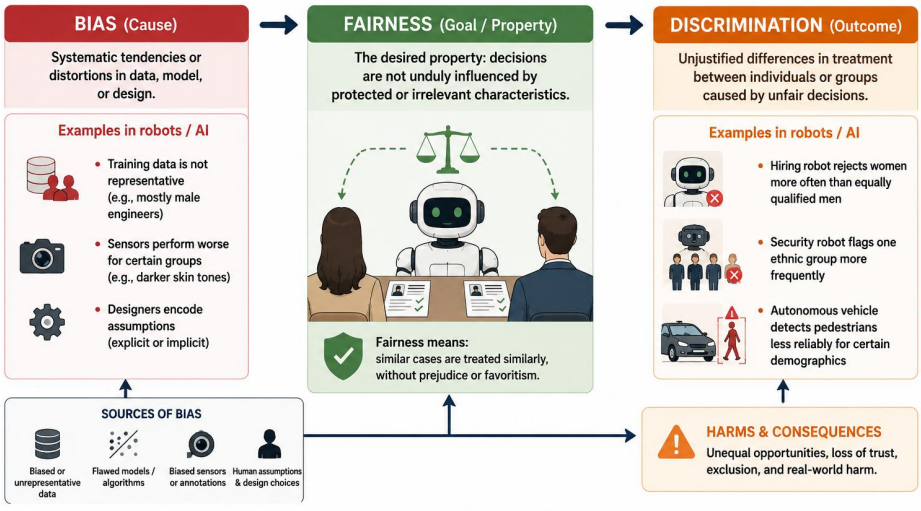
Definition of fairness
the absence of any prejudice or favoritism toward an individual or group.
Discrimination and types
refers to misdesigned algorithms or biased outcomes that unfairly favor or disadvantage specific groupsbasedonattributes such as race, gender, or age.
Direct discrimination
(decisions are explicitly influenced by sensitive attributes)
Indirect discrimination
(decisions use apparently neutral attributes that are correlated with sensitive ones)
Systemic discrimination
(Unfairness built into institutions or broader systems)
Statistical discrimination
(Judging people by group averages rather than individual qualities)
Summary. Bias, Fairness and Discrimination
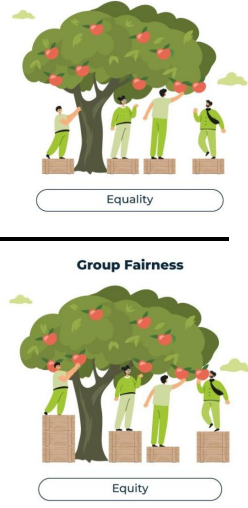
Equality VS Equity
Fairness measurement
Unawareness
The system tries to be fair by removing sensitive attributes like gender or race from the data.
Demographic Parity
The rate of positive outcomes should be the same across groups.
Equalized Odds
The system should have equal true positive and false positive/false negative behavior across groups.
Predictive Rate Parity
The probability that a positive prediction is correct should be the same across groups.
Individual Fairness
Similar individuals should be treated similarly by the model.
Counterfactual Fairness
A decision is fair if it would stay the same even if a sensitive attribute were changed in a hypothetical scenario.
Example of calculations
Definition and types of transparency
understanding how AI/robot systems make decisions, generate outputs, and use data.
Algorithmic transparency
(Internal workings of the system: the logic, processes, algorithms, and how data is used to make decisions)
Interaction transparency
(Communication between users and the AI/robot)
Social transparency
(Concerns the broader societal impact of AI, including ethical effects, public behavior, cultural values, social norms, and regulation)
Definition of accountability and reasons why we need it
Responsibility and answerability for actions and outcomes, including the duty to justify them to an authority.
Legal compliance
(Accountability helps ensure that robot systems follow existing laws and regulations)
Liability and compensation
(If damage or loss occurs, accountability helps determine who is responsible and who pays for damages)
Error and malfunction management
(It helps identify faults, unintended behaviors, and system failures, which improves reliability and safety)
Connection to transparency
(AI developers accountable requires understanding how the system works, so transparency supports accountability)
11
11
Types of Human-Robot interactions
Coexistence
(Humans and robots divided by a line)
Space: Separated
Tasks: Unrelated
Contact: Impossible
Context Awareness: Not necessary
Cooperation
(Humans and robots work in a shared space, but their tasks are linked rather than fully shared)
Space: Shared
Tasks: Linked
Contact: Possible
Context Awareness: Minimal
Collaboration
(Humans and robots work together in the same shared space on the same shared tasks, which requires stronger interaction)
Space: Shared
Tasks: Shared
Contact: Frequent and necessary
Context Awareness: High
Challenges in human-robot interaction
Cobot design
(Collaborative robots must be designed so they can work safely and efficiently with humans)
Safety and security
(Robots should operate without creating risks for human workers, so ensuring safe and secure operation is a central challenge)
Interaction quality
(Robots need to understand and predict human actions, intentions, and emotions to support good collaboration)
Explain a uncanny valley effect
robot becomes more human-like, people usually like it more at first, but if it becomes almost human, but not fully, it can suddenly feel strange, unsettling, or creepy
Design principles for robots
Human-centered design
(Design robots around people’s needs, context, and motivations using steps like empathize, define, ideate, prototype, test)
Usability
(A robot should not only work technically, but also be easy and useful to use)
Match appearance to capability
(A robot should not seem more intelligent, emotional, or capable than it really is)
Support safe interaction
(Robots should be designed for safe, efficient, and intuitive collaboration with humans)
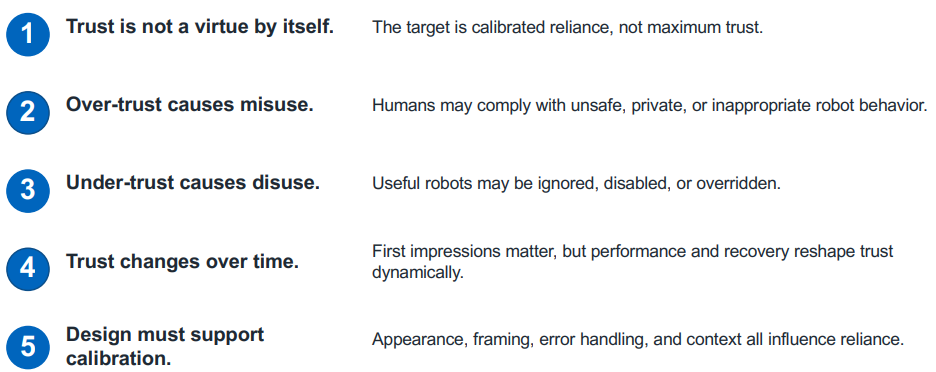
What is trust calibration in HRI?
matching human trust to the robot’s real capabilities so people rely on it appropriately, safely, and effectively
Summary
12
12
What are the impacts of robots on society?
What is privacy and why is it important?
What regulations are existing that prevent companies in misusing our data?