U3 SLOA
 Call Kai
 Learn
Learn Practice Test
 Spaced Repetition
 Match
Match Flashcards
 Knowt Play
1/25

There's no tags or description
Looks like no tags are added yet.
Name | Mastery | Learn | Test | Matching | Spaced | Call with Kai | Chat |
|---|
No analytics yet
Send a link to your students to track their progress
26 Terms
exceptions to the octet rule
group 2 and 13 elements
expanded octet in elements with an empty d sublevel
properties of covalent bonds
low reactivity
stable
give 3 examples of dative bonds
NH4+, H3O+, CO
when do delocalised electrons happen?
Bonding e are in a double bond
There is more than one possible position for a double bond in a molecule or polyatomic ion
The ___ of a small covalent molecule is determined by the ___ of its ___
The shape of a small covalent molecule is determined by the position of its nuclei
accroding to VSEPR, what effect do ED repulsion have.
minimising the energy of the molecule by maximising the distance in betwee atoms.
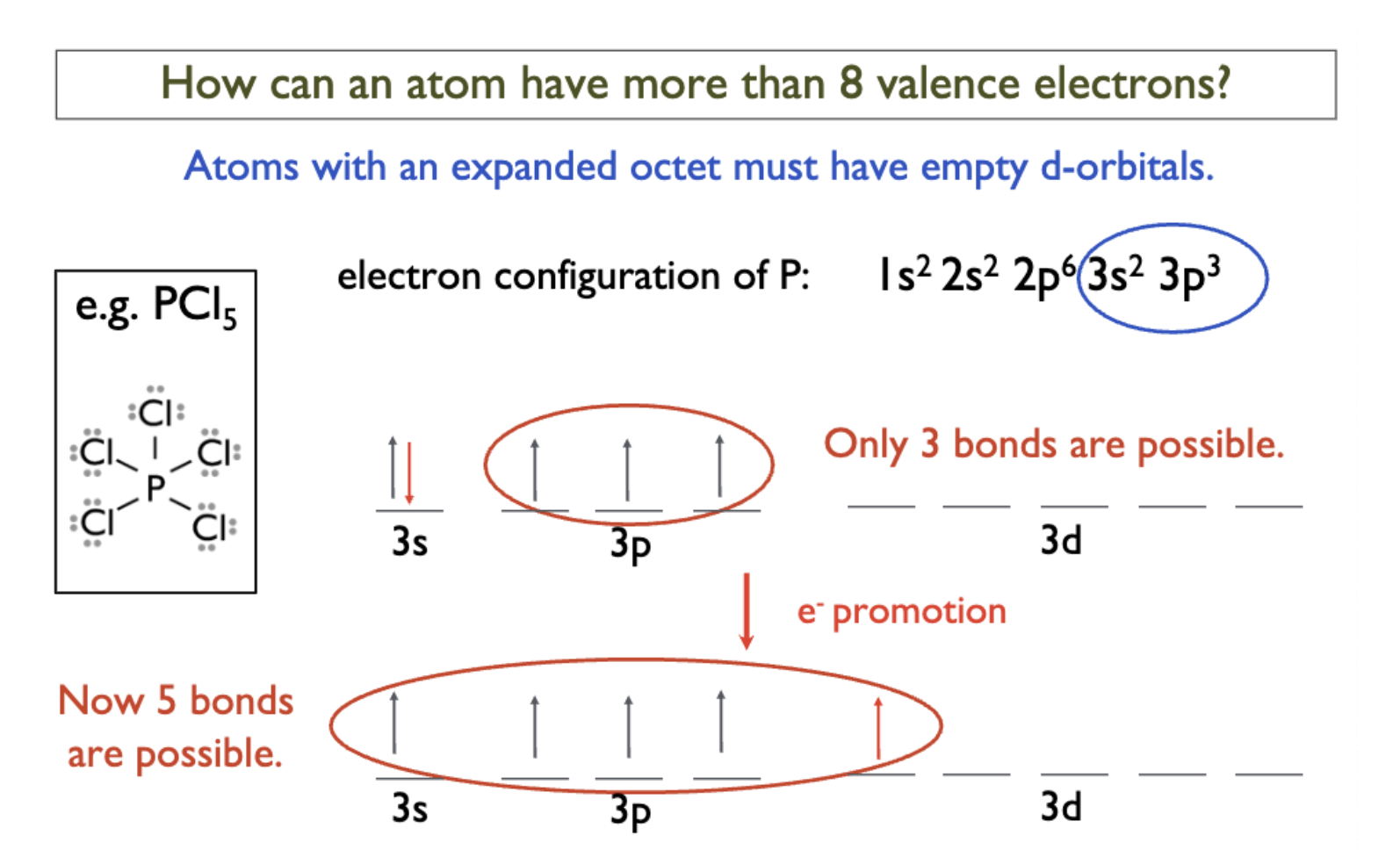
explain why PCl3 can also be PCl5 (expanded octet)
3 rules for determining preferred structure from formal charge

4 Characteristics of ideal gas at all temperature and pressures
Gas particles occupy negligible volume (because particles are small and move quickly, it is very low density)
Particles are in constant, random motion, but in straight lines and random directions.
Particle collisions are elastic, so no energy is lost.
No force of attraction between particles
Characteristics of real gas
Similar to ideal gas in high temperature and low pressure
At low temperature: particles move more slowly, more significant force of attraction
At high pressure: higher density of particles --> volume of gas particles and force of attraction are more significant
3 properties of radicals
High enthalpy
Very reactive
Short lifetime
give 3 examples of radicals
Cl, Br, H, NO, OH, O2-, C6H6
wavelength of light that breaks intermediate between single and double (ozone)
<330 nm
wavelength of light that breaks double bonds (oxygen gas)
<240nm
reaction mechanims of ozone formation
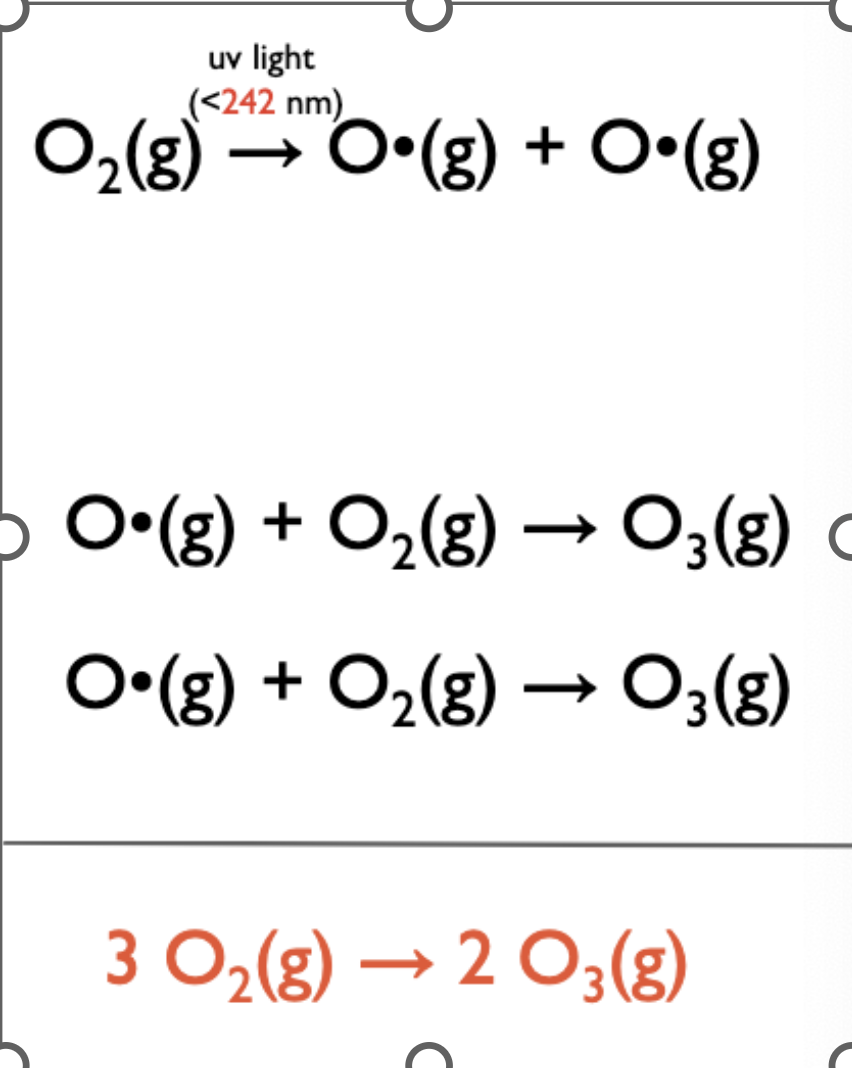
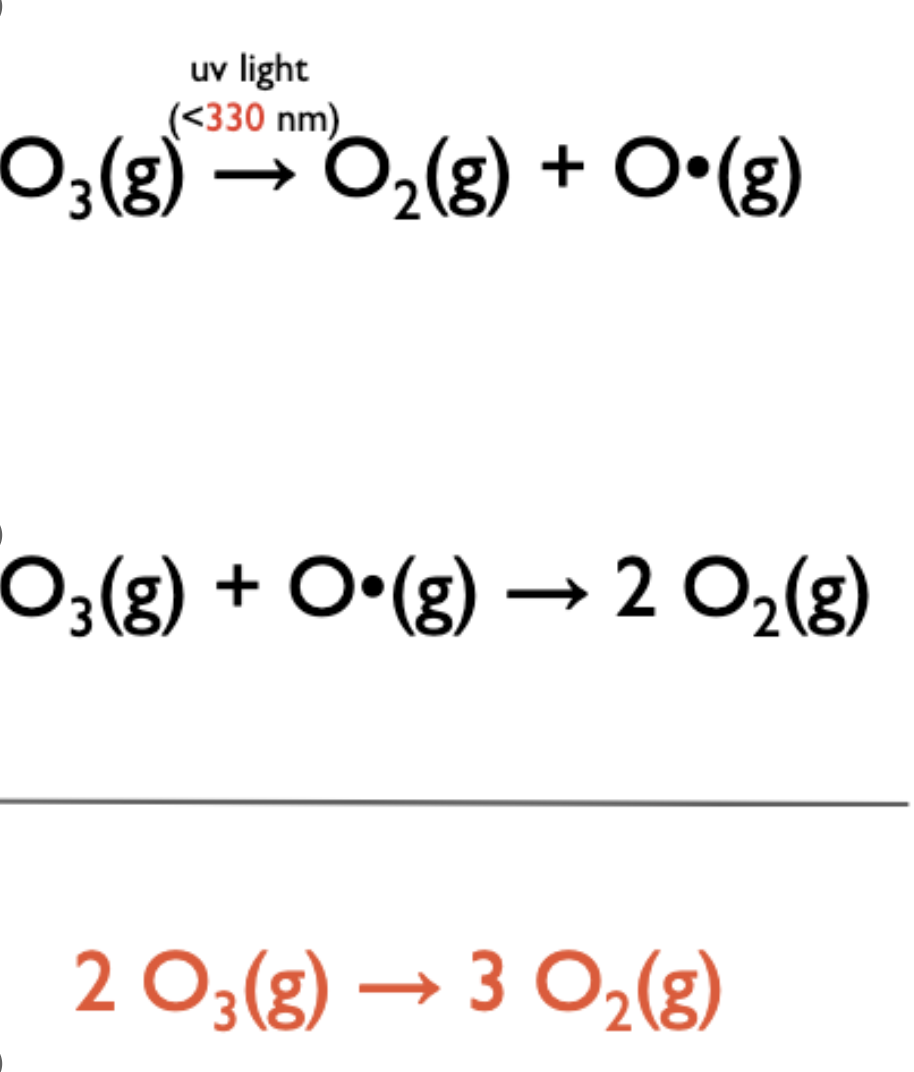
reaction mechanims of ozone depletion
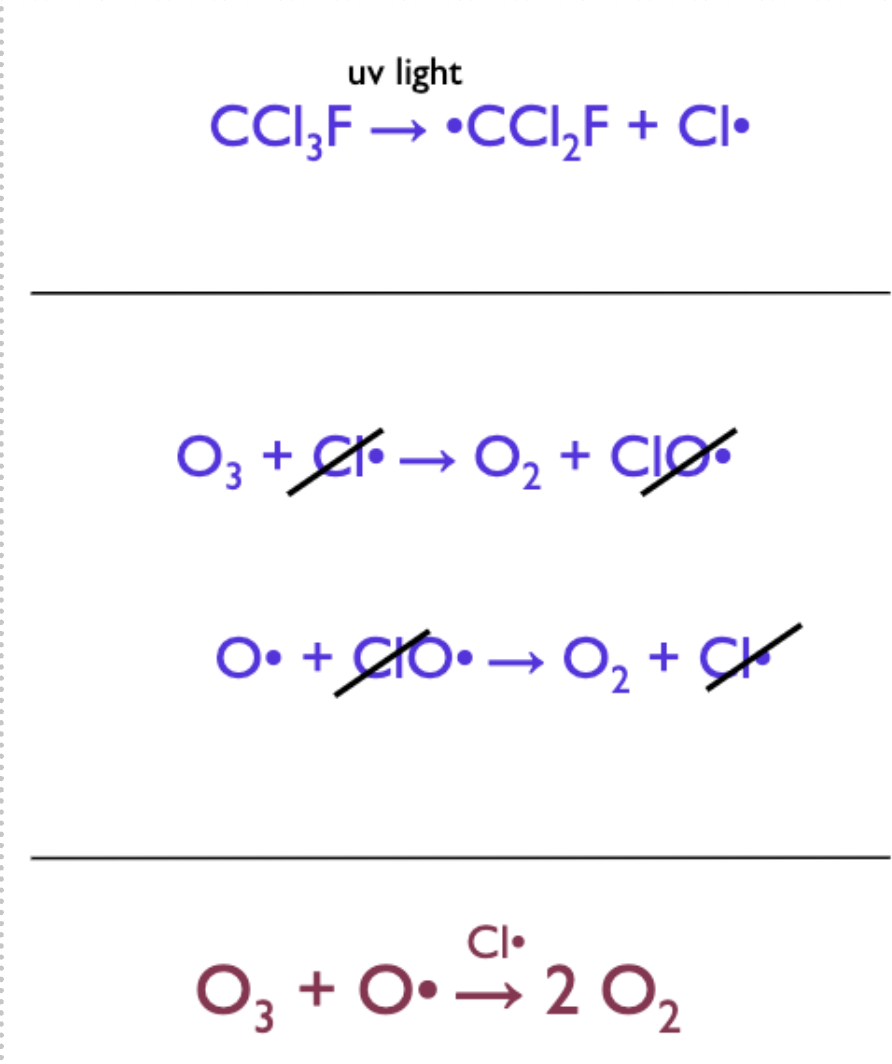
reaction mechanims of ozone depletion with CFCs
describe the ozone equilibirum in the stratosphere
In the stratosphere, ozone is produced and broken down steadily
The ozone layer blocks a range of UV, protecting the Earth
But air pollutants disrupt this equilibrium
Chlorofluocarbons (CFCs) from human activities act as catalysts in the depletion of ozone. So that ozone depletion > ozone formation
compare and contrast stratosphere ozone versus trophosphere ozone
Stratosphere
| Troposphere
|
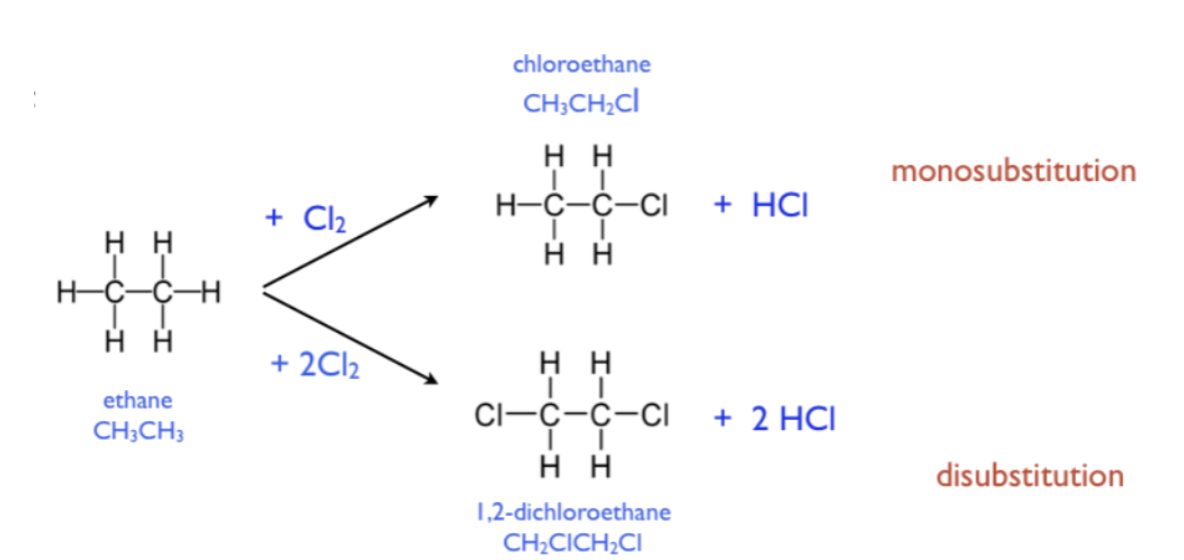
demonstrate monosubstituion and disubstitution with C2H6 with Cl2
why are alkanes low reactivity
High bond enthalpy for C-C and C-H (needs a strong source of energy, such as a combustion reaction, or a with a very reactive substance)
Non-polar nature of the bonds and molecules (lack of polar region --> low reactivity with common reactants)
what special conditions are required to overcome alkane’s low reactivity
The formation of reactive free radical intermediate
Use high energy UV to form free radicals
Free radical substituion mechanism
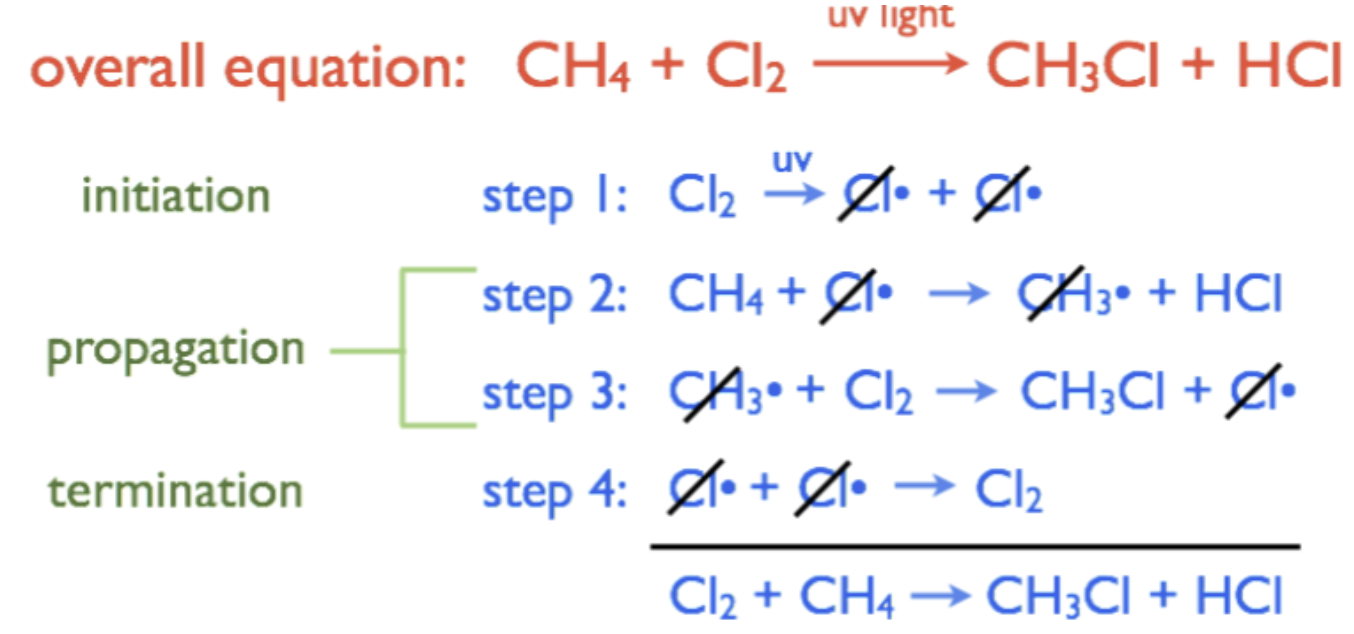
Outline initiation in free radical substituion mechanism
Photolytic fission
UV light photodissociates CL2 into radicals
Outline propagation in free radical substituion mechanism
A series of steps where free radicals are formed and used in later steps
Chlorine radical is reformed/ regenerated, setting up a chain reaction/ reaction cycle to continue propagation
Outline termination in free radical substituion mechanism
2 free radicals combine
Removes free radicals, stops the reaction
Larger alkanes may be produced as a result