T lymphocytes and cell-mediated immunity and B lymphocytes and humoral immunity
 Call Kai
 Learn
Learn Practice Test
 Spaced Repetition
 Match
Match Flashcards
 Knowt Play
1/7

There's no tags or description
Looks like no tags are added yet.
Name | Mastery | Learn | Test | Matching | Spaced | Call with Kai | Chat |
|---|
No analytics yet
Send a link to your students to track their progress
8 Terms
What are the two types of lymphocyte?
B lymphocytes (B cells) - humoral immunity
T lymphocytes (T cells) - cell mediated immunity
Lymphocytes are involved in the body’s specific response as they react to specific atigens
Cell mediated immunity
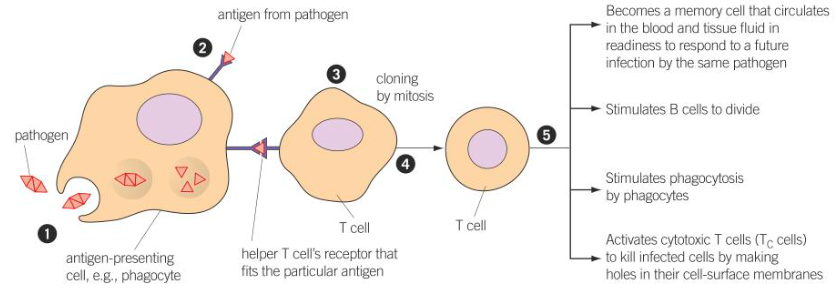
T lymphocytes will only respond to antigens that are presented on a body cell
pathogens invade body cells/are taken in by phagocytes
phagocyte places antigens from pathogen on its cell-surface membrane
receptors on a specific helper T cell fit exactly onto these antigens
attachment stimulates T cell to divide rapidly by mitosis and form a clone of genetically identical cells
cloned T cells have four different functions
Four functions of cloned T cells
develop into memory cells to enable a rapid response to future infection by the same pathogen
stimulates phagocytes to engulf pathogens by phagocytosis
stimulates B cells to divide and secrete their antibody
activate cytotoxic T cells
How do cytotoxic T cells kill infected cells?
produce protein called perforin
makes holes in cell-surface membrane
cell membrane becomes freely permeable to all substances so cells die
What does humoral immunity involve?
Antibodies
What is clonal selection?
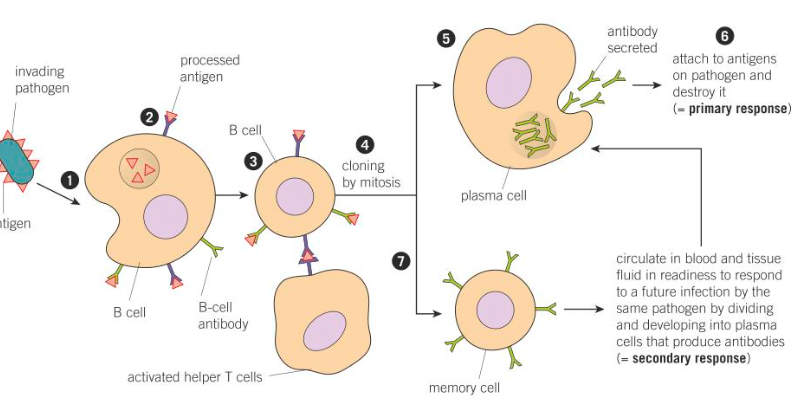
an antigen enters blood/tissue fluid
antigen attaches to complementory antibody
antigen enters B cell by endocytosis and gets presented on its surface
T helper cells bind to these processed antigens and stimulate B cell to divide by mitosis
all clones produce antibody that is specific to the foreign antigen
What do plasma cells do?
secrete antibodies into blood plasma
these antibodies lead to the destruction of the antigen
responsible for immediate defence against infection (primary immune response)
What do memory cells do?
responsible for secondary immune response
live longer than plasma cells (decades)
circulate in blood and tissue fluid
when the encounter the same antigen at a later date, they divide rapidly and develop into plasma cells and more memory cells
create long term immunity against original infection