Unit 1 section 3 : Discovering How Populations Change and Evidence of Evolution
 Call Kai
 Learn
Learn Practice Test
 Spaced Repetition
 Match
Match Flashcards
 Knowt Play
1/28

Earn XP
Description and Tags
the process of natural selection, which drives the process of evolution.Charles Darwin referred to evolution as "descent with modification".
Name | Mastery | Learn | Test | Matching | Spaced | Call with Kai | Chat |
|---|
No analytics yet
Send a link to your students to track their progress
29 Terms
what is The theory of evolution by natural selection
The theory of evolution by natural selection states that organisms with heritable traits better suited to their environment are more likely to survive and reproduce
What did Jean Baptiste Lamarck do?
published a book that detailed a mechanism for evolutionary change that is now referred to as inheritance of acquired characteristics. Lamarck’s ideas were an important influence on evolutionary thought.
Who discoveres The theory of evolution by natural selection?
Charles Darwin and Alfred Russel Wallace
What is Natural Selection?
the primary mechanism of evolution, where organisms better adapted to their environment are more likely to survive and reproduce. Over successive generations, the advantageous traits that helped these individuals survive become more common in the population.
how can Natural selection take place?
If there is Variation
What is Variation?
differences, among individuals in a population. This is critical because variation among individuals can be caused by non-genetic reasons, such as an individual being taller because of better nutrition rather than different genes.
What does Genetic diversity in a population come from?
Mutation and Sexual Reproduction
What is Mutation?
a change in DNA, is the ultimate source of new alleles or new genetic variation in any population. An individual that has a mutated gene might have a different trait than other individuals in the population.
what 3 outcomes can a muatation have on a organism?
A mutation may affect the phenotype of the organism in a way that gives it reduced fitness—lower likelihood of survival, resulting in fewer offspring.
A mutation may produce a phenotype with a beneficial effect on fitness.
Many mutations, called neutral mutations, will have no effect on fitness.
What is Sexual Reproduction?
a biological process where two parents combine their genetic material to create offspring. It is the primary mode of reproduction for the vast majority of animals, plants, and fungi.
what is adaptation?
is a “match” of the organism to the environment. Adaptation to an environment comes about when a change in the range of genetic variation occurs over time that increases or maintains the match of the population with its environment. EX: The variations in finch beaks shifted from generation to generation providing adaptation to food availability.
what is divergent evolution?
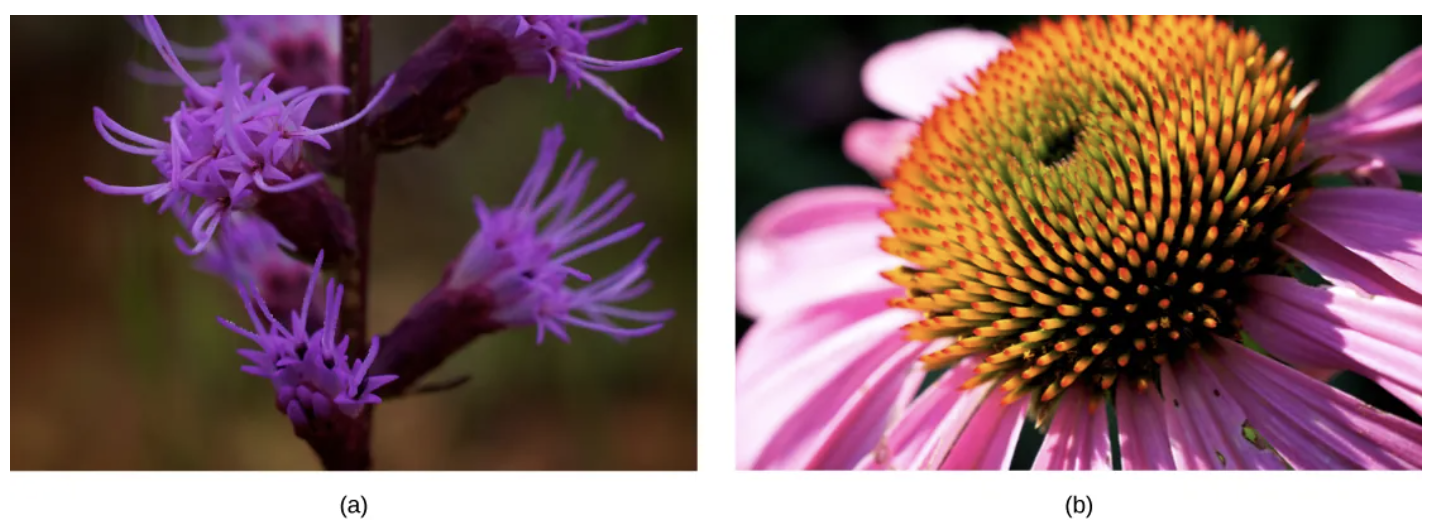
When two species evolve in different directions from a common point. EX: can be seen in the forms of the reproductive organs of flowering plants, which share the same basic anatomies; however, they can look very different as a result of selection in different physical environments, and adaptation to different kinds of pollinators
What is convergent evolution?
When similar structures arise through evolution independently in different species
what is a analogous structure?
they are similar in function and appearance, but do not share an origin in a common ancestor. Instead they evolved independently in the two lineages. EX: The wings of bats and insects
What is a homologous structure?
they share similarities (despite their differences resulting from evolutionary divergence). EX: The wings of hummingbirds and ostriches did not evolve independently in the hummingbird lineage and the ostrich lineage—they descended from a common ancestor with wings.
What is Modern Synthesis?
describes how evolutionary pressures, such as natural selection, can affect a population’s genetic makeup, and, in turn, how this can result in the gradual evolution of populations and species. The
What is Microevolution?
the change in gene (allele) frequencies within a single population over a relatively short period. Because this small-scale evolutionary process happens quickly, it can be directly observed in real-time.
What is Macro evolution?
large-scale evolutionary changes that occur at or above the species level. It encompasses major milestones in the history of life, such as the emergence of entirely new species (speciation), the origin of major groups like mammals, and mass extinctions
What is population genetics?
the branch of evolutionary biology that studies the genetic composition of biological populations and how it changes over time. The total collection of all genes and their different alleles (variants) and The proportion of a specific allele in the population’s gene pool.
what sevral ways can the alle frequencies of a population change?
natural selection
what is a gene pool?
, the sum of all the alleles in a population.
what is genetic drift?
is the random, chance-based fluctuation in the frequency of gene variants (alleles) within a population from one generation to the next. Unlike natural selection, it is non-adaptive and usually results in the loss of genetic diversity.
what is migration?
is the random, chance-based fluctuation in the frequency of gene variants (alleles) within a population from one generation to the next. Unlike natural selection, it is non-adaptive and usually results in the loss of genetic diversity.
what are the four most important evolutionary forces that will disruspt the equilibrium?
natural selection, mutation, genetic drift, and migration
what two ways does sexual selection occur?
through intrasexual selection, as male–male or female–female competition for mates.
through intersexual selection, as female or male selection of mates.
what is another type of evidence for evolution regarding the organisms insides?
the presence of structures in organisms that share the same basic form. For example, the bones in the appendages of a human, dog, bird, and whale all share the same overall construction. That similarity results from their origin in the appendages of a common ancestor. Over time, evolution led to changes in the shapes and sizes of these bones in different species.
is the convergence of form in organisms that share similar environments. For example, species of unrelated animals, such as the arctic fox and ptarmigan (a bird), living in the arctic region have temporary white coverings during winter to blend with the snow and ice (
What are vestigial structures?
unused structures without function. EX: are wings on flightless birds, leaves on some cacti, traces of pelvic bones in whales, and the sightless eyes of cave animals.
What is Embryology?
the study of the development of the anatomy of an organism to its adult form also provides evidence of relatedness between now widely divergent groups of organisms.
Structures that are absent in some groups often appear in their embryonic forms and disappear by the time the adult or juvenile form is reached. what is an example of this?
all vertebrate embryos, including humans, exhibit gill slits at some point in their early development. These disappear in the adults of terrestrial groups, but are maintained in adult forms of aquatic groups such as fish and some amphibians.
Great ape embryos, including humans, have a tail structure during their development that is lost by the time of birth.