Bio Honors Chapter 6
 Call Kai
 Learn
Learn Practice Test
 Spaced Repetition
 Match
Match Flashcards
 Knowt Play
1/53

There's no tags or description
Looks like no tags are added yet.
Name | Mastery | Learn | Test | Matching | Spaced | Call with Kai | Chat |
|---|
No analytics yet
Send a link to your students to track their progress
54 Terms
Atom
The building block of mater containing neutrons, protons, and electrons
Element
A pure substance made from only one type of atom and cannot be broken down
Compound
A pure substance formed when two or more different elements combine
Ion
An atom or molecule with a + or - charge because it lost or gained electrons
Isotopes
Two or more atoms of the same element, having a different number of neutrons
Molecule
A group of two or more atoms bonded together to make the smallest form of a pure substance, held together by covalent bonds
How many atoms are in the following molecule? H20
3
How many atoms are in the following molecule? CH3OH
6
How many atoms are in the following molecule? CH3COCH3
10
What are the four most abundant elements found in living things?
Oxygen, hydrogen, carbon, and nitrogen
what is a covalent bond?
A covalent bond is when an electron is shared between two nonmetals
What is an Ionic bond?
An ionic bond is when an electron is fully transferred from a metal to nonmetal
Define an endothermic reaction
An endothermic reaction traps heat and feels cold to the touch
Define exothermic reaction
An exothermic reaction releases heat and feels hot to the touch

What does number 1 represent
Active site
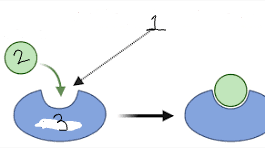
What does number 2 represent
Substrate
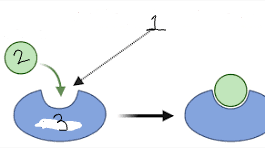
What does number 3 represent
Enzyme
Define activation energy
The smallest amount of energy needed to start a chemical reaction
Define enzyme
a protein that speeds up a chemical reaction to see faster results
define substrate
a molecule that an enzyme acts upon in a chemical reaction
define catalyst
a substance that speeds up a reaction without being exchanged itself
Define denaturing
Denaturing is when a protein looses its shape and cant function properly
Identify an environmental factor and explain how it can affect enzyme function
Temperature affects an enzymes function because it directly influences the energy and stability of the enzyme.
Identify an environmental factor and explain how it can affect enzyme function
The pH of the surrounding fluid affects the charges of the acid in the enzyme
Where is neutral on the pH scale?
7
Where are acids on the pH scale?
below 7
Where are bases on the pH scale?
above 7
define acid
An acid is a substance that releases hydrogen ions when dissolved in water and has a pH below 7
Define base
a substance that releases hydroxide ions and pH is above 7
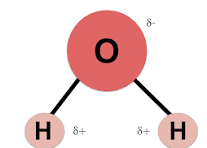
draw a water molecule
Define polarity
A property of a molecule when the charges are unevenly distributed as + and -
define adhesion
the attraction between different types of molecules causing them to cling to each other
define cohesion
the attraction of molecules of the same kin causing them to cling
define capillary action
the ability for a liquid to flow upward through narrow spaces against gravity
define surface tension
a property of a liquids surface to resist external force
How does a hydrogen bond connect?
between two hydrogens (+)
How does a covalent bond connect?
between an oxygen and a hydrogen (+, -)
Define universal solvent
A substance that can dissolve a wide variety or elements, more than most others
Define solution
A homogeneous mixture composed of two or more substances
Define solute
The substance that is dissolved in the solvent
Define suspension
A heterogeneous mixture with large enough particles that they could settle over time
Define heterogeneous
A mixture where you can see the distinct substances
Define homogeneous
A mixture where the substances look the same
On the periodic table, each element has a unique _______ and ________
name and symbol
The periodic table in organized into horizontal rows called ______
Periods
The periodic table is organized into vertical columns called _____
groups
Water is a compound composed of ______ and _______
Hydrogen and Oxygen
what principle explains why there must be the same number of atoms of each element on each side of the equation
law for conservation of mass
define half life
The amount of time it takes for half of a radioactive isotope to decay
what number indicates the number of atoms of a substance
the subscript
what particles make up an atom? what are their charges?
proton (positive) neutron (neutral) electron (negative)
if oxygen has 8 protons, calculate the number of neutrons in the oxygen-16 atom. how do you find it?
You subtract 16-8 to get 8
for something to be a compound it cant vary, true or false
true
what is a buffer? why is it important?
A buffer is a small solution that resists changes in pH. this is important because can resist the big changes in pH during an experiment