ideology et identity
 Call Kai
 Learn
Learn Practice Test
 Spaced Repetition
 Match
Match Flashcards
 Knowt Play
1/31

There's no tags or description
Looks like no tags are added yet.
Name | Mastery | Learn | Test | Matching | Spaced | Call with Kai | Chat |
|---|
No analytics yet
Send a link to your students to track their progress
32 Terms
issue meaning
a matter of interest where there is a significant disagreement
politics
a system which prioritizes resolving conflict and making decisions
distribution of power
economics
how a society decides who gets what, when, and how
it os also the study of how people use limited resources to meet the unlimited wants.
individualists believe/value:
their own self interest
acting on accomplishing their own goals
want limited government interferance
freedom and worth of the individual (sometimes freedom over security/other rights)
individualists are typically right winged
collectivists believe/value:
shared goals
take actions as part of a group
security for all people
significant gov’t involvement
the “common good” over the goals of any individual
collectivsts are usually left winged
how to tell between collectivists and individualists?
the role of the government
individualists - self reliance, freedom from authority
collectivists - interdependance, importance of the group over the individual
pluralistic society
one where there are many viewpoints about how the society should advance
(many political parties, democratic)
monistic society
only one viewpoint is permitted
(dictatorships)
democracy
Democracy is a system of government where supreme power is vested in the people
extreme left
radicals - want immediate change - will achieve this change through violence
egalitarianism
freedom
human rights
internationalism
left
liberals
favour change through peaceful and legal means
human rights
personal liberty
centre
moderates
favour gradual change
human rights with some limitation
equality w/ some equality
international cooperation while defending nation
right
conservative
usually content with status quo and want to keep traditions and social order
little government interference
private property
law and order
few restrictions on personal freedoms
extreme right
reactionaries
favour in returning to the “good old days” and rationalize violence to get this idealized version of the olden days
authoritarian rule
inequality
political spectrum horseshue
ok
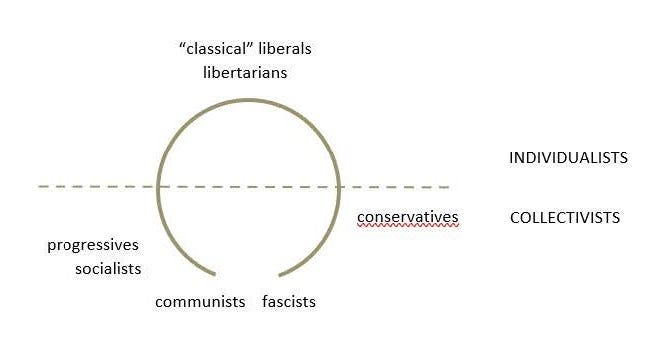
whos idea was communism
Karl Marx
he wanted an anarchy and to overthrow people in power and to temporarily share everything so everyone has equal everything and once society evens out, this political party can disintegrate with it.
communism
an attempt to make a society of equals — both politically and economically
This was Lenin’s interpretation of Marx’s ideas
life under communism
the state controlled all aspects of the economy and made all decisions politically - ultimate collectivist’s society
democratic socialism
under the “liberal” umbrella term but left leaning
embraced Marx’s ideas but concentrated on peaceful political changes instead of being extremist
liberalism
(aka modern liberalism)
embodies the ideas of personal freedom, individual rights, and political equality
in the middle of liberalism
where did liberalism originate from
John Locke
conservatism
under the “liberal” umbrella term but right leaning
seeks to maintain the status quo and wants to preserve traditions and values
goals of conservatism
law and order
persoanl economic freedom
slower approach to change (no rapic change)
fascism beliefs
extreme nationalism, racial superiority, supremacy of the state and the leader (like Hitler)
very far right
want to replicate an idealized form of the past
fascism origin
Benito Mussolini
wanted to replicate the roman empire in Italy
anarchy
belief that people should organize themselbves into small groups withut a formal government structure and people will naturally share and cooperate
believes that man is born good and society corrups
ideology =
beliefs + values
beliefs
what we accept as the truth
values
convictions held about the world and these ar our basic principles
socialism is an umbrella term
left - communism socialism
middle - democratic socialism
right - utopian socialism
individualism goals
PRICES
Private property
Rule of law
Individual rights and freedoms
Competition
Economic freedom
Self-interest
government is seen as a negative force holding them back from their fullest potentials
collectivism goals
PRINCE
Public property
(collective) Responsibility
(collective) Interest
(collective) Norms
Cooperation
Economic equality
government is seen as a positive force